


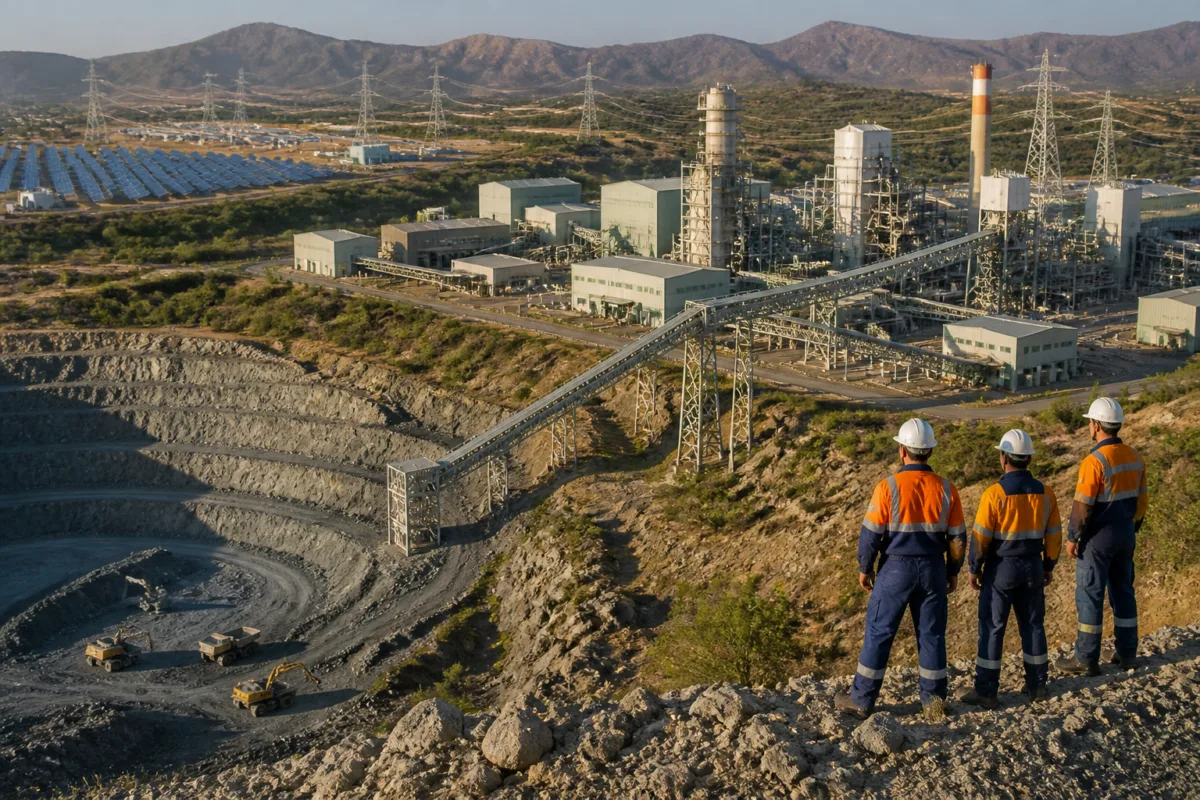
Hindustan Zinc’s proposed ₹80,000 crore expansion is more than a capacity announcement. It is a large industrial build-out across mining, processing, smelting, power and logistics, designed to take the company’s refined zinc production towards 2 million tonnes a year while reducing India’s dependence on imported metal. Its success will depend not only on capital availability, but also on how existing mines, regulatory approvals, land requirements, energy systems and domestic demand are brought together.
The company plans to invest the amount over three to five years and nearly double its production capacity to 2 million tonnes per annum. The investment covers the entire value chain, from ore mining to finished metal. According to comments by Hindustan Zinc CEO Amarendu Prakash and CFO Amit Gupta reported by The Hindu BusinessLine, zinc capacity will rise to 1.6 million tonnes, lead capacity to 0.4 million tonnes and silver capacity to 1,500 tonnes a year.
That structure is important because the expansion is not based only on adding a refinery or smelter. It combines upstream mining assets with processing and metal-production facilities. The company says its existing reserves and resources can support the proposed capacity, with a mine life of more than 25 years at the expanded production level. It also says the expansion can be achieved through existing assets, although further exploration and possible acquisitions of mining assets remain part of its broader approach.
The planned Bamnia Kalan, or BK, Mine in Rajasthan is a specific part of this pipeline. Hindustan Zinc said core work for the mine has been completed and that it is expected to provide an additional 3.5 million tonnes of ore as part of the new project. The company already holds a lease for the mine. This points to one of the central advantages of an integrated expansion: the company is attempting to align mineral reserves and processing capacity before increasing finished-metal output.
It also shows where the project’s implementation risks lie. Hindustan Zinc said it has the necessary mining assets, but regulatory approvals will be required as mining activity expands. Most of its mines are underground, and the company expects much of the supporting infrastructure to be built on land it already owns. However, additional land may be needed for auxiliary services, with the acquisition process already under way. The distinction matters because a large industrial project can face delays even when its main production assets are already secured, particularly where auxiliary infrastructure, approvals and land parcels move on separate administrative tracks.
Rajasthan is positioned to receive a significant fiscal benefit if the expansion progresses as planned. Hindustan Zinc currently contributes about ₹6,000 crore annually to the state exchequer, and the company expects that contribution to nearly double as the expansion advances. The project therefore links corporate capacity growth with state-level revenue, mining activity and the development of industrial infrastructure around the company’s operating areas. The supplied material does not establish the precise distribution of this additional revenue or the public infrastructure obligations attached to the expansion, but the scale of the proposed investment makes those institutional questions relevant to its eventual execution.
The funding plan is designed to limit balance-sheet pressure. The company says it has net cash of more than ₹12,000 crore and does not expect to take on net debt for the project. Instead, the investment is to be funded through internal accruals. Annual expenditure is expected to range between ₹10,000 crore and ₹20,000 crore, depending on the peak construction phase and foreign-exchange movements. Hindustan Zinc also said its dividend policy would not change and that existing dividend commitments have been considered in the funding plan.
This approach places the burden of delivery on operating cash generation and construction sequencing rather than on external borrowing. The company expects revenue and EBITDA to double while broadly maintaining existing margins. It estimates a five- to six-year payback period based on what it describes as conservative assumptions about London Metal Exchange prices and production costs. These are company projections, not independently established outcomes, and their realisation will depend on commodity prices, production performance, approval timelines and the cost of building new capacity.
The ₹80,000 crore figure includes a previously announced ₹14,000 crore project to add 2.5 lakh tonnes of capacity. Hindustan Zinc said that project is progressing on schedule and is expected to be commissioned in the second quarter of FY29, with returns beginning to accrue in FY30. This provides an earlier milestone against which the larger expansion can be assessed. It also means that the proposed investment is not a single construction package with one completion date, but a programme containing projects at different stages of development.
Cost competitiveness is another central part of the company’s case. Hindustan Zinc said its production cost guidance would remain below $1,000 per tonne even after expansion. The company acknowledged that deeper mining could increase costs, but said economies of scale and better absorption of fixed costs would offset the pressure. It also plans to use newer technologies to improve operational efficiency and metal recovery, particularly for silver. The company’s expectation of retaining its position as the lowest-cost producer remains an internal projection and will need to be tested as the mining footprint expands.
The domestic-demand argument is particularly relevant to India’s industrial and construction economy. Hindustan Zinc said Indian zinc demand is growing at about 7-8 per cent annually. It currently sells about 50,000 tonnes of zinc domestically and expects domestic sales to rise as demand expands. Zinc is used across industrial and construction-linked value chains, although the supplied material does not provide a sector-by-sector breakdown of future consumption. The company’s expansion is therefore premised on a continuing increase in domestic absorption rather than on export markets alone.
Silver adds a second demand and revenue channel. The company said India consumes about 7,000 tonnes of silver annually, while its current domestic sales are about 700 tonnes. With silver capacity planned to increase to 1,500 tonnes, Hindustan Zinc said it expects to sell the entire output in India. At current prices, it estimated that incremental silver sales could contribute more than $1 billion in revenue. It also expects the overall expansion to reduce India’s import bill by nearly $2 billion. These estimates are based on the company’s current-price and demand assumptions, but they show how the project is being framed as a domestic supply and import-substitution strategy.
Energy is the other major infrastructure requirement. Hindustan Zinc said it has already tied up 400 MW of renewable power, meeting nearly 70 per cent of its current requirement. With the expansion, it is looking to tie up another 400 MW and aims to meet around 70-80 per cent of its power needs through renewable sources. The company plans to use a captive power model rather than directly investing in renewable-energy projects.
That model connects the expansion to a wider industrial question: how energy-intensive manufacturing can grow while limiting exposure to conventional power costs and emissions. The information supplied does not specify the location, contracting structure or commissioning schedule for the additional renewable capacity. It does establish, however, that the company sees power procurement as a core part of the expansion rather than a separate sustainability initiative.
The larger urban and infrastructure significance of Hindustan Zinc’s plan lies in the systems required to make a mine-to-metal chain function. Mines, processing units, smelters, auxiliary facilities and captive power arrangements require land, roads, utilities, approvals and labour ecosystems. The investment will also increase the importance of Rajasthan’s mining and industrial corridors, although the supplied material does not quantify the associated employment, transport or municipal infrastructure requirements.
What the evidence confirms is a large, internally funded expansion built around existing mining assets, rising domestic demand and a substantial renewable-power target. What remains to be established is how quickly regulatory approvals and auxiliary land acquisition will proceed, whether the first capacity project meets its FY29 commissioning target, and whether the company’s cost, payback, domestic-sales and import-reduction projections hold as construction and production scale up. Those milestones will determine whether the plan becomes a durable expansion of India’s domestic metals base or remains primarily a capital-intent announcement.

