


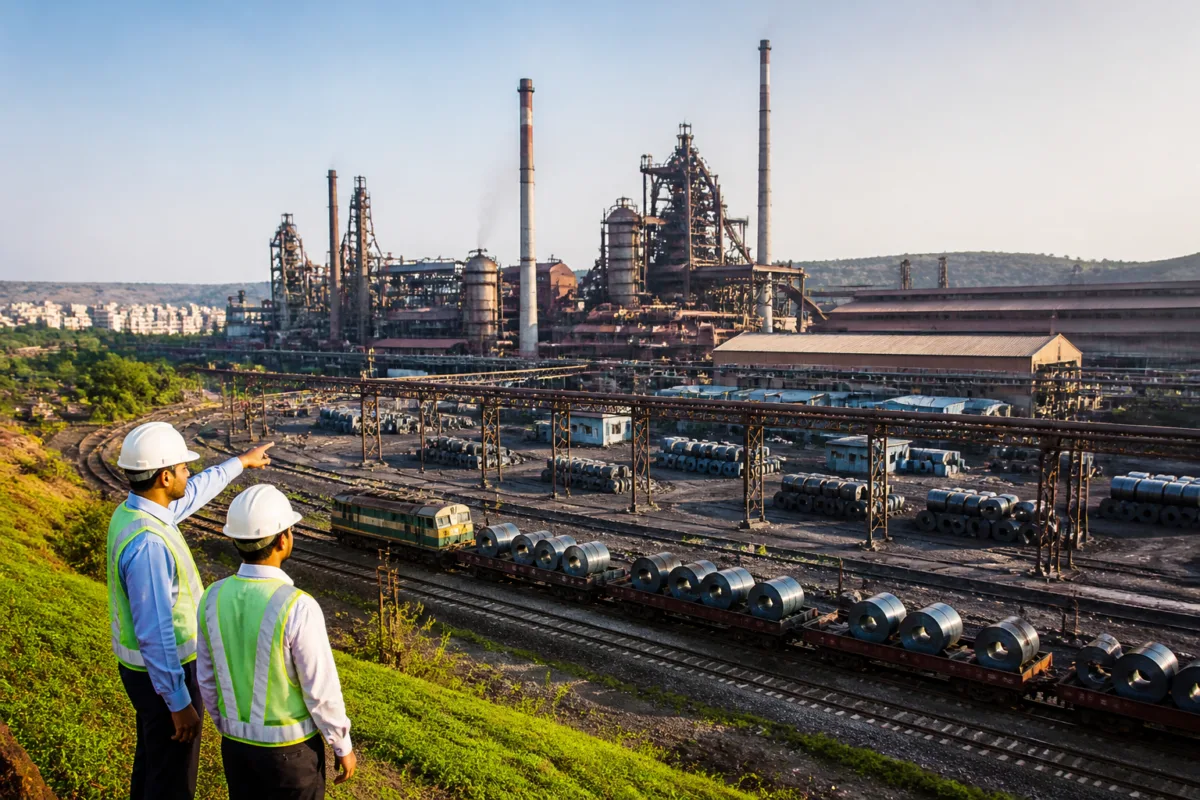
Tata Steel’s plan to raise its Indian steelmaking capacity from around 27 million tonnes to as much as 50 million tonnes over the next decade is more than a company growth target. It points to a wider restructuring of where India’s industrial capacity may be built, how large manufacturing projects will compete for land and infrastructure, and how steel producers are balancing scale with decarbonisation and financial discipline.
Managing Director and CEO T V Narendran said the company has a roadmap to reach 40 million tonnes and that its existing facilities could support expansion to 50 million tonnes. The company is also examining the possibility of a 15-million-tonne greenfield plant in Maharashtra, with discussions with the state government and land availability still relevant to the decision. Gadchiroli has emerged as a potential location, according to the report.
The proposal is not being presented as a single-site expansion. Tata Steel currently has an annual capacity of around 27 million tonnes, with facilities at Jamshedpur, Kalinganagar, Meramandali and Neelachal Ispat Nigam. Narendran said these plants provide multiple avenues for growth and that the company now has greater flexibility because its facilities use different production technologies and process routes.
That flexibility is important for understanding the plan. A 50-million-tonne ambition does not necessarily mean that one new mega-plant will be built immediately. The company’s stated approach combines expansion at existing facilities, possible new capacity in Maharashtra and the evaluation of different steelmaking technologies. It also reflects the long construction cycle of the sector: a greenfield plant with capacity of about 5 million tonnes typically takes three to four years to build.
Tata Steel’s India strategy has strengthened as its international business has become less central to the company’s growth story. Narendran said India accounted for 30 per cent of Tata Steel’s revenues 15 years ago, compared with 70 per cent today. The company expects to direct about 75 per cent of its annual capital expenditure to India this year, from total planned capital expenditure of around Rs 18,000-20,000 crore. Its annual capital expenditure in India is approximately Rs 15,000-16,000 crore.
These figures show why the expansion has an urban and infrastructure dimension. Large steel projects require not only furnaces and rolling facilities but also land, power, transport links, water systems, worker settlements, logistics networks and industrial services. The location of a plant affects the movement of raw materials and finished products, the demand for roads and rail connectivity, and the growth of nearby towns and cities. Where land is secured and how supporting infrastructure is financed can therefore be as decisive as the production technology itself.
## What Tata Steel’s capacity expansion reveals
The Maharashtra proposal also illustrates the institutional sequence behind a large industrial project. The company has indicated that discussions with the state government must be concluded and that the necessary land must be secured. This means the project remains at the stage of exploration rather than implementation. No final location, construction schedule or commissioning date has been announced in the supplied report.
That distinction matters for regional planning. A proposed 15-million-tonne plant can shape expectations around employment, housing, roads and local economic activity long before construction begins. But those outcomes depend on decisions that are not yet settled: the final site, land assembly, environmental and infrastructure clearances, technology choice, financing and the pace at which different project components are built.
Maharashtra’s role in the company’s expansion would also extend beyond the plant boundary. A steel facility of this scale would need links to suppliers, customers and distribution networks. Tata Steel is seeking to expand its downstream businesses in pipes, wires and tinplate while increasing its presence in automotive, oil and gas, infrastructure and consumer markets. This suggests that the value of new capacity would depend partly on how effectively it is connected to manufacturing and construction demand.
The company’s product strategy is significant because it seeks to reduce reliance on commodity steel. Narendran said Tata Steel is focusing on products that require specialised manufacturing, customer approvals and technological differentiation. The company is also expanding its downstream presence and strengthening relationships with large industrial customers and small and medium enterprises. In this model, capacity expansion is paired with an attempt to improve realisations through a more complex product mix.
For cities and construction markets, that could mean a stronger domestic supply base for products such as pipes, wires, reinforcement steel and other specialised applications. However, the supplied material does not establish the exact impact on prices, supply availability or project costs. Those outcomes would depend on demand, production efficiency, logistics and broader steel-market conditions.
## Capital, technology and the limits of scale
Tata Steel’s plan also demonstrates why industrial expansion cannot be judged by capacity numbers alone. Moving from 27 million tonnes to 50 million tonnes will require substantial capital and careful sequencing, according to Narendran. The company has linked the pace of expansion to profitability, cash flows and balance-sheet strength. This places financial resilience at the centre of a physical infrastructure decision.
The company is evaluating electric arc furnaces and recycling-based production as part of its future technology options. It also intends to improve the carbon efficiency of existing plants while considering alternative technologies as their commercial case develops. Hydrogen-based steelmaking remains a longer-term possibility, but Narendran said hydrogen would need to be available at around USD 2 per kilogram for the economics to become attractive.
This creates a tension between rapid capacity growth and the transition to lower-carbon production. Steel demand may require new capacity, but the form of that capacity will influence energy use, emissions and infrastructure requirements. The report says the government is discussing ways to promote green steel, while Indian customers are not yet consistently willing to pay the premium required for lower-carbon production. Tata Steel’s stated response is to combine improvements at existing plants with gradual adoption of alternative technologies.
The approach suggests that decarbonisation will be integrated into investment sequencing rather than treated as a separate project. Existing facilities remain important because they offer expansion opportunities, while new technologies will be adopted when their costs and operating conditions become viable. The company’s final choices will determine whether future capacity is built primarily through conventional expansion, recycling-based production, electric arc furnaces or a combination of routes.
## Why Maharashtra matters to the industrial map
A possible Maharashtra plant would place the state within Tata Steel’s next phase of domestic growth, but the report does not yet confirm that the project will proceed. The state government has been encouraging steel companies to establish manufacturing facilities, and Gadchiroli has been identified as a potential site. The unresolved land question is therefore central, not incidental.
For public authorities, the challenge is to align industrial policy with the actual capacity of local and regional infrastructure. Land allocation alone cannot make a large steel project viable. Transport access, power availability, water supply, worker housing, environmental management and connections to downstream industries all influence whether a project can be built and operated efficiently. The source material does not provide details of proposed public spending or the infrastructure commitments under discussion.
The existing-facility route may offer Tata Steel a way to expand without relying entirely on one greenfield site. Jamshedpur, Kalinganagar, Meramandali and Neelachal Ispat Nigam together provide the company with several locations and production routes. This optionality can allow investment to be phased, but the report does not specify the capacity contribution expected from each plant or the timetable for individual expansions.
The company is also not currently pursuing major inorganic expansion, although it may consider acquisitions in value-added products. That indicates a preference for building capacity and product capability through its existing platform rather than relying principally on acquisitions. The strategy remains focused on organic growth, downstream integration and cost competitiveness.
The larger urban question is how India manages the spatial consequences of industrial growth. A steel plant is both a production asset and an anchor for a wider settlement and logistics system. Its success can depend on the quality of surrounding infrastructure, while its arrival can create new demands on land, housing and public services. The Tata Steel plan therefore deserves to be tracked not only through its eventual production numbers but also through the administrative decisions that determine where and how those numbers become physical projects.
What is established is that Tata Steel wants to expand its Indian capacity to 50 million tonnes over the next decade, will direct most of its capital expenditure towards India, and is exploring a major Maharashtra project alongside growth at existing facilities. What remains open is the final location, land availability, technology mix, financing sequence and implementation timetable. Those decisions will determine whether the ambition becomes a distributed expansion across existing industrial centres or a new manufacturing corridor anchored by a large greenfield plant.

