


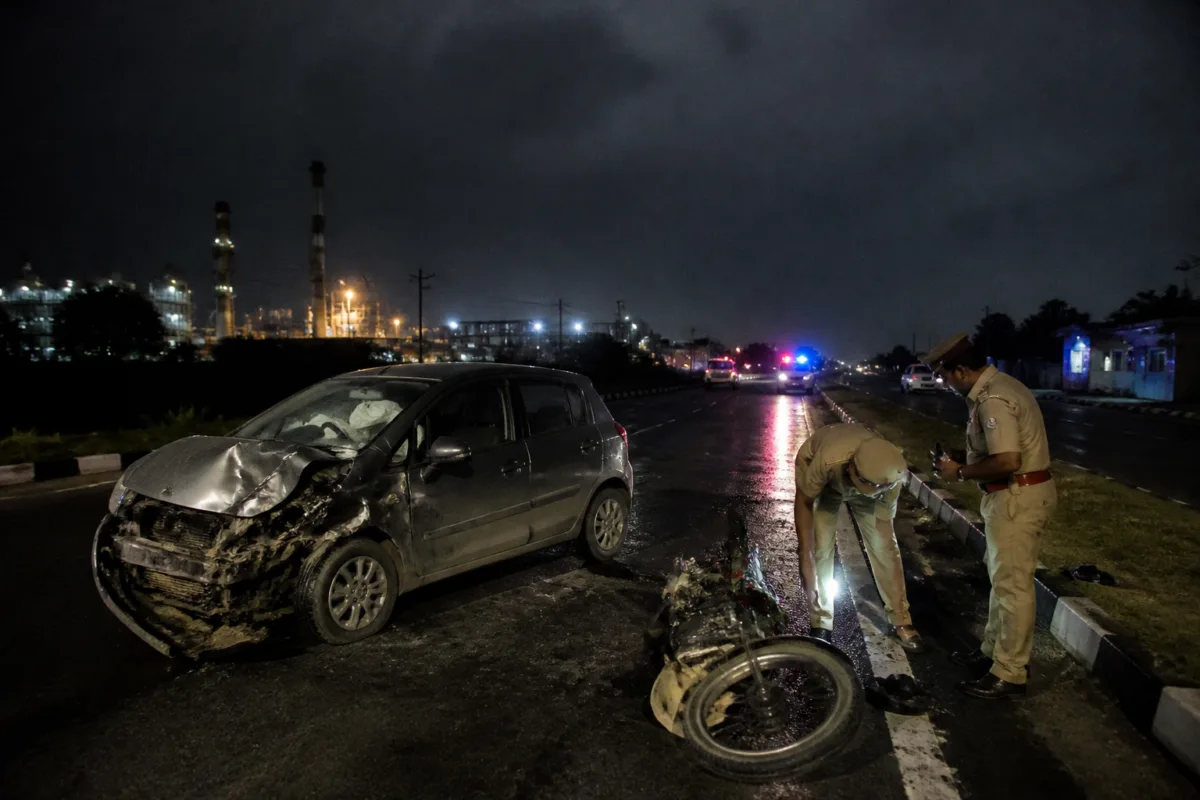
The Nagothane drunk driving case has moved from a fatal collision on a state highway to a test of how India’s road-safety and criminal-justice systems establish responsibility after a crash. A 37-year-old doctor, Amit Singh, was arrested after his car allegedly hit a two-wheeler from behind on the Pezari-Nagothane stretch in Raigad on November 15, killing the rider, Machindra Ghase. The police investigation now depends in part on medical evidence that is still awaited.
According to Nagothane police, the collision occurred at around 10.15 pm near the Marketing building and Material gate. Ghase, a 37-year-old resident of Pen, sustained severe injuries and was taken to the Nagothane primary health centre, where he was declared brought dead. Police said Singh was driving home after allegedly consuming alcohol and that he tried to leave the spot before local villagers blocked his vehicle about 200 metres away.
The immediate facts are significant because the case involves several distinct questions that are often collapsed into the single description of a drunk-driving crash. Investigators must establish what happened on the road, whether the driver was impaired, how the collision occurred, whether the driving was rash or dangerous, and what legal responsibility follows from the death. Each question depends on a different form of evidence and may be assessed under different provisions of law.
Assistant police inspector Ravindra Parkhe said Singh underwent a medical examination at the Nagothane primary health centre. Police invoked Section 185 of the Motor Vehicles Act for driving under the influence of alcohol, along with provisions of the Bharatiya Nyaya Sanhita relating to culpable homicide not amounting to murder, rash or negligent driving on a public way, acts endangering life or personal safety, and Section 184 of the Motor Vehicles Act concerning dangerous driving. Singh’s blood test report is awaited to confirm his blood alcohol concentration.
That pending report is central to the evidentiary structure of the case. The police statement that Singh appeared visibly intoxicated and smelled of alcohol is an observation recorded by officers, but the blood test is expected to provide a scientific measure relevant to the allegation under the Motor Vehicles Act. The source report does not establish the test result, and the allegation of intoxication must therefore remain attributed to the police until the report is available and the legal process proceeds.
The case also illustrates the difference between detention at the scene and formal criminal procedure. Police said they reached the location after receiving information, detained Singh and arranged for the injured rider to be taken to the health centre. Singh was arrested on November 16 and produced before the Roha Judicial Magistrate First Class court, which remanded him to police custody until November 18. The remand order records the next procedural stage, but it does not determine guilt.
The road location is important to understanding the incident without overstating what is known. The Pezari-Nagothane road is identified in the report as a state-highway stretch, and the collision occurred near a named commercial and industrial landmark. The available account does not provide the road’s design, lighting conditions, traffic volume, speed limit, lane configuration, CCTV availability or the condition of the vehicles. Those details may affect reconstruction of the crash, but they are not established in the supplied material.
What is established is that the collision was a rear-end impact involving a car and a two-wheeler. The rider died after being taken to a primary health centre, while the accused driver was stopped after allegedly attempting to accelerate away. The sequence places multiple institutions in the chain of response: local residents who blocked the car, Nagothane police who detained and arrested the driver, medical personnel who examined the accused and received the injured rider, and the magistrate’s court that authorised police custody.
This chain matters because road safety is not limited to preventing crashes. It also includes the capacity to respond quickly, preserve evidence, identify the parties involved, provide emergency medical care and move the case through lawful procedure. In this incident, the source report describes each of those stages, but it does not provide enough information to assess the speed or effectiveness of the response beyond the fact that police reached the spot and the rider was taken to the local health centre.
The location also raises a question about access to emergency trauma care. Ghase was taken to the Nagothane primary health centre, where he was declared brought dead. The report does not say whether he died at the scene or during transport, nor does it describe the availability of an ambulance, the distance to a higher-level hospital or the treatment provided. Those unanswered questions should not be filled with assumptions, but they are relevant to any serious examination of fatal crashes outside major metropolitan centres.
The legal provisions cited by police show how one road death can generate overlapping allegations. Section 185 addresses driving under the influence of alcohol or drugs. Section 184 concerns dangerous driving. The provisions of the Bharatiya Nyaya Sanhita cited by police address the manner of driving and the alleged consequences for public safety and human life. The final legal position will depend on the investigation, medical and forensic evidence, witness accounts, vehicle examination and the court process.
The case therefore cannot be reduced to whether a driver was arrested. Arrest is an investigative step, not a finding of guilt. Similarly, the invocation of legal sections indicates the offences being investigated at that stage; it does not establish that every allegation will ultimately be proved. The blood test, the police reconstruction and the court proceedings will determine how the initial allegations are tested.
The incident also shows the limits of public information immediately after a fatal crash. The report identifies the accused, the deceased, the road, the approximate time, the police officer’s account and the custody status. It does not include an independent eyewitness account, a police accident reconstruction, a post-mortem finding, a mechanical inspection, a speed estimate or a statement from the deceased rider’s family. These omissions do not invalidate the reported facts, but they define what can responsibly be concluded at this stage.
For road users, the most direct public-safety issue described in the case is the alleged combination of alcohol consumption, night-time driving and a collision with a two-wheeler. The source material does not establish how common such incidents are on the Pezari-Nagothane stretch or across Raigad. It does, however, show the potential consequence of a single alleged decision: a rider lost his life, a driver faces serious charges, local residents became part of the immediate response, and several public institutions were activated within hours.
The next stage is consequently procedural rather than speculative. Investigators must receive and assess the blood test report, continue examining the collision and present the case through the court process. Singh’s police custody was ordered until November 18, according to the report. The available evidence confirms a fatal road collision and an arrest based on allegations recorded by Nagothane police. It does not yet establish the final findings on intoxication, the precise cause of the crash or criminal liability. Those questions remain for the investigation and court to determine.

