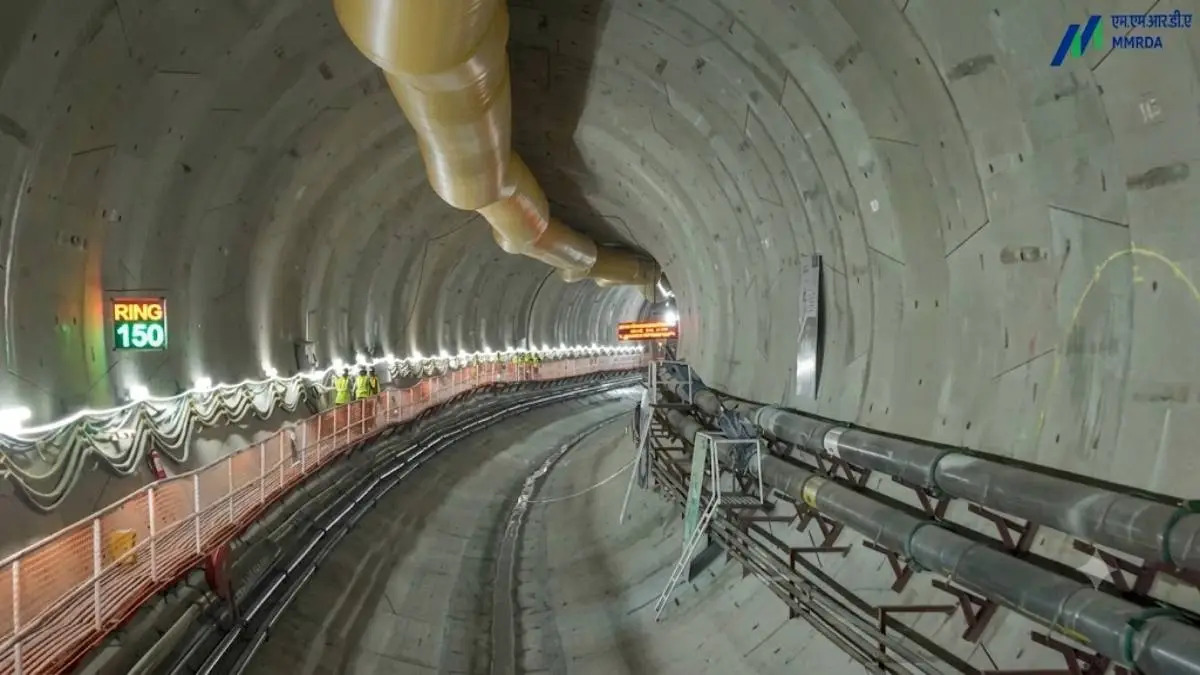
Mumbai Underground Corridor Moves Closer To Excavation
Mumbai’s northern coastal road is moving into a crucial construction stage, with work underway at Charkop for the shaft that will launch twin underground road tunnels towards Malad. Components for the Tunnel Boring Machines (TBMs) are expected in December, setting the stage for excavation on a 3.9-kilometre underground connection between Mindspace and Charkop. The project could reshape traffic movement across Mumbai’s northern western suburbs. The Mumbai Coastal Road tunnels are part of the 22.93-kilometre Versova-Dahisar corridor being developed by the civic administration. The northern extension is intended to provide an additional high-capacity route alongside existing arterial roads, while connecting with other major transport links across the western suburbs.
The underground section is being executed through Packages C and D. BMC planning documents identify one tunnel for northbound traffic and another for southbound movement, each extending 3.9 kilometres between the Mindspace and Charkop interchanges. Both are planned as three-lane tunnels. At Charkop, excavation has begun across a 65-metre by 40-metre site where the launching shaft is being prepared. The shaft will serve as the entry point for the TBMs, which are designed to operate at roughly 40 metres below ground. The machines are expected to have an external diameter of about 15.7 metres, making the launch infrastructure a substantial engineering project in its own right. The construction method will not rely entirely on underground boring. Of the 3.9-kilometre alignment, around 3 kilometres will be excavated using TBMs, while roughly 700 metres will use cut-and-cover construction. This method involves excavating from the surface, constructing the underground structure and then restoring the surface above it.
The Mumbai Coastal Road tunnels are significant because they pass beneath a densely developed part of North Mumbai. Underground construction can reduce the need for extensive surface-level road acquisition, but it also brings complex requirements around groundwater, utilities, settlement and construction traffic. Urban infrastructure specialists say the quality of these interfaces will matter as much as the eventual tunnel capacity. The wider corridor also raises environmental questions. The northern coastal road requires work in areas containing mangroves and other sensitive coastal landscapes. Government and civic project documents therefore make environmental management an important part of implementation. For a flood-prone coastal city, drainage and tidal-water movement need to remain part of construction planning rather than being treated as secondary concerns. The arrival of the TBM components will be the next major milestone. The first machine is expected to be assembled after the parts reach Mumbai, while the second machine is targeted for assembly and excavation by June 2027.
For commuters, the value of the tunnels will ultimately depend on how effectively they connect with surface roads, interchanges and public transport. The coming construction phase will therefore test not only engineering execution, but whether Mumbai can add road capacity without creating new bottlenecks or increasing pressure on its coastal environment.