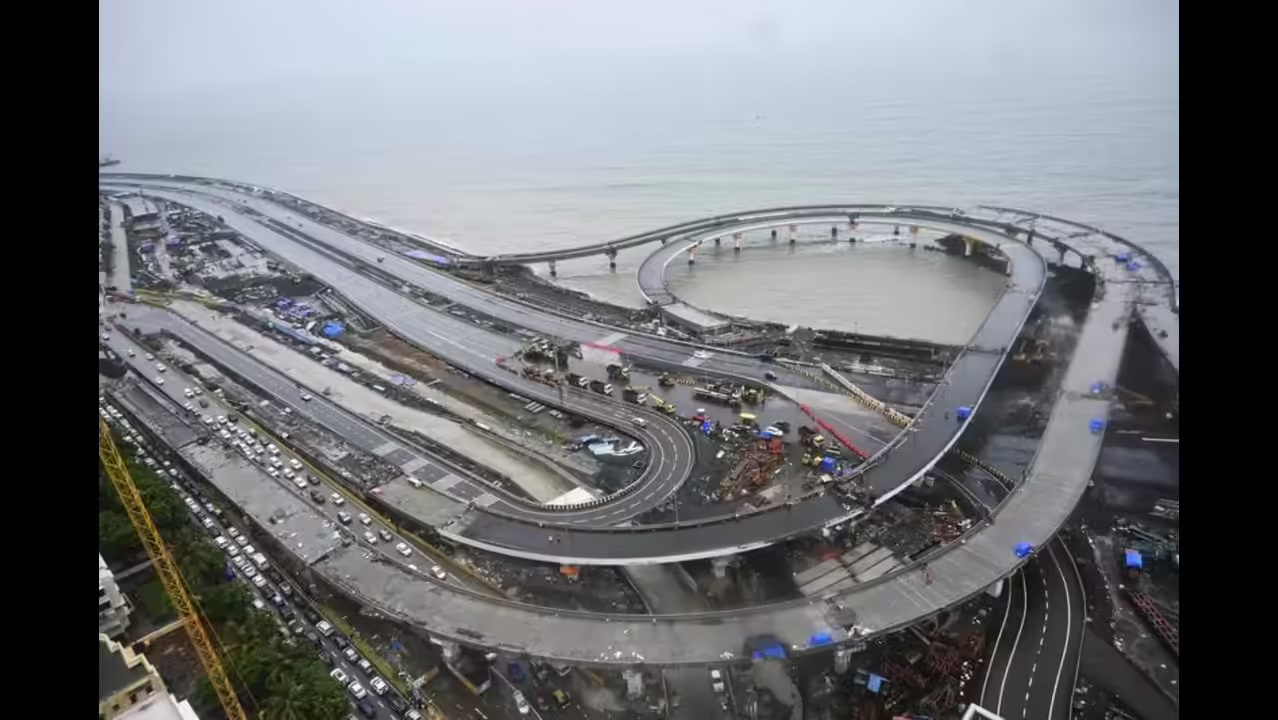
Mumbai Coastal Road North Moves Towards 2028 Target
Mumbai’s northern coastal corridor is entering a more intensive construction phase as the Brihanmumbai Municipal Corporation advances the Versova-Bhayandar link towards a December 2028 completion target. The nearly 60-kilometre project will combine elevated roads, bridges, interchanges and underground sections, creating a new east-west and north-south mobility network across the western suburbs and into the wider Mumbai Metropolitan Region. The Coastal Road North project is estimated to cost about ₹22,000 crore and is designed to connect the existing southern coastal corridor with the Bandra-Versova connection and the route towards Bhayandar. The broader objective is to provide an alternative to heavily congested road corridors, particularly the Western Express Highway, while improving connections between Mumbai and Mira-Bhayandar.
One of the technically significant sections is the 3.9-kilometre twin tunnel between Mindspace in Malad and Charkop Creek. Preparatory work at Charkop includes excavation and piling for a shaft that will allow Tunnel Boring Machines, or TBMs, to be lowered underground. Components for the machines are expected in December, after which assembly and tunnelling operations are scheduled to progress in stages. The project is being divided into seven packages covering different sections and structures. Its planned infrastructure includes elevated road sections, bridges, interchanges and tunnels. This approach is intended to accommodate the dense urban fabric of the western suburbs while reducing dependence on surface-level road expansion in some stretches.
However, the Coastal Road North project also carries a significant environmental cost. Central government records show approval for diversion of 103.6554 hectares of forest land classified as mangrove land for the Versova-Bhayandar Development Plan road. The clearance comes with conditions, while separate court proceedings have required compensatory plantation and long-term monitoring. The ecological question is particularly important because mangroves act as natural buffers against coastal flooding, help stabilise shorelines and support wetland ecosystems. Their removal can therefore create risks that extend beyond the immediate construction footprint. Recent concerns raised around Charkop have also focused on potential flooding and whether drainage and hydrological impacts are being adequately addressed. The project’s economic significance will ultimately depend on more than faster vehicle movement. Improved road connectivity can influence development patterns, land values and commercial activity along the western corridor, but the benefits will be broader if the infrastructure is integrated with public transport and local street networks.
With December 2028 now the stated completion target, execution will be closely watched. The next phase will test whether large-scale tunnelling and coastal construction can proceed at speed while maintaining environmental safeguards, flood resilience and reliable access for communities along the corridor.