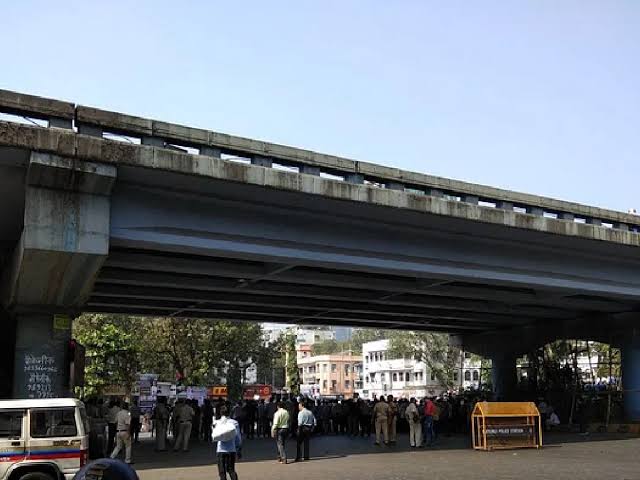
Mumbai is tightening crowd-management arrangements on the Parel bridge ahead of Ganeshotsav, with the civic administration installing barricades and green screening along the structure. The intervention is aimed at discouraging spectators from gathering on the bridge to watch processions and preventing vehicles from stopping unexpectedly. The measure highlights a recurring challenge for Mumbai: managing festival crowds without compromising pedestrian safety, traffic movement or emergency access. The Ganpati safety measures have been introduced by the F North ward after concerns were raised by the local police about crowd concentrations during the 10-day festival. The bridge near the ITC Grand Central area has traditionally attracted residents and devotees seeking a view of passing idols. During peak periods, people standing along the edges and motorists slowing or stopping can create conflicts between pedestrians and moving traffic.
The newly installed green view-cutters are designed to remove the visual incentive for people to stop on the bridge. Barricades will further restrict informal gathering points along the structure. Unlike a conventional traffic diversion, the intervention is aimed at changing how the space is used during procession hours, when ordinary road capacity can quickly be overwhelmed by spectators. The issue has a wider mobility dimension. Mumbai’s major festival routes often serve several functions at once: they carry public transport and private vehicles, provide pedestrian access to neighbourhoods and become temporary gathering spaces. When spectators occupy road edges or carriageways, even short interruptions can create traffic queues that spread to adjoining streets.
The Ganpati safety measures also have implications for emergency response. Unplanned vehicle stoppages and dense crowds can reduce the usable road width available to ambulances, fire services and other emergency vehicles. Preventing congregation at vulnerable points can therefore help preserve movement during periods when streets are already operating under unusual pressure. The Parel intervention comes as the civic administration prepares more broadly for this year’s Ganeshotsav. BMC road teams have also been directed to inspect idol arrival and immersion routes for potholes, uneven surfaces and potentially hazardous speed breakers. The wider preparation indicates that festival management is increasingly being treated as an urban infrastructure challenge rather than only an event-management exercise. For residents, however, safety measures will work best when alternative viewing and pedestrian arrangements are clear. Simply restricting access to a familiar vantage point can shift crowds towards another unsafe location. Effective crowd planning therefore requires coordinated policing, traffic management, pedestrian space and public communication.
As Mumbai prepares for another high-footfall festival, the Parel bridge measures offer a practical test of how the city can protect people while keeping essential movement flowing. The next priority will be ensuring that similar risks are identified across procession routes before crowds arrive, rather than after congestion or unsafe conditions emerge.