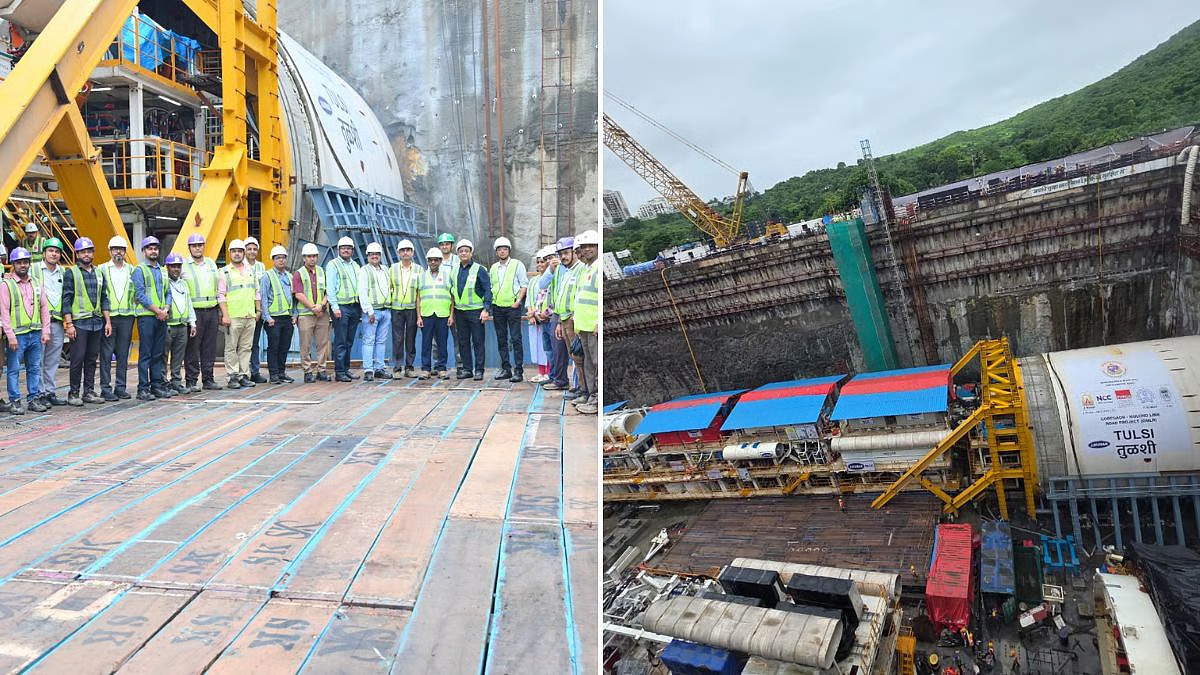
Mumbai GMLR Project Reaches Early Tunnelling Milestone
Mumbai’s Goregaon-Mulund Link Road has entered an early but significant phase of underground construction, with the first Tunnel Boring Machine (TBM) advancing beneath the Sanjay Gandhi National Park. The machine has excavated nine metres of rock since tunnelling began, marking the start of work on one of the city’s most complex road connections. The project aims to create a direct east-west route while limiting the need for major surface disruption. The GMLR tunnel project is being developed as part of Phase 3(B) of the Goregaon-Mulund Link Road. Its central underground section comprises twin three-lane tunnels extending about 5.3 kilometres between Dadasaheb Phalke Chitranagari in Goregaon East and Amar Nagar in Mulund West.
The machines are working beneath the protected landscape of the Sanjay Gandhi National Park, making construction considerably more sensitive than conventional urban tunnelling. The first TBM, named Tulsi, began excavation on August 17. A senior civic projects official inspected the site on August 26 to review excavation methods, technical systems and safety arrangements. The GMLR tunnel project is part of a wider 12.2-kilometre corridor connecting Goregaon in the western suburbs with Mulund and the Eastern Express Highway. The estimated project cost is around ₹14,000 crore. Once completed, the corridor is expected to provide an alternative cross-city route for traffic that currently relies on longer journeys through heavily used arterial roads. The economic case for the project rests on reducing travel friction between Mumbai’s western and eastern sides. A more direct connection could shorten journey times for commuters, commercial vehicles and service traffic while improving access between employment centres. Urban planners, however, note that additional road capacity does not automatically eliminate congestion. Traffic volumes can rise when previously difficult journeys become easier, making connections with public transport and local roads important to the project’s eventual performance.
Its environmental setting makes execution equally important. Sanjay Gandhi National Park is a major urban ecological asset, and tunnelling beneath it requires careful control of vibration, groundwater, spoil movement and surface impacts. Building underground can avoid extensive clearing at the surface, but it does not remove environmental risks. Monitoring construction effects will therefore remain important as excavation moves deeper and longer. Safety will also become more demanding as tunnelling progresses. TBM operations involve large rotating cutting systems, underground ventilation, material removal and continuous ground monitoring. Stable excavation conditions and emergency-response systems are essential when working beneath a protected area and densely populated parts of the city. The nine-metre advance is still only an initial milestone in a 5.3-kilometre underground section. The larger test will be maintaining excavation speed and safety over difficult geological conditions without compromising the park or nearby communities.
For Mumbai, the GMLR tunnel project represents a broader shift towards underground transport infrastructure where surface land is constrained. Its success will ultimately be measured not simply by kilometres excavated, but by whether the finished corridor improves connectivity while preserving the ecological and urban systems above it.