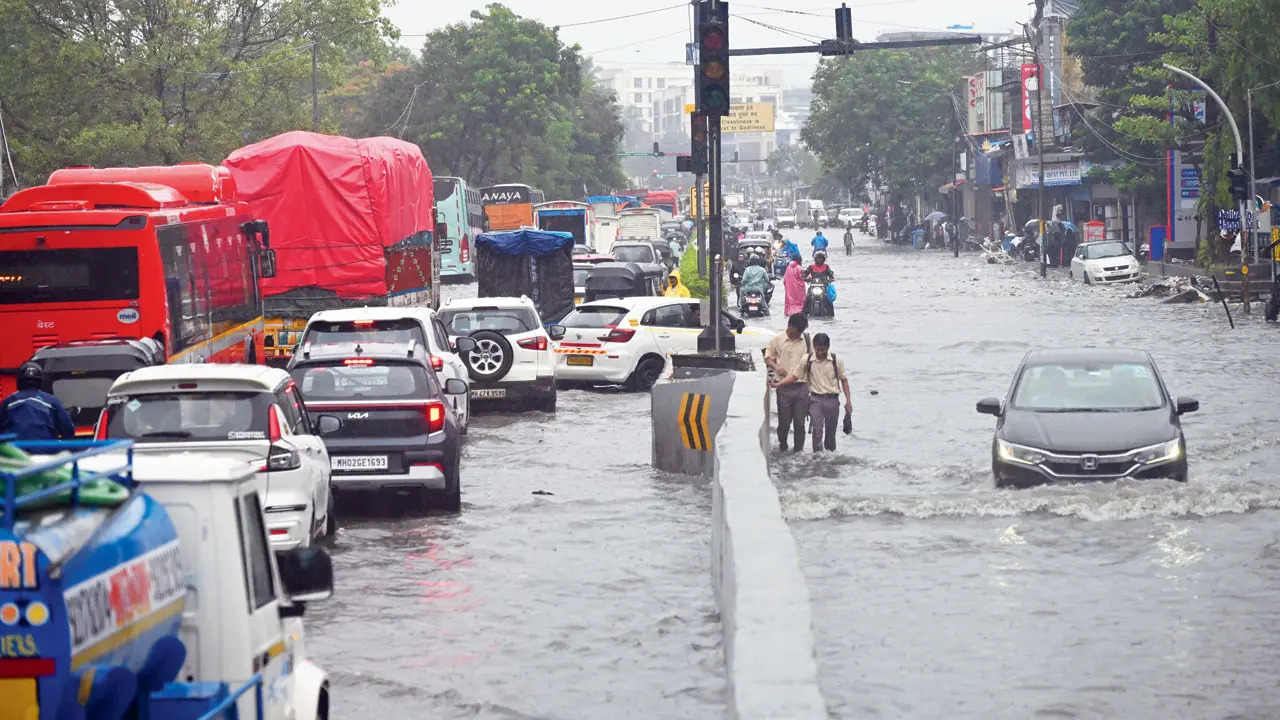
Mumbai Rain Disruptions Deepen Across Transport Corridors
Mumbai is facing another major monsoon disruption after intense rainfall affected roads, rail services and air travel across the metropolitan region. The civic administration has closed schools and colleges on July 7 as the weather department forecast another day of heavy to very heavy rain. The disruption highlights how extreme rainfall can quickly spread across interconnected transport systems, affecting commuters, businesses and essential services well beyond waterlogged neighbourhoods. Rainfall on July 6 was particularly intense in several parts of the city. Civic monitoring stations recorded 143.2 mm at a municipal school in Bhandup between 8am and 6pm, while Chincholi Fire Station registered 109.8 mm. Several locations in Vikhroli, Ghatkopar, Goregaon, Aarey and Versova recorded rainfall approaching or exceeding 90 mm during the same period.
The weather also created a substantial urban safety burden. The civic administration received 291 complaints involving fallen trees and branches by 6pm on July 6. Western suburbs accounted for the largest share, followed by the eastern suburbs and Mumbai city. Such incidents can obstruct roads, damage vehicles and infrastructure, and delay emergency response at a time when mobility is already under pressure. Rail connectivity towards Pune was among the most visible casualties. Landslides along the Bhor Ghat section between Karjat and Lonavala disrupted the Mumbai–Pune railway corridor, forcing several services to be cancelled, diverted, regulated or rescheduled. Intercity and long-distance trains were among those affected, leaving passengers with limited alternatives during deteriorating weather.
Air travel has faced similar pressure. At least 17 flights were cancelled and 217 delayed during the early stages of the disruption on July 6, affecting arrivals and departures at Mumbai airport. Airlines operating through Mumbai, Pune and Goa warned passengers about weather-related changes, adding uncertainty for business travel, tourism and time-sensitive cargo movements. For the city’s economy, the impact of such events extends beyond delayed journeys. Transport interruptions can affect attendance at workplaces, deliveries, retail activity and airport-linked businesses. Smaller businesses and workers who depend on predictable daily movement can be particularly exposed because they have fewer options when rail and road networks are disrupted simultaneously. The Mumbai monsoon disruption also underlines a larger infrastructure challenge. Urban resilience is not only about expanding drainage capacity. It requires coordinated planning across transport, vegetation management, slope protection, emergency services and public communication. As rainfall becomes more disruptive, infrastructure investment will increasingly need to account for how failures in one network can cascade into others.
The Mumbai monsoon disruption is therefore a test of preparedness as much as drainage. With another period of heavy rain forecast, maintaining safe mobility and protecting critical transport links will remain the immediate priority.