


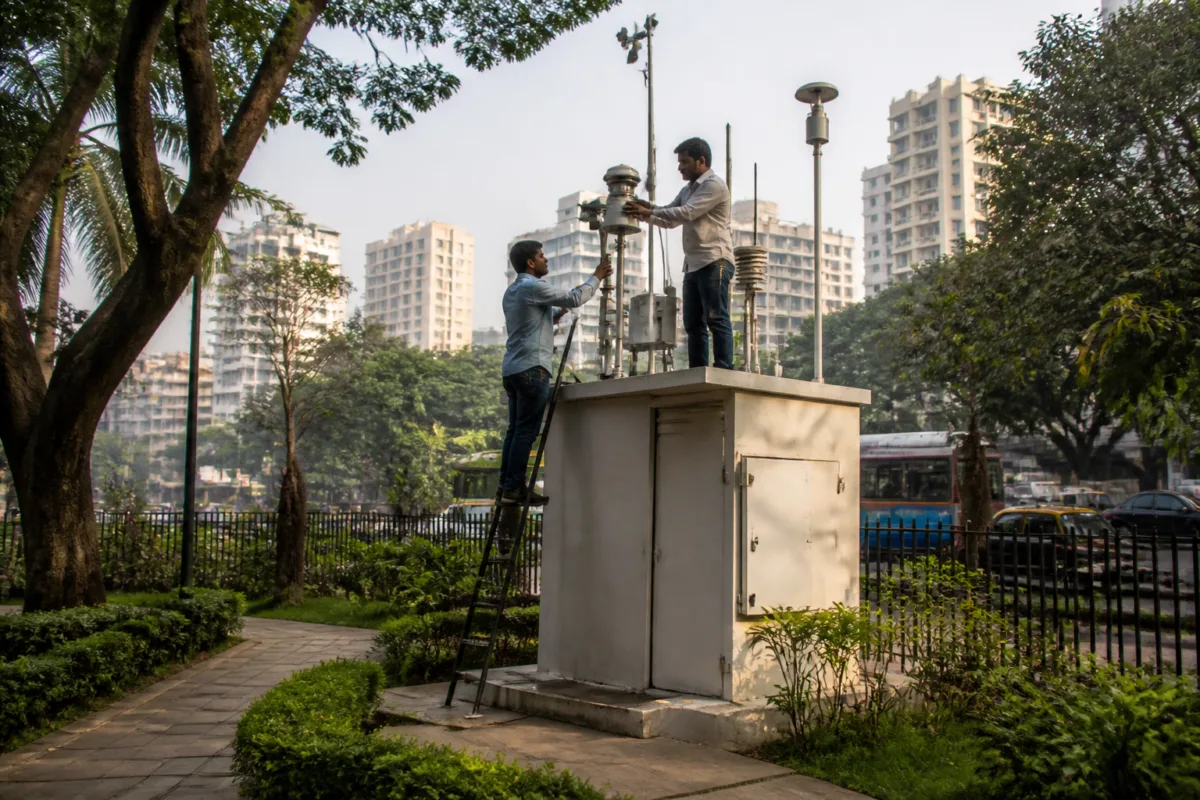
Mumbai’s air quality monitoring network is set to expand with five new continuous ambient air quality monitoring stations, with the Brihanmumbai Municipal Corporation allocating Rs 17.50 crore for the project. The stations will be installed across civic gardens and an administrative office in areas identified as not adequately covered by existing monitoring networks.
The new monitoring stations will come up at CD Deshmukh Garden in Mulund (East), Pramod Mahajan Park in Borivali (West), Chhota Kashmir in Aarey Garden, Goregaon (East), Dr Babasaheb Ambedkar Recreation Ground in Dahisar (East), and the BMC assistant municipal commissioner’s office in Khar, in the H-West ward.
According to the civic body, the continuous ambient air quality monitoring stations will record several air pollutants on an hourly basis. They will also measure meteorological conditions, including temperature, relative humidity, wind speed and wind direction. These parameters are used alongside pollution readings to understand how local weather conditions influence air quality.
Mumbai currently has 28 air quality monitoring stations. The BMC said the five additional facilities would be located in areas that are not already covered by monitoring networks operated by the Maharashtra Pollution Control Board, the BMC and the SAFAR-Mumbai project. The location strategy is intended to extend monitoring coverage beyond areas where stations already operate.
The data generated by the new stations is proposed to be made available through the BMC’s online portal. The portal will also be linked to the Central Pollution Control Board server, allowing the readings to be integrated with the broader national air-quality data system. The public availability of localised readings will depend on the civic body’s implementation of the portal and data-linking arrangements.
The project includes a three-year warranty followed by five years of maintenance, according to the report. The BMC has selected Invia India Private Limited to execute the work. The company’s appointment and the maintenance provision place responsibility for the stations’ installation, operational continuity and upkeep within a defined project period.
The expansion comes as Mumbai’s pollution monitoring needs vary across a large and densely developed urban area, with traffic, construction, industrial activity, weather and neighbourhood-level conditions influencing readings. The proposed locations cover eastern, western and northern parts of the city, including Mulund, Borivali, Goregaon, Dahisar and Khar. The next implementation step is the installation and commissioning of the five stations, after which their readings are expected to be connected to the BMC portal and CPCB server.

