


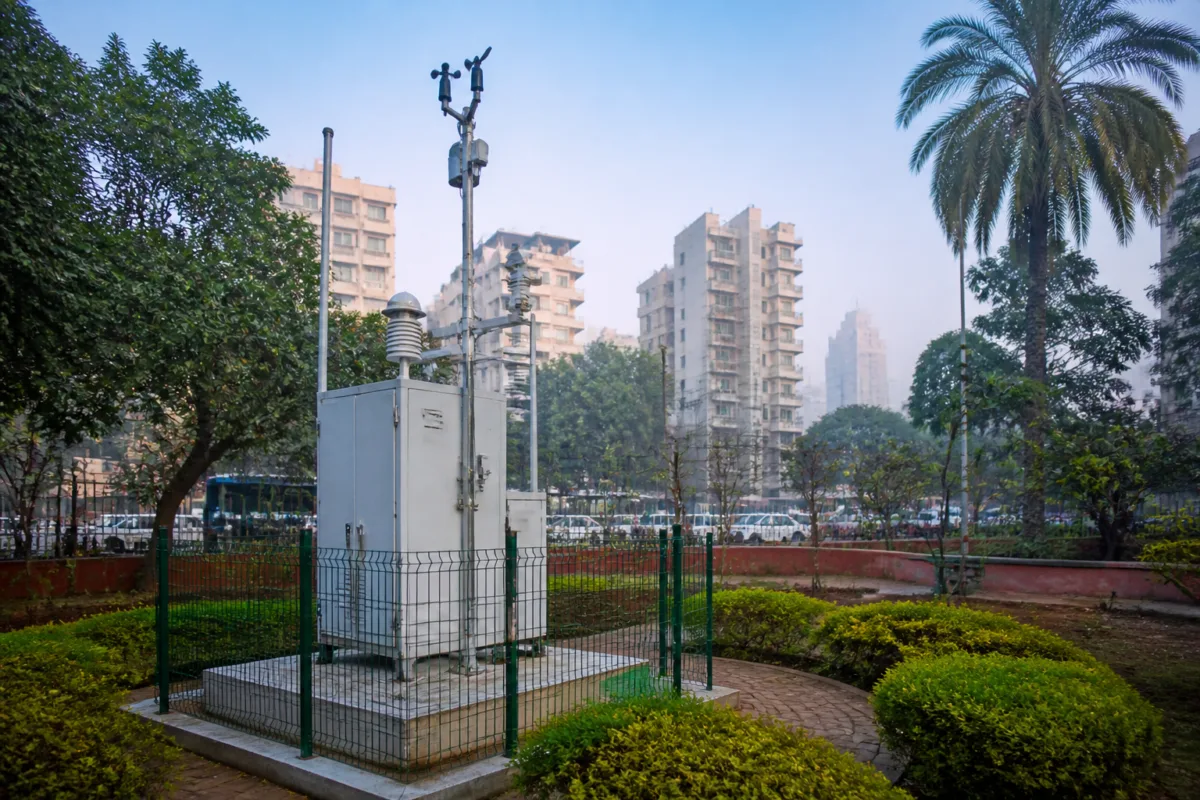
Mumbai’s air-quality monitoring network will expand with five new continuous ambient air quality monitoring stations at a project cost of Rs 17.50 crore, the Brihanmumbai Municipal Corporation (BMC) has announced. The stations will track air pollutants hourly and record weather conditions that help interpret how pollution levels change across the city.
The new continuous ambient air quality monitoring stations, or CAQMS, will be installed at CD Deshmukh Garden in Mulund (East), Pramod Mahajan Park in Borivali (West), Aarey Garden’s Chhota Kashmir in Goregaon (East), Dr Babasaheb Ambedkar Recreation Ground in Dahisar (East), and the BMC assistant municipal commissioner’s office in Khar’s H-West ward.
The BMC said the locations were selected in areas not already covered by monitoring networks operated by the Maharashtra Pollution Control Board, the civic body and the SAFAR-Mumbai project. The expansion is intended to improve the geographic spread of air-quality readings across Mumbai, which currently has 28 air-quality monitoring stations.
Each proposed station will measure various air pollutants on an hourly basis. It will also record meteorological parameters, including temperature, relative humidity, wind speed and wind direction. These measurements provide local environmental conditions alongside pollution readings and are part of the planned monitoring system.
The data is proposed to be published on the BMC portal and linked to the Central Pollution Control Board server. This would place the new readings within the wider national air-quality data network, although the BMC’s announcement does not specify when the additional stations will begin publishing live information.
The project includes a three-year warranty followed by five years of maintenance, according to the civic body. Invia India Private Limited has been selected to execute the work. The maintenance provision places responsibility for keeping the stations operational beyond installation, a key requirement for maintaining continuous monitoring rather than producing isolated or irregular readings.
The locations span eastern, western and northern parts of Mumbai, including residential, recreational and civic sites. The choice of gardens, parks, a recreation ground and a municipal office will bring monitoring equipment into public and administrative spaces while extending coverage to areas identified as gaps in the existing network.
The BMC’s expansion comes as air-quality monitoring remains dependent not only on the number of stations but also on their distribution, operational continuity and public access to data. The planned portal and CPCB linkage are intended to make the additional readings available through established civic and national systems. The project’s next operational milestones will be the installation of the five stations and their subsequent integration with the BMC and CPCB data platforms.

