


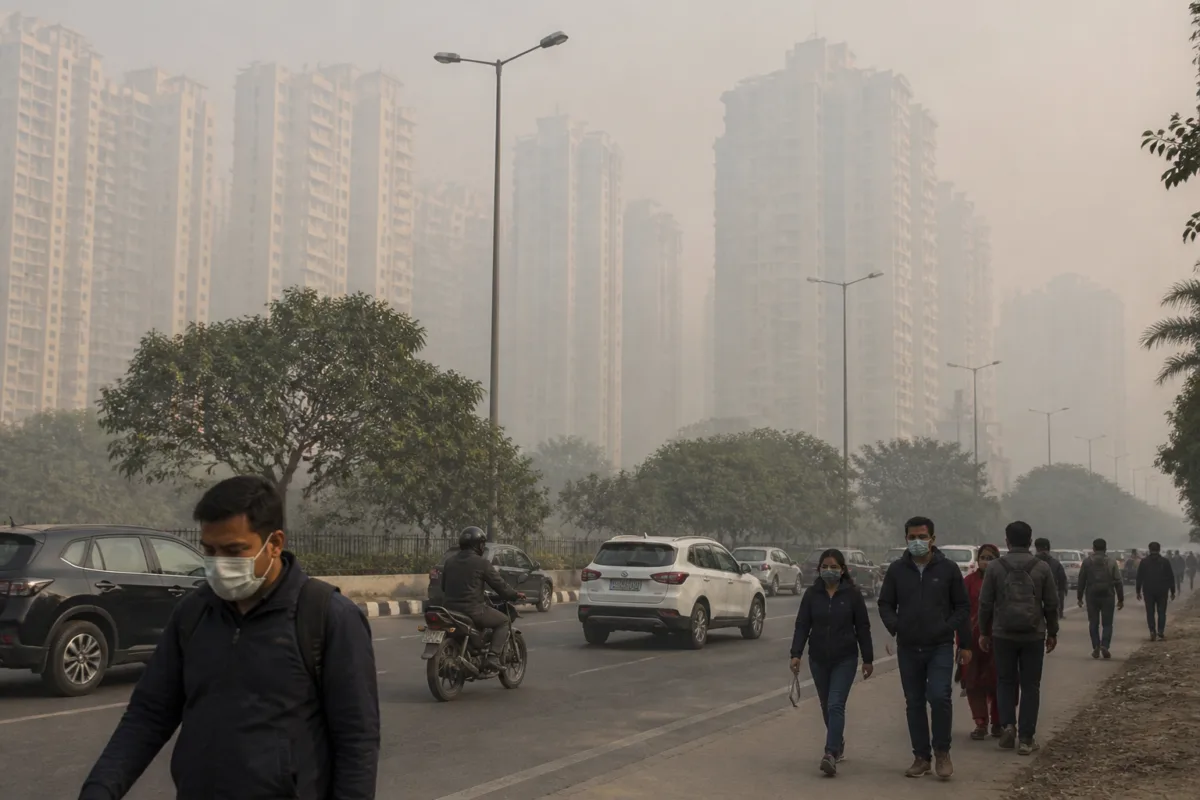
Noida’s air quality deteriorated sharply after Diwali, with the city’s Air Quality Index (AQI) reaching 461 on Wednesday, according to a report by Navbharat Times – Noida. The reading rose from 301 on Tuesday and 332 on Monday, indicating a steep worsening across three consecutive days.
The report said Noida ranked 17th among the world’s most polluted cities based on Wednesday’s AQI. The citywide deterioration was accompanied by substantially higher readings in several localities, showing that residents faced markedly different pollution levels depending on where they lived or travelled.
Nagli Bahramour recorded the highest local reading at 507. The AQI at ATS Green Village in Sector 93 reached 504, while Sector 92 recorded 483. Other high readings included 479 at Gaur City-1, 475 in Sector 150 and 472 in Sector 63. Sector 52 recorded an AQI of 440.
The pattern was different on Tuesday, when Sector 62 reported the highest reading at 353. Sector 110 recorded 329, followed by 321 in Sector 39, 310 in Sector 125 and 308 in Sector 150. Lower, though still elevated, readings were reported at Sector 1, where the AQI was 261, and Sector 116, where it was 211.
The sharp variation between monitoring locations highlights how pollution exposure can differ across Noida’s residential, commercial and industrial areas. The reported readings also show that the deterioration was not confined to a single neighbourhood. Multiple sectors recorded AQI levels above 470 on Wednesday, while both established residential developments and other urban pockets reported severe pollution.
The report advised asthma patients to limit exposure to dust, smoke and outdoor air during the pollution episode. It recommended using an N95 mask when going outside, covering the nose and mouth, and avoiding outdoor activity in the morning and evening when possible. Patients already prescribed inhalers were advised to continue using them regularly and not stop medication without consulting a doctor.
The health guidance also recommended keeping homes clean and preventing the accumulation of dust and dampness. Residents with respiratory conditions were advised to carry essential medicines and follow their doctor’s instructions while pollution levels remain elevated. The report did not provide a forecast for when Noida’s air quality would improve or identify the specific contribution of different pollution sources.

