


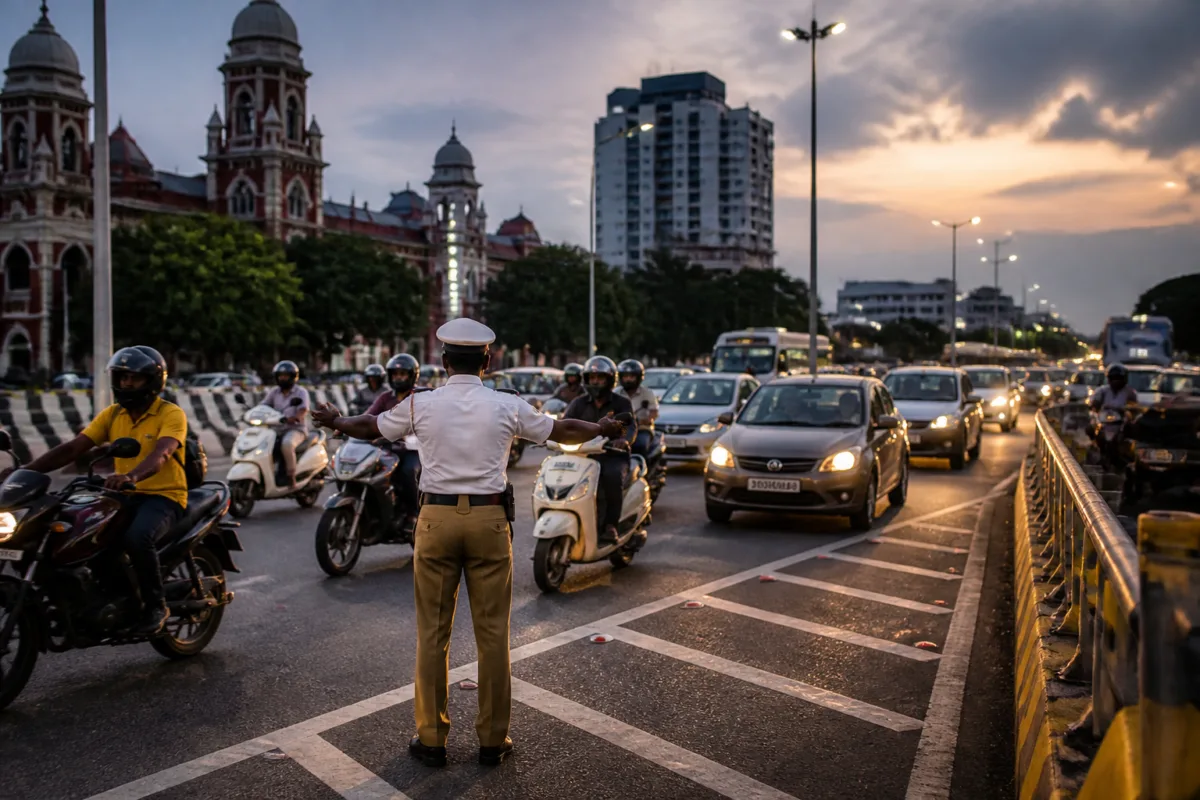
Tamil Nadu’s road-safety record is worsening even as Chennai has managed to reduce fatalities, exposing a gap between city-level enforcement and the state’s wider ability to prevent crashes, make dangerous locations safer and deliver timely emergency care. The state recorded 56,602 crashes and 14,373 deaths in the first nine months of 2026, an average of about 207 crashes and 53 deaths every day. Chennai reported 402 road deaths between January and October, down from 420 in the corresponding period a year earlier, while injuries fell from 2,997 to 2,865.
The contrast is important because it shows that road safety is not determined by a single measure such as vehicle speed, road width or police enforcement. In Chennai, officials attributed the decline to enforcement against violations and improvements at accident-prone locations. Across Tamil Nadu, however, the number of crashes and deaths has continued to rise alongside a growing vehicle population, unfinished hotspot interventions and uneven access to advanced emergency care.
The state’s averages have deteriorated compared with 2025. Tamil Nadu recorded about 195 crashes and 51 deaths a day in 2025. Between January and June 2026, the state averaged 206 crashes a day, with the total nearly 6% higher than the previous year. The daily average rose further to 210 crashes between July and September. The figures indicate that the increase was not confined to the first half of the year.
Police attributed part of the early rise to personnel being diverted to election duty. That explanation, however, does not account for the higher daily average recorded between July and September. An IIT Madras scientist, Venkatesh Balasubramanian, linked the challenge to the growth in vehicle numbers and rising violations, while calling for greater road-safety awareness.
Tamil Nadu has about 4.1 crore registered vehicles. Between 2022 and 2025, vehicle numbers grew 17%, crashes increased 11% and deaths rose 3.5%. The relationship is not a simple one-to-one equation: the growth in deaths was smaller than the growth in vehicles, but the overall direction remained upward. The data also shows that improvements in enforcement and safety design have not kept pace consistently with the expansion of road use.
Chennai’s recent measures offer a partial explanation for its better performance. Between June and August, 1.17 lakh two-wheeler riders were booked for helmet violations. Helmet compliance among riders has now reached nearly 95%, according to the traffic police, although it remains at 50% among pillion passengers. Police used number plate recognition cameras, speed radars and interceptor vehicles to identify offenders. Civic agencies also closed unsafe median openings and improved lighting and road signs.
The Chennai experience combines behaviour enforcement with changes to the road environment. That distinction matters. A traffic violation can be detected by police, but a dangerous median opening, poor lighting or inadequate signage requires action by civic and road agencies. The reported decline in deaths therefore reflects an institutional chain rather than one department’s intervention: enforcement identifies risky behaviour, while infrastructure changes reduce opportunities for conflict and improve visibility.
The state’s treatment of high-risk locations remains incomplete. Authorities have identified 7,723 hotspots and completed interventions at 5,356 of them. A further 2,367 locations were awaiting action. Transport commissioner Sigy Thomas Vaidhyan said it would not be correct to attribute deaths only to speeding on wide, good-quality roads. The statement points to a broader road-safety problem in which risk can also emerge from junction design, access points, signage, lighting, traffic mixing and local road conditions.
Vaidhyan said police had been instructed to investigate locations with at least three crashes, including crashes that did not cause injuries or deaths. That approach widens the evidence base beyond fatality data. If authorities examine only locations where people have already died, interventions may arrive after a pattern has become severe. The reported instruction recognises that repeated non-fatal crashes can also identify dangerous design or operating conditions.
National highways illustrate why the road network needs to be assessed by function and risk rather than by length alone. They account for less than 3% of Tamil Nadu’s road network but were associated with 31% of crashes in 2025. At the same time, the transport commissioner’s warning suggests that the safety challenge extends beyond high-speed corridors. A road’s formal classification does not by itself establish the cause of a crash, and the available figures do not identify how much of the state’s total burden occurred on each type of road in 2026.
The state is also moving towards technology-led enforcement and driver training. Authorities plan to pilot ‘Vizhi’, which uses dashboard cameras and artificial intelligence to flag traffic violations, in 100 enforcement vehicles before considering statewide expansion. ‘ThiranAI’ is intended to provide adaptive, game-based training for new drivers and refresher courses for offenders. These initiatives are presented as planned pilots and programmes; the supplied report does not establish their operational results or statewide coverage.
Technology can strengthen detection and training, but it does not remove the need for physical road improvements or adequate staffing. Number plate recognition, speed radars and dashboard cameras can identify violations after or during risky behaviour. They cannot, on their own, close a hazardous median opening, redesign a junction or reduce the time needed to reach a trauma facility. The division of responsibilities between police, civic agencies, transport authorities and health services remains central to the state’s road-safety performance.
The post-crash system reveals another layer of the problem. The health department has expanded ambulance services, upgraded emergency rooms and provided treatment cover of up to Rs 2 lakh for victims. More than 700 government and empanelled private hospitals offer free care for the first 48 hours. Health secretary Darez Ahamed said ambulances are positioned near crash hotspots and reach within 10 minutes.
That response is not uniform across all locations. EMRI data cited in the report shows that transporting patients can take 20 to 30 minutes in remote areas and heavy-traffic zones. M Selvakumar, head of EMRI, said ambulances do not have facilities for intubation and that delays in reaching a tertiary-care centre can lead to fatalities in severe cases. The issue is therefore not only whether an ambulance reaches a crash scene, but also what stabilisation capacity exists inside the ambulance and how quickly the patient can be moved through the wider care network.
Government doctors have called for more Emergency Care and Recovery Centres, which stabilise patients before transfer to higher-level facilities. One doctor said districts need at least two or three such centres each. The report does not state how many currently exist, where they are located or whether a statewide expansion has been approved. Those gaps matter because the benefit of a 10-minute ambulance response can be reduced if patients then face a long journey to a facility equipped to treat severe trauma.
The evidence therefore points to three connected layers of road safety: preventing dangerous behaviour, correcting hazardous road locations and reducing the consequences when crashes occur. Chennai’s results suggest that coordinated enforcement and local engineering changes can coincide with fewer deaths. Tamil Nadu’s statewide figures show that these measures have not yet been completed or applied at a scale sufficient to reverse the broader trend.
The state’s next phase will be judged by implementation rather than announcement. The key milestones include action at the 2,367 remaining hotspots, the performance of the Vizhi pilot, the reach and effectiveness of ThiranAI training, helmet compliance among pillion passengers and the expansion of emergency stabilisation capacity. The available figures confirm a serious statewide road-safety burden and a more positive Chennai trend, while leaving open how quickly the state can connect enforcement, safer road design and trauma care into one functioning system.

