


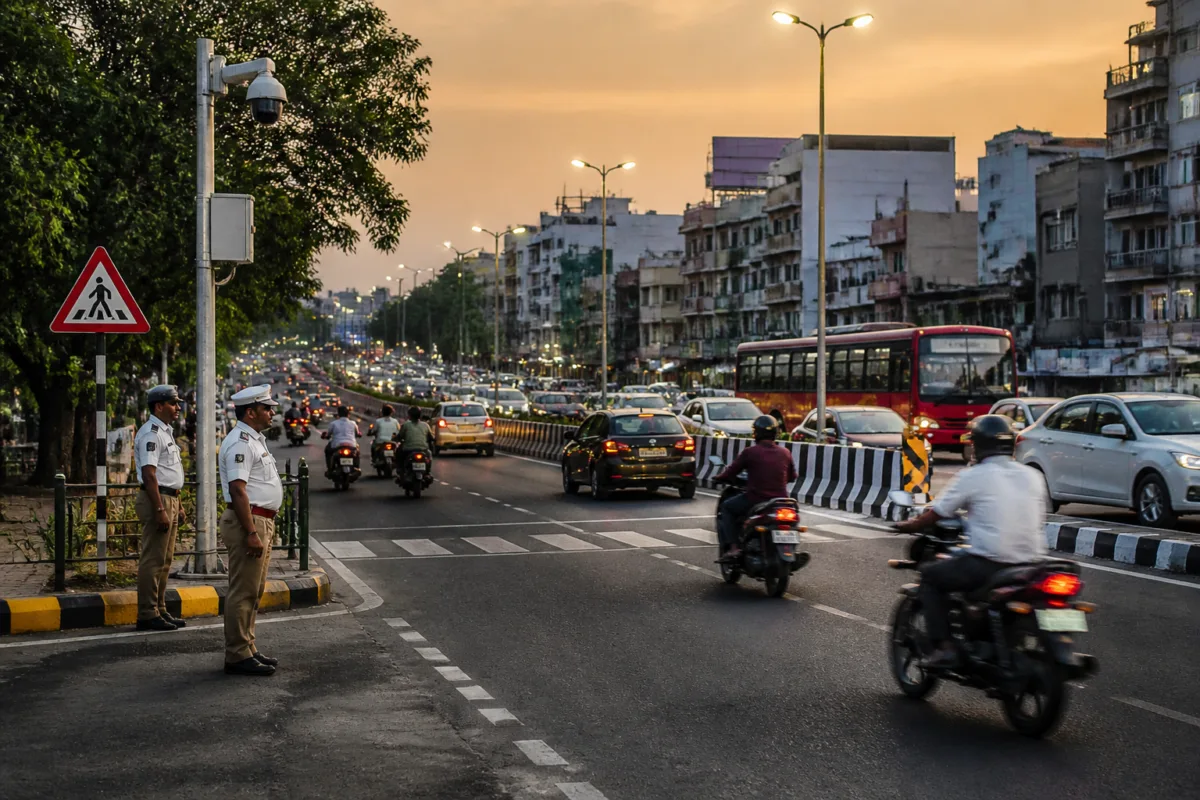
Tamil Nadu road deaths have reached a scale that cannot be explained by isolated crashes or individual driver behaviour alone. The state recorded 14,373 deaths in 56,602 crashes during the first nine months of 2026, an average of about 53 deaths and 207 crashes every day. Chennai, however, moved in the opposite direction: deaths fell to 402 between January and October from 420 in the corresponding period a year earlier, while injuries declined from 2,997 to 2,865.
That contrast is the most important signal in the latest road-safety data. Tamil Nadu’s overall trend remains negative, but Chennai’s experience suggests that enforcement, targeted engineering changes and better identification of high-risk locations can influence outcomes. It also shows the limits of treating road safety as a single state-wide problem. The risks on an urban arterial, a city junction, a rural road and a national highway may be connected, but they are not identical.
The state’s road-safety challenge has expanded alongside its vehicle population. Tamil Nadu has about 4.1 crore registered vehicles. Between 2022 and 2025, vehicle numbers grew by 17%, while crashes increased by 11% and deaths by 3.5%. The figures do not establish that vehicle growth alone caused the increase, but they show the pressure placed on enforcement systems, road design and emergency medical services as more vehicles use the network.
The rise has also not been uniform through 2026. Between January and June, Tamil Nadu averaged 206 crashes a day, with the total nearly 6% higher than the previous year. Police attributed part of that increase to personnel being diverted to election duty. The daily average rose further to 210 crashes between July and September, indicating that the problem continued after the earlier administrative disruption.
Chennai’s improvement has been associated with measures operating at several points in the road-safety chain. Joint commissioner of police for traffic, south, P Pakalavan attributed the decline to enforcement against violations and improvements at accident-prone locations. Between June and August, police booked 1.17 lakh two-wheeler riders for helmet violations. Compliance among riders has since reached nearly 95%, although it remains about 50% among pillion passengers.
This difference is significant because it shows that compliance is not a single behaviour shared by everyone using a vehicle. A rider’s helmet use may improve through enforcement, while pillion passengers remain less likely to comply. The available figures do not explain why that gap persists, but they show that enforcement results need to be measured by user category rather than reported as a general improvement.
Police have also used number-plate recognition cameras, speed radars and interceptor vehicles to identify offenders. These tools shift enforcement away from occasional manual checks towards more continuous detection. Their value, however, depends on how violations are followed up and whether enforcement is concentrated at locations and times where serious crashes are most likely. The Chennai data indicates an association between the combined measures and lower fatalities, but the supplied evidence does not isolate the contribution of each individual intervention.
Civic agencies have made physical changes at unsafe median openings and improved lighting and signage. These interventions address the road environment rather than only the conduct of road users. A median opening can create conflict between vehicles turning across traffic, while inadequate lighting and signs can reduce the time available for drivers and pedestrians to respond. The report does not provide before-and-after crash figures for each location, but it identifies engineering changes as part of the city’s response.
The state-wide hotspot programme illustrates the scale of the implementation challenge. Tamil Nadu has identified 7,723 hotspots and completed interventions at 5,356 of them. Work remains pending at 2,367 locations. The gap is not simply a count of unfinished projects; it represents a continuing set of places where authorities have already identified a recurring safety risk but have not yet completed the planned response.
Transport commissioner Sigy Thomas Vaidhyan said it would not be right to attribute deaths only to speeding on wide, good-quality roads. That caution broadens the policy question. A road can have a smooth surface and substantial width while still producing dangerous interactions between vehicles, pedestrians, turning movements, roadside activity and access points. Road quality in the conventional construction sense is therefore not the same as road safety.
The state has asked police to investigate locations with at least three crashes, including crashes that did not involve injuries or deaths. This approach matters because waiting only for fatal crashes can make prevention reactive. Non-fatal incidents can reveal recurring conflicts before they produce more severe outcomes. The source does not state how these investigations will be standardised or how quickly findings will translate into engineering or enforcement measures, leaving implementation as a crucial part of the programme.
National highways offer another warning against broad assumptions. They account for less than 3% of Tamil Nadu’s road network but were responsible for 31% of crashes in 2025. Their disproportionate share indicates that road length alone does not determine risk. Traffic volumes, speeds, access patterns and the severity of collisions may all shape the outcome, although the supplied report does not provide a breakdown of those factors.
The data also complicates a simple city-versus-highway narrative. Chennai’s lower fatality count suggests that dense urban enforcement and targeted changes can produce gains, while the state-wide highway figures show that high-speed corridors need distinct safety responses. At the same time, the state’s overall crash increase demonstrates that improvements in one urban jurisdiction do not automatically translate into better outcomes across the broader network.
Technology is being positioned as the next layer of enforcement. Tamil Nadu plans to pilot Vizhi, a system using dashboard cameras and artificial intelligence to flag traffic violations, in 100 enforcement vehicles before a possible statewide expansion. ThiranAI is intended to provide adaptive, game-based training for new drivers and refresher courses for offenders. These initiatives extend the road-safety system from detection into training, but their eventual value will depend on how accurately violations are identified, how decisions are reviewed and whether training changes behaviour.
The administrative structure is equally important. Police are responsible for enforcement and investigation, civic agencies for several road-environment interventions, transport authorities for wider road-safety measures, and the health system for post-crash care. The figures in the report show that no single department controls the full chain from prevention to survival. A dangerous median opening may require civic action, a speeding violation may require police enforcement, and a serious injury may depend on ambulance capability and the receiving hospital.
Tamil Nadu has expanded ambulance services, upgraded emergency rooms and provided treatment cover of up to Rs 2 lakh for victims. More than 700 government and empanelled private hospitals offer free care for the first 48 hours. Health secretary Darez Ahamed said ambulances are positioned near crash hotspots and reach within 10 minutes. This indicates an effort to reduce the time between a crash and the start of medical care.
But the reported response time is not uniform. EMRI data indicates that transporting patients can take 20 to 30 minutes in remote areas and heavy-traffic zones. M Selvakumar, head of EMRI, said ambulances do not have the facility to intubate and that, in severe cases, delays in reaching a tertiary-care centre can lead to fatalities. This distinction separates ambulance arrival from effective emergency care. Reaching a crash site quickly does not necessarily mean that a patient can receive advanced stabilisation or reach the appropriate hospital quickly.
Emergency doctors have called for more Emergency Care and Recovery Centres, with one government doctor saying every district should have at least two or three. The report does not establish how many such centres currently exist or provide a state-wide capacity assessment. It does, however, identify a structural gap between immediate response and specialised treatment, particularly for victims in remote areas or on congested roads.
The state’s licensing data provides another measure of enforcement intensity. Authorities suspended 41,402 licences in six months, compared with 95,568 during the whole of 2025, according to State Crime Records Bureau figures. The comparison suggests that suspensions have accelerated, although the supplied material does not identify the violations involved, the geographic distribution of suspensions or whether the action is linked to subsequent reductions in crashes.
Taken together, the evidence points to a road-safety system making progress in selected areas while remaining under pressure at the state level. Chennai’s decline in deaths, higher helmet compliance among riders, hotspot interventions and expanded emergency services show that institutions are acting across prevention, enforcement and response. The 14,373 deaths, the unfinished work at 2,367 identified hotspots, the continuing crash increase and the delays in remote and congested areas show that these measures have not yet matched the scale of the problem.
The larger urban question is whether road safety will be managed as a permanent operating function of the transport system rather than as a series of responses after serious crashes. Chennai’s experience suggests that combining enforcement with physical changes can improve outcomes. Tamil Nadu’s wider data shows that those gains must be extended across different road types, districts and emergency-care networks. The next evidence to watch is whether hotspot interventions are completed, whether the planned technology pilots produce measurable enforcement improvements, and whether faster access to advanced medical care reduces fatalities after crashes occur.

