


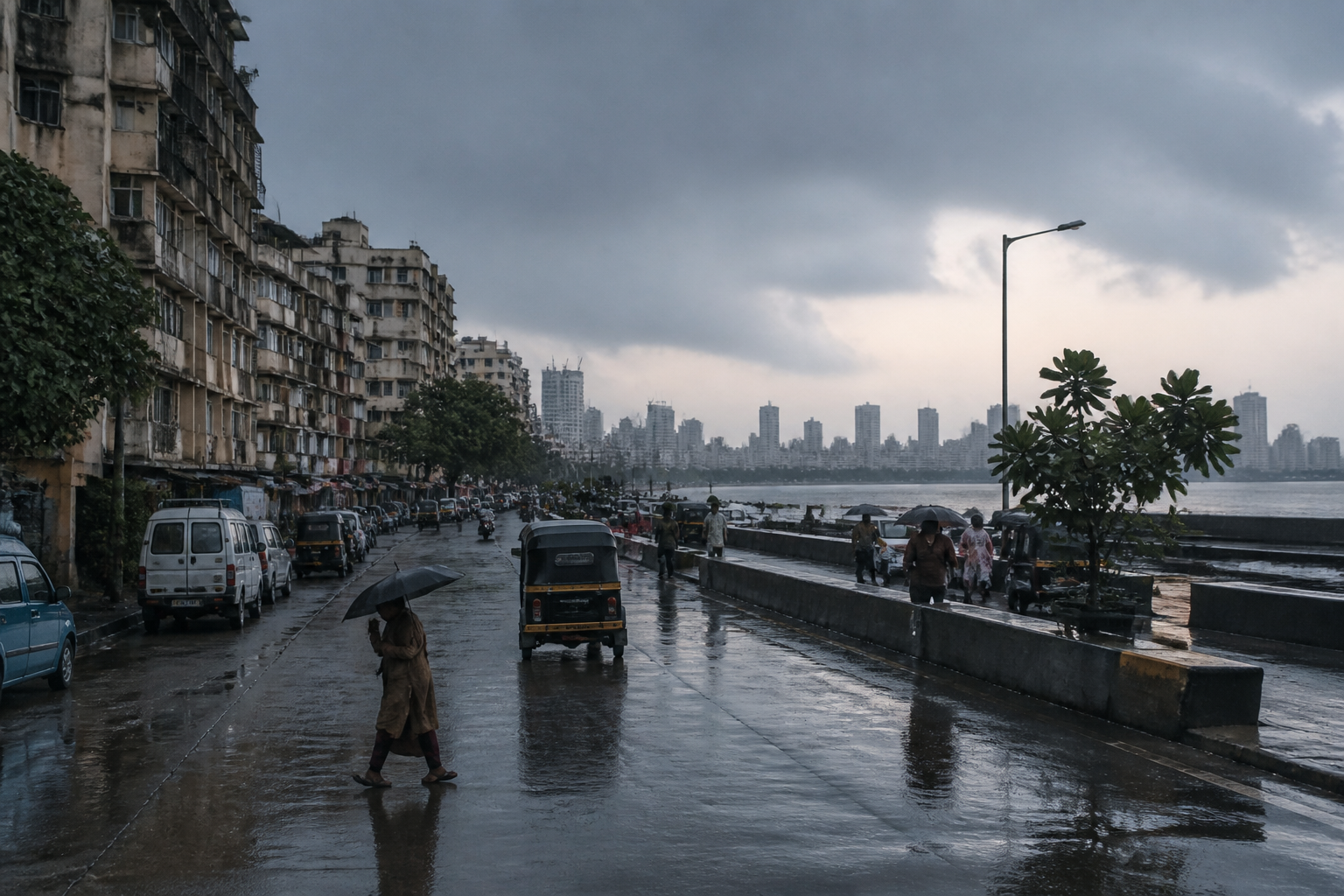
Mumbai’s monsoon has ended on a deficit note, but the most important feature of the season is not simply that the city received less rain. It is that rainfall was distributed unevenly across the metropolitan area, leaving the island city below its seasonal norm even as the suburban station crossed its average because of an exceptionally wet July. That split matters for a city whose rainfall, drainage, water management and flood preparedness are often discussed as though Mumbai experiences one uniform monsoon.
According to India Meteorological Department data cited by The Indian Express, Santacruz recorded 304.2 mm of rain between September 1 and September 30, around 20 per cent below its September average of 383.5 mm. The suburban station typically receives 2,390 mm during the June-to-September monsoon season. Colaba, which represents the island city, has a seasonal average of 2,102 mm but received only 1,957 mm between June and September.
The result is a city divided by its rain gauges. Santacruz recorded 2,530 mm during the season, exceeding its seasonal average, while Colaba remained below its normal quota. The difference was largely created by July, when Mumbai recorded rainfall 66 per cent above average. That concentrated burst did not translate into a seasonally normal outcome for every part of the city.
## One city, different monsoon outcomes
The station-level contrast shows why citywide rainfall averages can conceal important local conditions. The suburban station’s above-average seasonal figure was shaped by July’s heavy rainfall, while the island city did not receive enough comparable rain to cross its own average. In September, the pattern again favoured parts of the suburbs: 31.2 mm was recorded between Tuesday and Wednesday morning in suburban pockets, while the island city division remained dry.
This unevenness is not a minor statistical detail. Mumbai’s built environment stretches across coastal, island and suburban landscapes with different densities, drainage conditions and exposure to rainfall. A rain deficit in one division and intense spells in another create distinct administrative situations at the same time. One area may be waiting for adequate rainfall while another is dealing with concentrated runoff.
The data also cautions against treating a season with a single wet month as a normal monsoon. Mumbai received only 318 mm in August, equivalent to 57 per cent of its monthly average of 560.8 mm. June and August were below average, and September also ended with a deficit. The wet July therefore acted as an outlier within an otherwise weaker pattern rather than evidence of consistently strong rainfall.
## The climate signal behind the deficit
The Indian Express report links the season’s deficit to intensifying El Niño conditions. El Niño is a phenomenon in the eastern Pacific Ocean that influences global weather patterns. The report also notes that the IMD had forecast below-average monsoon showers across the country because of the developing El Niño.
The available evidence does not establish that every rainfall event in Mumbai was caused by El Niño. It does, however, place the city’s season within a broader forecast environment in which below-normal rainfall was expected. Weather observers cited in the report said that favourable rain-inducing systems repeatedly evaded the region, limiting the heavy showers normally associated with Mumbai’s monsoon.
That explanation is important because a rainfall deficit is not merely a total at the end of September. It is also a question of timing and distribution. Rainfall that arrives in a short, intense spell can produce a different urban outcome from rain spread across several weeks. The source material does not provide a citywide assessment of water storage, reservoir levels or municipal supply, so the direct implications for Mumbai’s water availability cannot be established from this report alone. But the rainfall pattern itself demonstrates why seasonal totals are an incomplete measure of urban resilience.
## What the numbers reveal about urban monitoring
The figures from Colaba and Santacruz describe two different monsoon realities within the same city. Colaba’s 1,957 mm was 145 mm below its seasonal average of 2,102 mm. Santacruz, by contrast, recorded 2,530 mm against a normal seasonal figure of 2,390 mm, a surplus of 140 mm.
September strengthened that divergence. Santacruz’s 304.2 mm was below its monthly average, while the island city remained dry during the reported Tuesday-to-Wednesday period. The pattern shows how a suburban station can record a season above normal even when another major part of Mumbai remains in deficit.
For urban administration, this makes the choice and interpretation of monitoring points consequential. A single headline number can suggest that Mumbai had adequate rainfall, while conditions in the island city tell a different story. Conversely, a deficit at one station does not describe every neighbourhood’s experience. The data supports a more localised reading of rainfall, especially in a metropolitan region where the built environment and weather exposure vary across short distances.
The reported figures also highlight the difference between normal rainfall and reliable rainfall. A seasonal average is a useful benchmark, but it does not show whether rain arrived when the city needed it, whether it was concentrated in a few events or whether different divisions received comparable amounts. July’s 66 per cent surplus at the city level did not prevent August and September deficits, nor did it lift Colaba above its seasonal average.
## The administrative challenge after the monsoon
The report places Mumbai at the beginning of the monsoon withdrawal phase. The official date of withdrawal in the city is October 10, and the IMD has forecast only light showers in the coming week. That means the period of opportunity for a late-season recovery is narrowing, even though the source does not quantify whether further rainfall would materially change the seasonal position.
The immediate administrative task is therefore one of transition: interpreting the end of the rainy season while accounting for different station-level outcomes. The city’s agencies must read rainfall data alongside their own operational information, including the conditions in different municipal divisions. The supplied report does not identify specific municipal decisions or water-management measures, so those responses cannot be assessed here.
What can be established is that Mumbai’s monsoon monitoring cannot stop at the question of whether the city as a whole crossed its average. The 2026 season recorded a surplus at Santacruz and a deficit at Colaba, with below-average rainfall in September and a forecast of limited showers during the final week. Those facts point to a monitoring problem as much as a weather story: the city needs to understand where rain falls, when it falls and how long dry intervals persist.
The larger urban question is whether planning systems are prepared for a monsoon that is less consistent across time and space. This report does not provide enough evidence to judge Mumbai’s water security, drainage performance or climate preparedness. It does show that a single seasonal total can obscure meaningful differences between the island city and the suburbs. As the monsoon withdraws, the next developments to watch are the official rainfall assessment, the final seasonal figures for each observatory and any administrative response to the uneven pattern recorded this year.
