


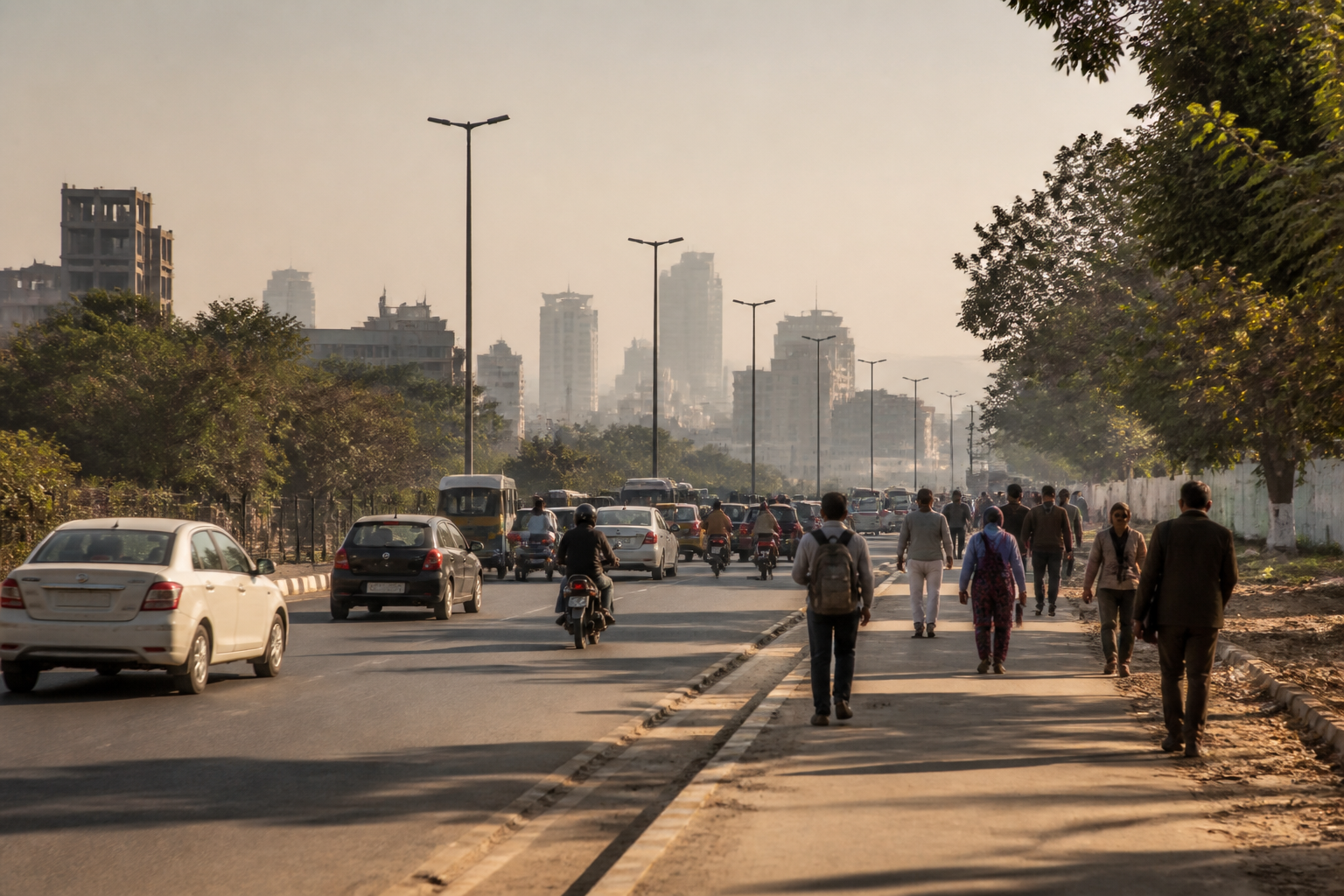
Delhi’s latest weather pattern is exposing how quickly a relatively dry transition from monsoon to autumn can become an air-quality problem. The India Meteorological Department’s forecast of clear skies and no rain for the coming week, combined with below-normal September rainfall and a sharp rise in the city’s average air-quality index, suggests that the season’s pollution build-up may begin earlier than residents expect.
The immediate forecast is not unusual in itself. The capital has entered a drier phase, with strong sunshine keeping daytime temperatures relatively high while nights become more comfortable as minimum temperatures fall slightly. But the significance of this shift lies in what happens to the air when rain stops interrupting the accumulation of dust and other pollutants.
At Safdarjung, Delhi’s standard weather observatory, the maximum temperature was recorded at 34.2 degrees Celsius, 0.5 degrees below normal. The minimum temperature stood at 22.4 degrees Celsius. The report says the city is expected to experience generally clear skies through the following week, with no significant possibility of rain.
That forecast comes after a weak September rainfall performance. Delhi received 79.6 millimetres of rain during the month, against a normal September total of 123.5 millimetres. The deficit was therefore 36 per cent. The supplied report, citing Safdarjung records, describes this as the lowest September rainfall in the past five years.
The rainfall figures show that September has become an important transition month for Delhi’s air-quality trajectory. Rain does not eliminate pollution, but it can provide temporary relief by removing some particulate matter from the air and reducing dust on roads and exposed surfaces. The Centre for Science and Environment, cited in the report, has also noted that rainfall offers only short-term relief from pollution. When the rain weakens or stops, that temporary improvement can disappear.
The city’s air-quality data already reflects the change. According to the Central Pollution Control Board, Delhi’s average AQI was 129 on Wednesday, placing it in the moderate category. The previous day, the average AQI was 71. The 58-point increase in 24 hours is significant because it demonstrates how quickly the city’s pollution conditions can worsen even before the peak winter season arrives.
The evidence does not establish that the weather alone caused the entire increase. Air quality in a large metropolitan region is shaped by several factors, including emissions and atmospheric conditions. However, the report directly links the prolonged dry spell with rising pollutant levels and dust in different parts of the capital. It also records that north-westerly winds have made the weather drier, creating conditions in which dust can be seen being lifted in some locations.
This is the central urban issue behind the forecast: Delhi’s pollution problem is not confined to winter or to a single source of emissions. It is also affected by how the city’s atmosphere, streets and exposed surfaces respond to changing weather. A dry city can generate and retain more dust, while the absence of rain removes one of the limited natural interruptions to the build-up of particulate matter.
The rainfall record supplied in the report reinforces that pattern. Delhi received 20.9 millimetres of rain in September 2020, 413.3 millimetres in 2021, 164.5 millimetres in 2022, 82.7 millimetres in 2023, 192 millimetres in 2024, 136.5 millimetres in 2025 and 79.6 millimetres in 2026. The series shows substantial year-to-year variation rather than a steady decline. That variation matters because the city’s air-quality transition can look very different depending on how much rain arrives late in the monsoon season.
The comparison with 2020 is especially relevant in the supplied account. That year’s September rainfall was lower than this year’s, at 20.9 millimetres, and the onset of pollution-heavy days in October was reported to have occurred earlier. The comparison does not prove that 2026 will follow the same path, but it provides a documented example of how a particularly dry September can precede an earlier deterioration in air quality.
The report also describes this year’s monsoon as mixed. Seasonal rainfall was reportedly above normal overall, but the monsoon arrived in Delhi five days later than usual. The city then received good rainfall during September in some periods and remained affected by the monsoon for longer, conditions that generally help moderate pollution temporarily. The second half of September, however, saw very little rain, leaving the capital increasingly dry as October began.
This distinction between seasonal rainfall and rainfall timing is important for urban administration. A city may record an adequate or above-normal total over an entire monsoon season while still experiencing poor air-quality conditions during a critical transition period. For residents, roads, construction sites and neighbourhoods, the timing of rain can matter as much as the seasonal total because dust and pollutants respond to current conditions rather than to an annual average.
The institutional chain behind the information is also spread across multiple bodies. The India Meteorological Department provides the forecast and temperature observations. The Safdarjung observatory supplies the long-term rainfall record used for comparison. The Central Pollution Control Board reports the AQI. The Centre for Science and Environment provides an interpretation of rainfall’s temporary effect on pollution. Together, these sources describe different parts of the same urban system: weather conditions, measured air quality, historical patterns and environmental analysis.
That system becomes more difficult to manage when the city moves from monsoon conditions into a dry period. The immediate responsibility for air-quality response does not rest with weather agencies alone. The supplied report does not detail any new administrative measures or emergency restrictions, so it would be premature to attribute a specific policy response to the latest AQI movement. What the evidence does show is that meteorological monitoring and pollution monitoring need to be read together rather than treated as separate public issues.
For Delhi’s residents, the practical effect is a shift from rain-related discomfort to heat, dust and worsening air. Daytime conditions are expected to remain warm because of strong sunshine, while nights may be more pleasant because minimum temperatures are likely to decline slightly. This combination can make the weather feel more comfortable after sunset even as air-quality conditions deteriorate. Comfortable nights, therefore, should not be read as evidence that the broader environmental conditions are improving.
The data also cautions against treating a single day’s AQI as a complete account of the season. Wednesday’s reading of 129 followed Tuesday’s 71, showing considerable short-term movement. The rainfall series similarly shows that September totals can vary sharply from one year to another. The stronger conclusion is not that one forecast determines Delhi’s entire autumn, but that the city has entered a period in which dry weather can increase the likelihood of rising pollution and dust.
The larger urban question is whether Delhi’s seasonal planning is sufficiently connected across weather forecasting, air-quality surveillance and ground-level management of dust. The supplied material does not provide evidence on road-dust controls, construction compliance, transport emissions or industrial sources, and those issues cannot be assessed from this report alone. It does, however, establish the environmental conditions under which those sources may become more visible in the city’s air.
What is confirmed is that Delhi began October with a dry forecast, a 36 per cent September rainfall deficit, an AQI increase from 71 to 129 in one day and a recorded September rainfall total of 79.6 millimetres. The immediate forecast points to another week without rain. The developments that now warrant close monitoring are the next rainfall event, daily AQI movement and whether the early-October pollution increase persists as the city moves further into the dry season.

