


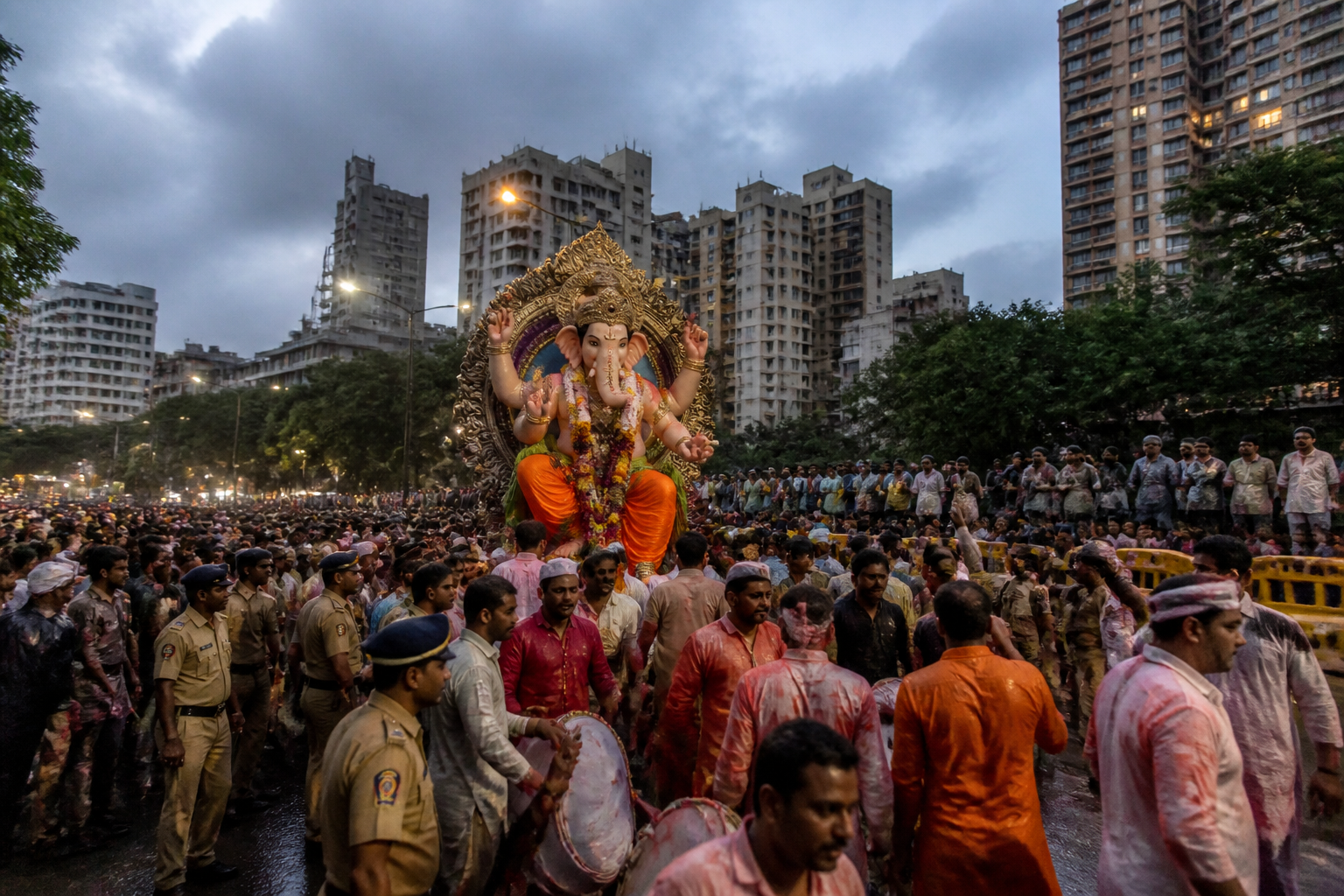
Mumbai’s Ganesh Visarjan processions continued for more than 24 hours after Anant Chaturdashi, with the Loksatta report alleging violations of Bombay High Court directions on noise and air pollution and saying police largely remained passive during the processions.
Public Ganesh mandals across the city took idols to immersion points including Girgaum, Dadar and Juhu Chowpatty after 12 days of Ganesh festival worship. The processions featured gulal, drums and other musical instruments as devotees accompanied the idols for immersion and called for Ganapati to return the following year.
The report said the processions continued through the day and night, with loud use of banned instruments and DJs at some locations. It also said firecrackers and gulal were used during several processions. These activities brought renewed attention to the difficulty of enforcing pollution-control restrictions during large public festivals involving thousands of participants and multiple routes across Mumbai.
Mumbai has approximately 12,000 public Ganesh mandals, according to the report. Most of the mandals traditionally take their idols to immersion points on Anant Chaturdashi with drums, firecrackers and coloured powder. The scale of the celebrations places substantial operational demands on the police, civic authorities and agencies responsible for managing roads, crowds, traffic and immersion sites.
The report linked the latest events to Bombay High Court directions aimed at preventing noise and air pollution during Ganeshotsav and other religious festivals and processions. According to the report, the court had ordered restrictions on firecrackers in public places and on roads, as well as bans on DJs, loud instruments, laser lights and beams during such events.
The enforcement of those directions had been closely watched before Anant Chaturdashi because the processions move through densely populated neighbourhoods and remain active for extended periods. The Loksatta report said that, despite the alleged violation of the court’s directions, police personnel largely adopted the role of observers rather than taking effective action.
The report did not provide a consolidated account of the number of violations recorded, penalties imposed, sound-level readings or enforcement action taken against individual mandals. It also did not specify whether the police or civic authorities issued a formal response after the processions concluded. Those details will be important for assessing how the court’s restrictions were implemented across the city.
The completion of the immersion processions marks the end of the festival’s principal public celebrations, but the reported enforcement concerns remain relevant to Mumbai’s management of large gatherings. The next official account from the police and civic authorities is expected to clarify the action taken during the processions and whether any cases or penalties were recorded for violations of the court directions.
