


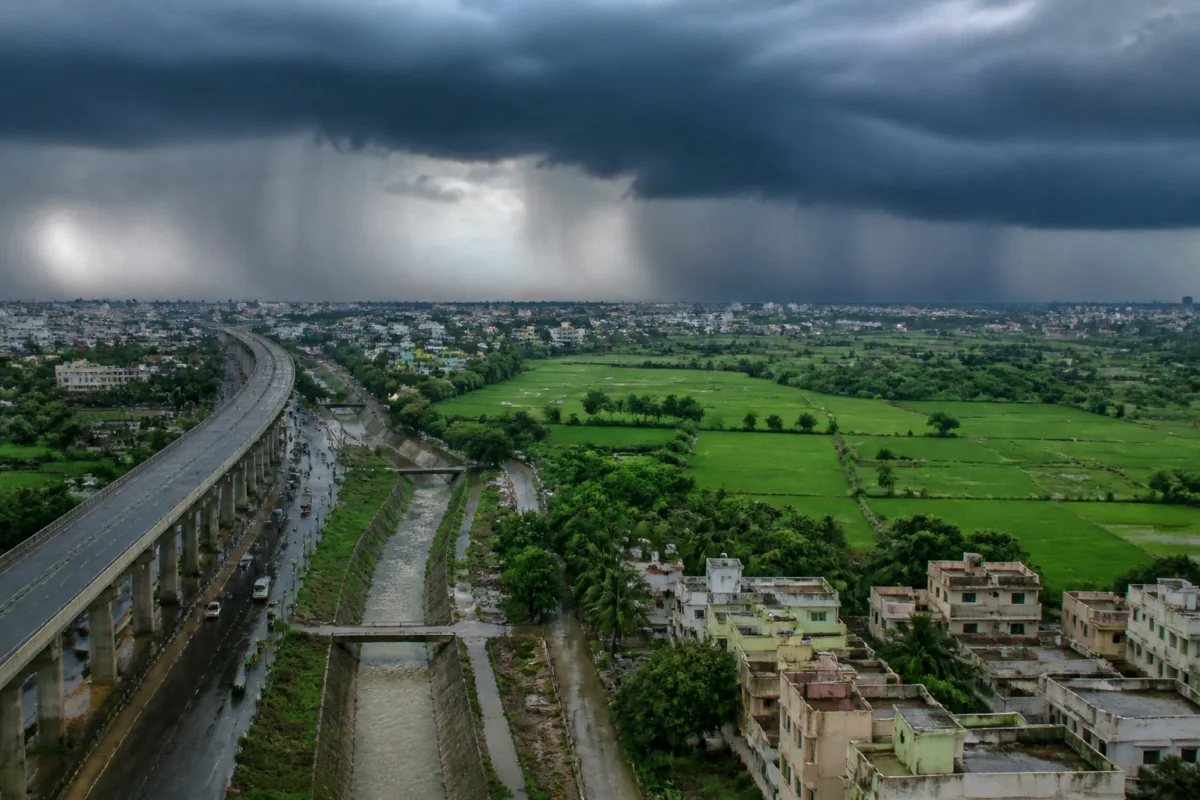
The arrival of the monsoon is often treated as a date on a calendar: the first rains appear, the season is declared, and public agencies begin acting on that signal. A new study by the Indian Institute of Technology Madras and Gauhati University argues that this approach can miss a crucial distinction. Rainfall at a location may begin before the larger monsoon system has actually established itself there.
Published in the Journal of Climate, the study proposes a climate-network method to distinguish transient local rain spells from the arrival of a large-scale monsoon system. Its central idea is straightforward but important: the first rain experienced at a location is not necessarily the point at which the monsoon has arrived in a durable, interconnected sense.
The researchers define large-scale onset as the point when rainfall at a location becomes part of the largest interconnected cluster of rainfall onsets across India. In this framework, a local shower is not automatically treated as evidence that the monsoon has established itself. Instead, the method examines whether that rainfall is connected to a wider pattern spreading through the country.
That distinction matters because rainfall is not only a weather event. It is also an operating signal for agriculture, water resources and flood preparedness. Decisions on sowing, water storage and emergency planning depend on understanding whether rain is an isolated occurrence or part of a broader seasonal transition. The study does not replace conventional monsoon definitions, but offers a way to complement them with information about the structure and continuity of rainfall.
The research team included Prof R.I. Sujith, Head of the Centre of Excellence for Studying Critical Transitions in Complex Systems at IIT Madras, and Prof B.N. Goswami of Gauhati University. Sujith said the monsoon’s arrival at a location is “not necessarily the first rainfall experienced there”. Goswami said the proposed method was intended to complement, rather than replace, conventional operational definitions.
The study’s analytical shift is from individual rainfall events to relationships between rainfall events. The researchers treated geographical locations as nodes in a climate network. They then tracked how clusters of rainfall onset grew and moved across India. A local onset becomes more meaningful in this model when it is embedded in the largest connected cluster, indicating that it belongs to the wider monsoon system rather than being caused by a temporary local weather event.
This is a different way of reading the same physical phenomenon. Conventional observation can focus on when rain crosses a local threshold. The climate-network approach asks whether that rainfall is linked to a larger pattern. The difference is particularly relevant in a country where a spell of rain can be followed by a pause, and where local weather conditions may not reflect the behaviour of the broader monsoon system.
The study used 84 years of rainfall data, giving the researchers a long historical basis for identifying climatological patterns. Their findings indicate that large-scale onset occurs, on average, around May 15 over northeast India and June 9 over the Indian peninsula. These dates describe the climatological timing of the interconnected rainfall pattern identified by the researchers; they are not presented as a replacement for operational declarations in any particular year.
The geographical distinction is significant. Northeast India and the Indian peninsula experience the large-scale onset at different points in the seasonal progression. A single national date therefore cannot fully describe how the monsoon becomes established across different regions. The study’s network model makes that spatial progression central to the definition rather than treating each location as an isolated reporting point.
For agricultural decisions, the practical question is not simply whether rain has occurred. It is whether the rainfall pattern is sufficiently connected and established to support a decision based on the beginning of the season. The study says the method could provide useful information for sowing and food security. The supplied research account does not specify a new operational calendar for farmers, but it establishes why the distinction between early rain and large-scale onset can matter.
The same logic applies to water resources. A local shower may temporarily change conditions at one location without signalling the sustained, wider rainfall pattern needed for broader water-management decisions. By identifying when local rainfall becomes part of the largest interconnected cluster, the method could offer an additional indicator for interpreting the progression of the season.
Flood preparedness presents the other side of the problem. Early rainfall can be locally intense, but the study’s focus is not on measuring the severity of an individual storm. It is on identifying whether rainfall is connected to the wider monsoon system. That makes the method relevant as an additional layer of information for authorities assessing how seasonal rainfall is developing, while leaving the immediate assessment of local flood risk dependent on local weather and ground conditions.
For cities, the implications are indirect but important. Urban administrations must manage water, drainage and flood preparedness under conditions in which rainfall can change rapidly. A more precise distinction between a temporary local spell and a broader seasonal transition could help institutions interpret rainfall signals more carefully. The study, however, does not claim that its method by itself can forecast urban flooding or determine municipal action. Its contribution is to improve the description of monsoon establishment.
This institutional boundary is important. The researchers explicitly position the method as complementary to conventional operational definitions. That means the proposed approach is best understood as an additional analytical tool rather than a new authority for announcing the monsoon. Operational systems may continue to use their existing criteria, while climate-network information could provide further insight into how rainfall clusters are forming and connecting.
The study also highlights why the definition of an event can shape the decisions that follow. If monsoon onset is defined only as the first rainfall at a place, a temporary event may be interpreted as the start of a larger seasonal process. If onset is understood as participation in a connected rainfall system, the signal becomes more closely tied to the spatial evolution of the monsoon. Neither measure answers every planning question, but they describe different aspects of the same transition.
The 84-year dataset is central to the study’s evidence. It allows the researchers to identify climatological onset timing rather than relying on a single season. The reported dates—around May 15 for northeast India and June 9 for the Indian peninsula—show that the large-scale pattern has a regional rhythm. They also demonstrate the value of studying rainfall as a network that grows and moves, rather than as a series of disconnected local observations.
What the supplied evidence establishes is the method, its conceptual distinction, its historical dataset and its potential application areas. It does not establish that the approach has already been adopted by operational agencies, that it will replace existing monsoon declarations, or that it can predict the exact date of onset in a given year. Those questions remain separate from the study’s stated contribution.
The larger urban question is how public systems should respond when environmental processes do not conform to simple administrative signals. A rain event can be local while the monsoon is regional; a calendar date can be useful while still failing to capture the system’s structure. By connecting rainfall onset across locations, the IIT Madras–Gauhati University study offers a way to make that complexity visible.
The research therefore matters less as a new monsoon date than as a new framework for interpreting arrival. It confirms that the first rainfall and the establishment of the larger monsoon system are not always the same event. Its next significance will depend on how such network-based information is evaluated alongside conventional definitions and whether agencies find it useful for decisions involving sowing, water resources, food security and flood preparedness.

