


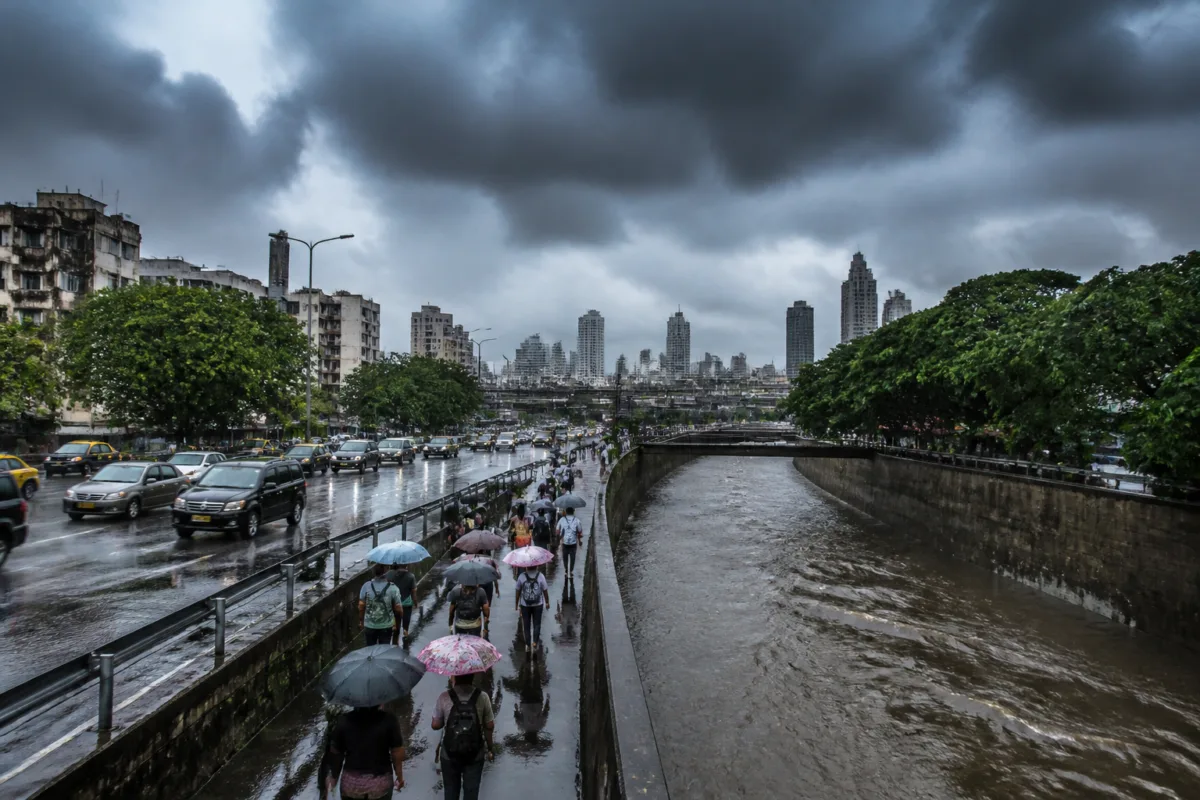
A new monsoon onset study by researchers at IIT-Madras and Gauhati University could give Indian cities and farming regions a more reliable way to distinguish the establishment of the rainy season from isolated showers. That distinction matters for flood preparedness, water-resource management, food security and decisions that depend on when rainfall becomes persistent across a wider region.
Published in the Journal of Climate, a peer-reviewed journal of the American Meteorological Society, the study uses 84 years of rainfall data and a climate-network method to track how rainfall onset develops across locations. Rather than treating the first rain at a place as proof that the monsoon has arrived, the method looks for the point at which local rainfall becomes part of a large, interconnected monsoon system.
That shift addresses a familiar planning problem. The first showers can be brief and localised, while the established monsoon is a broader and more sustained system. For farmers, acting on an isolated early spell can carry risks for sowing. For cities and water agencies, mistaking a transient event for the beginning of the monsoon can complicate preparedness for heavy rainfall, reservoir management and drainage operations. The study does not claim to replace existing operational definitions; its authors say it is intended to complement them.
The research treats geographical locations as nodes in a climate network. Links represent spatial connections between locations experiencing rainfall onset. Researchers then tracked the growth and movement of rainfall-onset clusters to identify when rainfall at a particular location became part of the larger monsoon system.
Prof RI Sujith of IIT-Madras, who heads the Centre of Excellence for Studying Critical Transitions in Complex Systems, said the approach could provide farmers with more reliable sowing information and assist policymakers with food-security and water-resource management. He said the key insight was that monsoon arrival at a location is not necessarily the first rainfall experienced there.
Under the study’s definition, large-scale onset occurs when a location’s local rainfall onset becomes part of the largest, planetary-scale cluster of interconnected rainfall onsets. The researchers found that the largest cluster undergoes an abrupt increase in size, followed by continued spatial growth and northward progression across India. This pattern is intended to identify the organisation of the monsoon rather than a short-lived rainfall episode.
The study estimated that large-scale monsoon onset occurs climatologically around May 15 over the northeast and June 9 over the Indian peninsula. These dates describe the long-term pattern identified in the dataset, not a fixed annual schedule for every location. The distinction is important because planning systems need both a broad seasonal signal and local information about how rainfall is developing.
The researchers also linked the peninsula’s large-scale onset to the northward propagation of rainfall associated with the first pulse of the monsoon intraseasonal oscillation, or MISO. In the study’s interpretation, that progression indicates the establishment of the monsoon rather than a transient rainfall event.
Using the method, the researchers identified June 22 this year as the large-scale monsoon onset date over the Indian peninsula. They said the subsequent northward progression was reflected in heavy rainfall in Mumbai by June 24 and in Delhi by July 1. The supplied study account does not establish that the method itself caused changes in flood management or agricultural decisions during those events; it presents them as part of the observed progression.
For urban authorities, the significance lies in the possibility of connecting weather information more closely to the way municipal systems operate. Flood planning is rarely based only on whether rain has started. It depends on how rainfall is expected to evolve, whether catchments are receiving rain simultaneously, how drainage networks are responding and how water resources are being managed. A method that distinguishes local showers from the wider establishment of the monsoon could provide another layer of information for those decisions, although the study account does not specify an operational protocol for municipal agencies.
The same distinction applies to water management. A first shower does not necessarily signal a stable inflow pattern into reservoirs or a dependable seasonal supply. By tracking the growth of rainfall-onset clusters, the climate-network approach places local observations within a larger geographical pattern. That can help frame the difference between an isolated weather event and a monsoon system that is progressing across regions, while leaving final operational decisions to the relevant authorities.
The research also has implications for the relationship between regional climate science and local planning. Conventional onset definitions remain in use, and B N Goswami of Gauhati University said the new method was designed to complement rather than replace them. Its contribution is to link local observations to the larger-scale organisation of the monsoon and identify large-scale onset at different locations.
That institutional distinction is important. A research method can improve the interpretation of climate data without automatically becoming an official warning system or changing the responsibilities of meteorological, municipal, agricultural or water agencies. The supplied findings establish the method, the historical dataset and the researchers’ interpretation of onset. They do not establish whether governments have adopted it, how it would be integrated into operational forecasts or whether it has been tested across all planning applications.
The evidence nevertheless identifies a clear planning challenge: the timing of rainfall is not simply a local, one-day observation. The study’s 84-year dataset and its focus on cluster growth present monsoon onset as a spatially connected process. The reported climatological dates—around May 15 in the northeast and June 9 over the peninsula—provide broad reference points, while the 2026 onset date identified for the peninsula and the later rainfall progression towards Mumbai and Delhi illustrate how the researchers applied the method.
For cities, the larger question is whether seasonal planning can move beyond fixed assumptions about when the monsoon has begun. Urban flood preparedness, water management and food systems operate across administrative boundaries, while rainfall systems do not stop at municipal limits. The study’s network approach is relevant because it examines those connections directly. At the same time, the available evidence does not show how the method performs against existing operational systems in real-time decision-making or whether it improves outcomes on the ground.
What the study confirms is that the first rainfall at a location and the sustained, large-scale establishment of the monsoon are not necessarily the same event. By using rainfall connections across geographical locations and analysing 84 years of data, the researchers offer a framework that could support more informed farming, water and flood planning. The developments that require monitoring are whether meteorological and public agencies adopt the approach, how it is tested operationally, and whether it produces measurable improvements in preparedness and resource management.

