


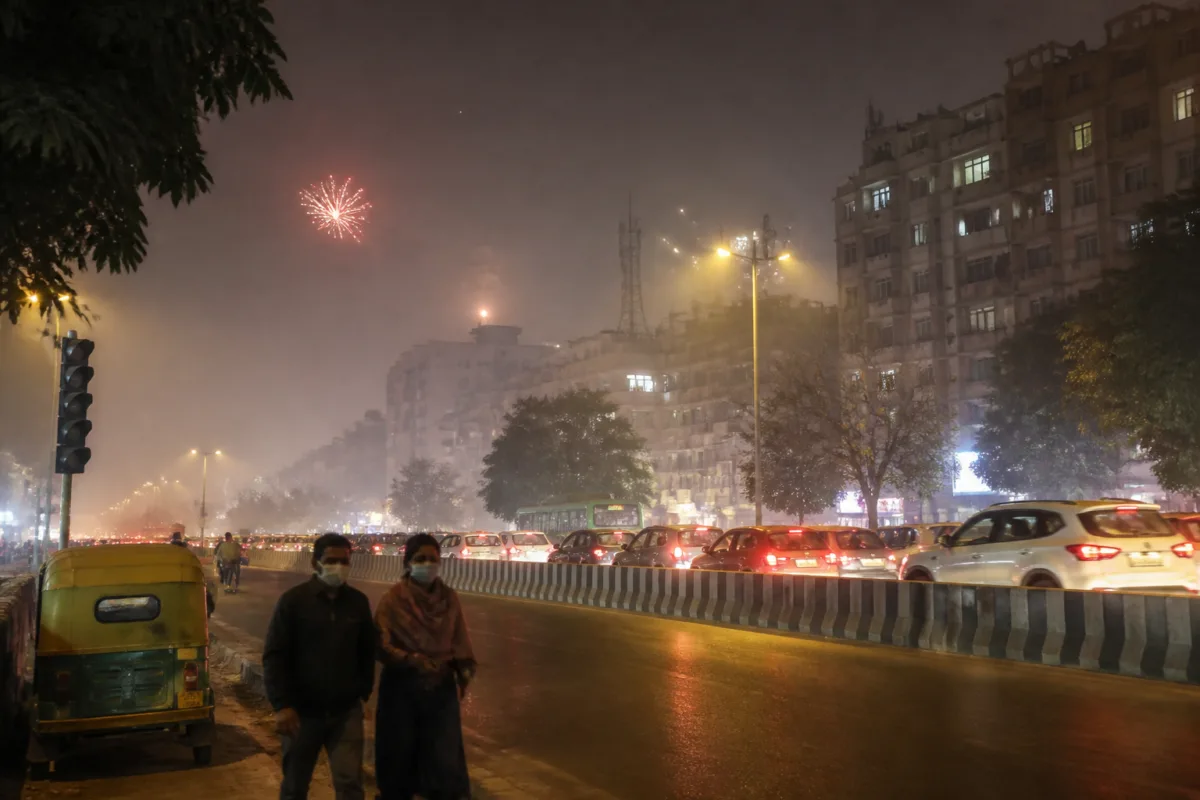
Delhi’s Diwali pollution crisis was not defined only by extreme particulate concentrations. It also exposed a second urban failure: the city’s air-quality monitoring network did not provide a complete record during the hours when pollution was at its worst. Most missing readings from Delhi Pollution Control Committee monitoring stations were later updated, but some data remained unavailable, while readings from Central Pollution Control Board stations were still missing, according to a report by Millennium Post citing Press Trust of India.
The revised data showed pollution levels far beyond prescribed limits at several locations. At RK Puram, PM2.5 reached 2,389 micrograms per cubic metre at midnight, against the prescribed limit of 60 micrograms per cubic metre. PM10 at the same station rose to 2,881 micrograms per cubic metre, compared with the prescribed limit of 100 micrograms per cubic metre.
These figures matter because the two pollutants do not represent an abstract technical problem. PM2.5 consists of fine particles that can penetrate deep into the lungs and enter the bloodstream. PM10 includes larger inhalable particles. When both rise sharply during a period of intense firecracker use, the monitoring system becomes the basic public record of the exposure faced by residents. If that record is incomplete, the city’s understanding of the event is incomplete as well.
The reported gaps were concentrated around the period when firecracker use was at its peak. An analysis of hourly PM2.5 data from Delhi’s 59 monitoring stations found that only one station was not reporting readings at 7 pm on Sunday. By 1 am on Monday, the number of stations not reporting had risen to 36, leaving data available from only 23 stations.
That pattern changes the meaning of an air-quality reading. A single station can show how pollution behaved at one location, but it cannot by itself establish how the entire city experienced a pollution episode. Delhi contains neighbourhoods with different traffic levels, building densities, open spaces, road conditions and local emission sources. A monitoring network is therefore not merely a collection of instruments; it is the infrastructure through which a city converts dispersed exposure into public information.
The updated station data showed that the most severe concentrations were not confined to one part of the capital. At Anand Vihar, PM10 peaked at 3,490 micrograms per cubic metre at 2 am on Monday, while PM2.5 reached 1,670 micrograms per cubic metre around the same time. At Ashok Vihar, PM10 rose to 3,425 micrograms per cubic metre at 2 am and PM2.5 reached 2,589 micrograms per cubic metre around 2 am.
The Commonwealth Sports Complex station recorded a PM10 peak of 2,928 micrograms per cubic metre at 5 am, while PM2.5 reached 2,471 micrograms per cubic metre at 4 am. Dwarka Sector 8 recorded a PM10 peak of 2,196 micrograms per cubic metre at midnight, with PM2.5 reaching 1,996 micrograms per cubic metre at 6 am.
These readings suggest that the pollution episode persisted across several hours and locations rather than appearing as an isolated spike. However, the supplied report does not establish whether all stations used identical instruments, whether the missing data resulted from technical failure, connectivity problems, power interruptions, maintenance issues or another cause. That uncertainty is important because it limits what can be concluded about the monitoring system itself.
The data revision at some stations offers one partial remedy but does not eliminate the institutional problem. Ashok Vihar, which had earlier shown four hours of missing data, later displayed readings for that period. The Commonwealth Sports Complex station, which had shown nine hours of missing data, also reported updated values. Dwarka Sector 8, initially showing eight hours of missing data, later showed only one hour unavailable around 8 am on Monday in the revised PM10 readings.
Yet the record remained incomplete. One hour of PM10 data at RK Puram was still missing on Diwali night. The report also said that CPCB data for the night remained unavailable. Manoj Kumar, an analyst at the Centre for Research on Energy and Clean Air, said the CPCB data had still not been released at the time of reporting.
This distinction between delayed data and permanently missing data is central to public accountability. Delayed readings can eventually improve the historical record, but they do not help residents, hospitals, schools or enforcement agencies respond during the exposure itself. Real-time pollution information is used to understand whether restrictions are working, whether outdoor activity should be limited and whether emergency measures are necessary. A later correction serves a different purpose: documenting what happened after the immediate risk has passed.
The episode also exposes the difference between pollution control and pollution measurement. The report described the Diwali night as Delhi’s most polluted in five years and said firecracker restrictions were widely flouted. That indicates a breakdown in enforcement, but enforcement cannot be assessed fully without a dependable record of where and when pollution peaked. If the data disappears during the critical hours, it becomes harder to evaluate the timing and geographic reach of the episode.
Responsibility is distributed across institutions. The DPCC operates monitoring stations within Delhi, while the CPCB maintains its own network and publishes national-level air-quality information. The report’s reference to missing data from both systems raises questions about coordination, disclosure and public communication. It does not, however, identify the specific operational cause of the outages or assign responsibility for them.
The structure of the monitoring network also matters. The report refers to 59 stations in the analysis of hourly PM2.5 data, but the number of stations reporting at a given moment changed sharply through the night. This means that the city’s headline air-quality picture may be based on a changing sample. A citywide average calculated from fewer active stations may not be directly comparable with one calculated from a fuller network unless the method and limitations are clearly explained.
For residents, the consequence is practical rather than statistical. People need to know whether conditions near their homes, workplaces, schools and hospitals are deteriorating. A station several kilometres away may not capture local conditions created by traffic, construction dust, street-level burning or concentrated firecracker use. The more uneven the coverage becomes, the less useful a citywide number may be for neighbourhood-level decisions.
The available evidence confirms two simultaneous facts. First, several Delhi monitoring stations recorded extraordinarily high PM2.5 and PM10 concentrations during the early hours after Diwali celebrations. Second, the public record of that episode was incomplete while the pollution was unfolding and remained partly incomplete even after revisions. The supplied material does not establish why the data gaps occurred, whether they affected official AQI calculations, or how authorities responded operationally.
Those unresolved questions should remain part of the post-Diwali review. The next stage is not only to examine the pollution readings, but also to document station uptime, data-recovery procedures, CPCB and DPCC publication timelines, and the reasons for the missing observations. Without that institutional record, Delhi can measure the scale of a pollution emergency after the fact while still lacking a fully reliable account of what residents were exposed to in real time.

