


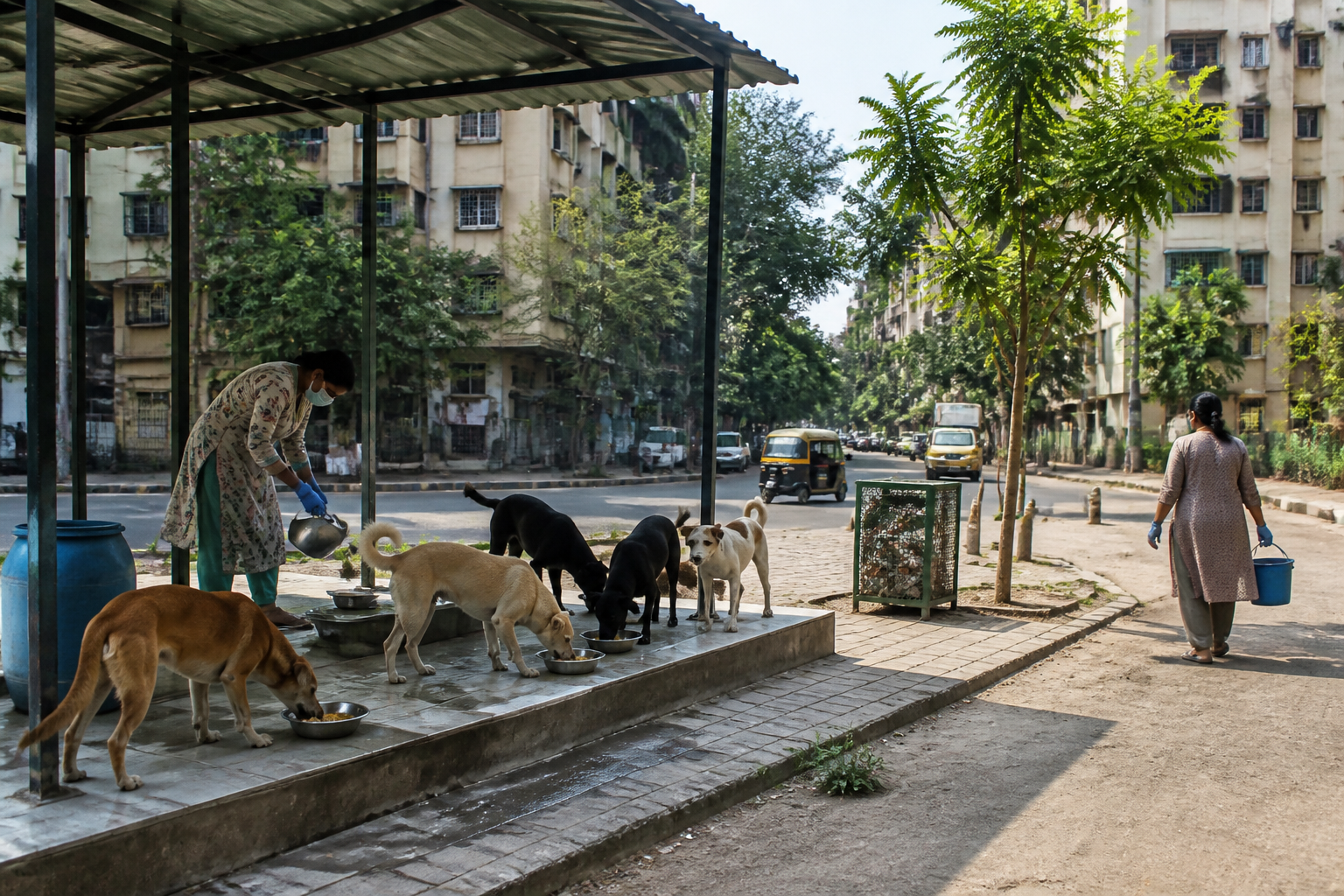
Mira-Bhayandar’s decision to impose a fine of up to Rs 5,000 for feeding stray dogs outside designated centres has brought a larger municipal question into focus: can regulating one part of the stray-dog system improve public safety when sterilisation, vaccination, sanitation and monitoring remain uneven?
The measure was introduced in response to complaints about unclean public spaces, inconvenience to residents and disputes between citizens and animal lovers. The Mira-Bhayandar Municipal Corporation has established 30 feeding centres across the city. However, animal-welfare organisations cited in the report argue that the centres are insufficient for the number of dogs and the size of the areas in which they move. Dogs generally remain within a familiar territory, making it difficult to take them to a feeding centre located far from that area.
That gap is central to the debate. A feeding restriction can be enforced only when residents have a practical alternative. If a locality has no nearby centre, people who feed dogs there may either continue feeding in unofficial locations or stop feeding altogether. The municipal decision therefore raises two linked questions: whether the designated network is geographically adequate, and whether the corporation has the capacity to maintain those sites properly.
The report says leftover food, including chicken, eggs and other meat products, is not always removed promptly at some centres. Residents have complained of foul odours and increased movement of flies, mosquitoes and rats. This creates a contradiction in the policy. Centres intended to reduce conflict and improve cleanliness can themselves become sources of waste and nuisance if food collection and cleaning are not carried out regularly.
For the policy to function as an urban-management system rather than simply a penalty regime, the corporation would need to connect the location of feeding centres with the distribution of dogs, establish clear cleaning responsibilities and ensure that waste is removed on a predictable schedule. The supplied report does not establish that such a system is already operating consistently. It instead points to a basic implementation problem: the decision to regulate feeding has advanced faster than the supporting arrangements required to make regulation workable.
The more consequential measure is sterilisation. Between January and August 2026, 2,701 dogs were sterilised in Mira-Bhayandar, according to figures cited in the report. During the same period, 1,009 cats were sterilised. The report also states that more than 100,000 dogs have undergone sterilisation in the city over approximately two decades.
Those numbers describe activity, but they do not by themselves establish effectiveness. A count of completed procedures cannot show whether the dog population is declining, whether coverage is concentrated in particular neighbourhoods or whether dogs are being sterilised at a rate that corresponds to population growth. The report calls for the corporation to publish more granular information: the number of dogs in different areas, the number sterilised in those areas, and the resulting changes in population.
This distinction between output and outcome is important in any municipal programme. The number of operations performed is an operational indicator. The number of dogs sterilised as a share of the local population, the continuity of the programme and the change in dog numbers are measures of whether the intervention is producing the intended result. Without location-specific information, residents cannot easily assess whether the programme is addressing the areas where conflict and bites are most frequent.
Operational continuity is another concern. The municipal sterilisation centre at Uttan is reported to have remained closed intermittently. The centre performs more than 30 sterilisation surgeries a day and keeps dogs there for five to seven days after surgery before returning them to their original areas. When such a facility stops functioning, the effect is not limited to a missed day of work. It interrupts the capture, treatment, recovery and release cycle on which the programme depends.
The corporation has decided to establish another sterilisation centre at Uttan because of the rising dog population, but the report says a site is still being sought. This leaves a transition problem: the existing centre has reportedly faced interruptions while the proposed additional facility is not yet available. The centre is primarily operated through a contractor, and disputes between the administration and the contractor have reportedly led to repeated closures.
The issue is therefore also one of institutional responsibility. Contracting may be the chosen delivery model, but a contractor dispute cannot by itself suspend a service connected to public safety. The report argues that the administration must arrange an alternative so that sterilisation continues. Whether the corporation has a contingency plan, and how it measures contractor performance, are not established in the supplied material. They are nevertheless central questions raised by the reported interruptions.
The report also refers to complaints of irregularities in sterilisation work, allegedly involving collusion between officials and a contractor. The state animal husbandry department has ordered an inquiry into the functioning of the municipal veterinary department and asked for a report. That inquiry is significant because it could clarify how many dogs actually underwent surgery, how much was spent and what results followed. Until those facts are established, the allegations remain complaints under examination rather than proven findings.
Public safety provides the clearest measure of the system’s current pressure. Between January and August 2026, 1,705 people in Mira-Bhayandar reportedly suffered dog bites. Over eight months, that works out to an average of about seven incidents a day. The figure does not, on its own, explain the causes of the bites or identify which interventions failed. It does show why the discussion cannot be confined to the legality of feeding in public places.
A useful municipal response would require the bite data to be mapped against dog populations, sterilisation coverage and vaccination activity. The report specifically raises the need for ward-level information on where bites occur, how many dogs have been sterilised in those areas and how many have been vaccinated. It also calls for year-on-year comparisons. Without this information, the corporation and residents are left with an overall incident figure but limited ability to identify patterns or judge whether resources are reaching the highest-risk locations.
The feeding-centre dispute also reflects a conflict between two legitimate administrative objectives. Residents want cleaner public spaces and greater protection from dog bites. Animal lovers want feeding to continue and may regard restrictions as harmful if they are not accompanied by humane management. The report says local animal-welfare organisations oppose the fine and are preparing to challenge it in court. That means the policy may become a legal and administrative contest unless the corporation can demonstrate that its designated system is accessible, clean and connected to sterilisation and vaccination work.
The central problem is that these functions are often treated as separate activities. Feeding regulation is handled through a penalty. Sterilisation is measured through surgery counts. Cleaning is treated as a maintenance task. Dog bites are recorded as incidents. Yet the city’s experience, as presented in the report, suggests that they form one interconnected management system. A feeding centre affects cleanliness and where people interact with dogs. Sterilisation affects population control. Vaccination affects public-health protection. Bite data should help determine where interventions are prioritised. A breakdown in one part can weaken the others.
The available figures also expose the limits of judging performance by scale alone. More than 100,000 sterilisation procedures over two decades sounds substantial, as do 2,701 procedures in eight months. But the persistence of dog-bite incidents, continuing complaints and reported centre closures indicates that the city needs outcome-based evaluation. The supplied material does not provide a current dog-population estimate, area-wise sterilisation coverage, vaccination totals or a time series of bite incidents. Without those figures, it is not possible to determine whether the programme is improving, stagnating or losing ground.
That uncertainty should shape the next stage of the policy. The corporation’s stated or reported actions include maintaining designated feeding centres, adding another sterilisation facility at Uttan and responding to the inquiry ordered by the state animal husbandry department. The quality of implementation will depend on whether those steps are supported by transparent records and uninterrupted operations. The reported decision to impose a fine may be immediate, but the system needed to make it effective is still being tested.
Mira-Bhayandar’s stray-dog policy therefore represents more than a disagreement over a Rs 5,000 penalty. It is a test of whether an urban local body can coordinate enforcement with infrastructure, contracted services, sanitation, veterinary care and public-health reporting. The evidence in the supplied report confirms the scale of the administrative challenge, but it does not yet establish whether the municipality’s interventions are reducing dog numbers or bite incidents. The next developments to monitor are the state inquiry, the continuity of sterilisation at Uttan, the search for an additional centre, the maintenance of the 30 feeding centres and the publication of area-wise data.
