


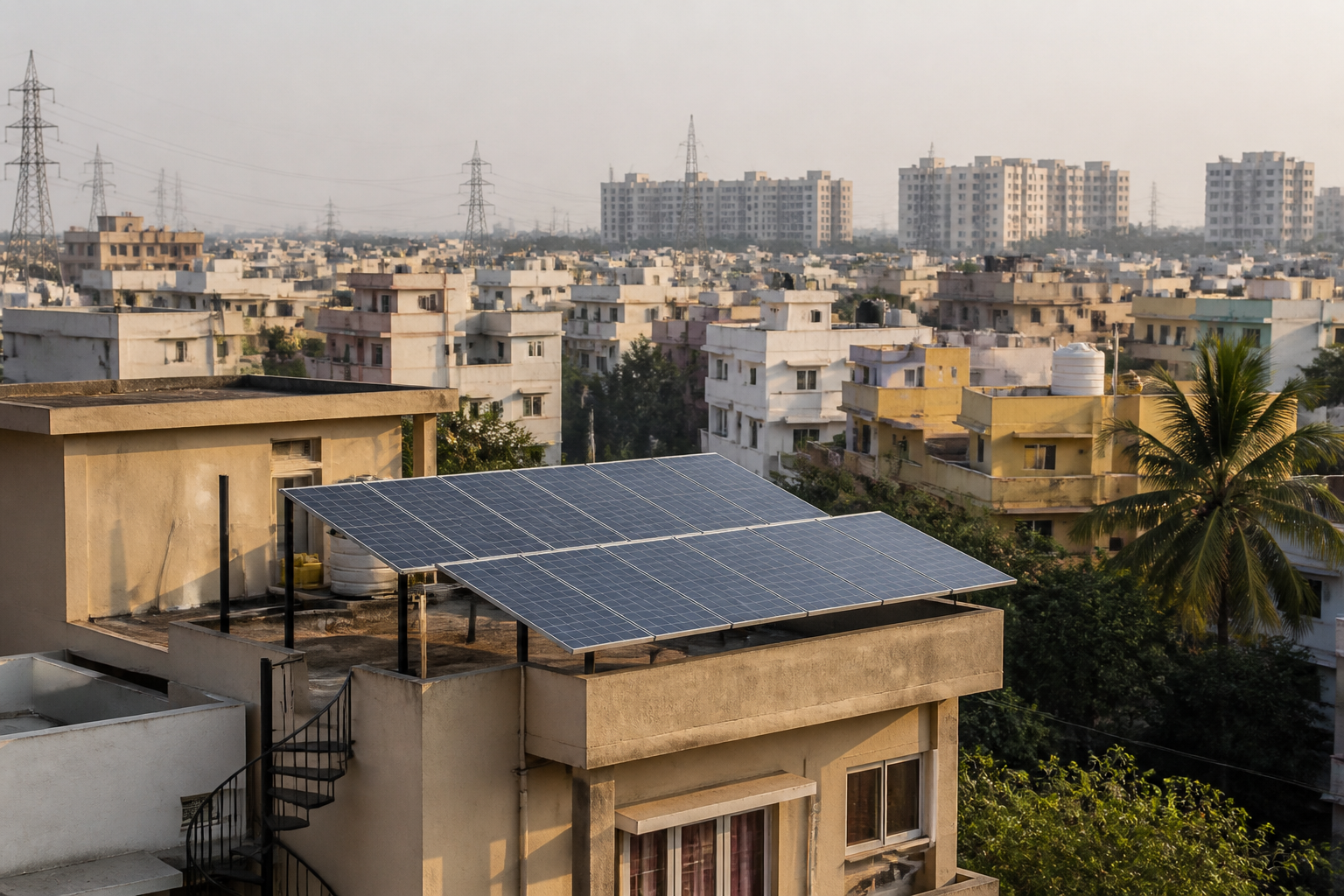
State-level subsidy differences are reshaping the household economics of PM Surya Ghar, India’s rooftop-solar programme. The central scheme offers up to ₹78,000 for a 3-kilowatt system, while additional support reported by Aaj Tak Business ranges from ₹17,000 in Rajasthan to ₹45,000 for eligible low-income households in Jharkhand. The result is a programme whose appeal depends not only on the national subsidy, but also on where a household lives and how its state government structures additional assistance.
The reported figures place rooftop solar within a wider urban question: how can electricity infrastructure move from a centralised model towards one in which homes also become small power-generating units? PM Surya Ghar is designed around that transition. Households with a grid-connected electricity connection can install panels on their roofs, use the generated electricity and seek subsidy support after installation and verification by the distribution company, or DISCOM.
The scheme was launched in 2024, according to the supplied report, with a target of reaching one crore households by 2027. Government figures cited by Aaj Tak Business indicate that more than 50 lakh homes had been covered and around 19 lakh households had reported electricity bills falling to zero. These figures describe the scale of the programme, but they also show that enrolment, installation and the experience of receiving lower bills are not necessarily the same stage of adoption.
That distinction matters. A household may register interest in rooftop solar, receive an approval, install a system or complete DISCOM verification at different points in the process. The report groups these outcomes under the broader success of the programme, but the figures do not explain how many applications are pending, how many systems are operational, how quickly subsidies are released or how electricity savings vary between households. Those details are central to understanding the programme’s performance, but they are not established in the supplied material.
The national subsidy is structured around system capacity. For a 3-kilowatt rooftop-solar installation, the central assistance is reported at up to ₹78,000. States can add support. Uttar Pradesh is reported to provide an additional ₹30,000 for a 3-kilowatt system, taking the combined assistance to ₹1.08 lakh. Delhi is reported to offer the same additional amount. In Jharkhand, low-income families are reported to receive ₹15,000 per kilowatt, or ₹45,000 for a 3-kilowatt system, producing total assistance of ₹1.23 lakh when combined with the central subsidy.
The reported arrangements in Rajasthan and Bihar are different. Rajasthan is described as providing an additional ₹17,000 alongside the central assistance. Bihar is reported to offer ₹10,000 per kilowatt, subject to a maximum of ₹20,000. On the figures given, the total support in Bihar can reach ₹98,000 for an eligible household. These differences mean that the same rooftop-solar system can have a substantially different upfront cost depending on the state, household category and applicable subsidy ceiling.
This is more than a comparison of promotional benefits. It shows how India’s rooftop-solar transition is being administered through multiple layers of government. The central government establishes the national framework and subsidy, while states determine whether to add their own support and which households should receive it. DISCOMs then remain involved in technical feasibility, installation-related processes, verification and the connection between the rooftop system and the electricity grid.
That institutional structure creates both opportunity and complexity. A national programme can establish a common platform and make rooftop solar visible to households across the country. State-level assistance can respond to local affordability concerns or policy priorities. But a household must still navigate several administrative steps: selecting the state and electricity distribution company on the official portal, entering consumer and contact details, seeking feasibility approval, choosing a registered vendor and completing installation followed by DISCOM verification.
The application process reported by Aaj Tak Business begins on the PM Surya Ghar portal. Applicants select the rooftop-solar application option, identify their state and DISCOM, and submit their electricity consumer number, mobile number and email address. After logging in with the consumer number and mobile number, the applicant proceeds with the rooftop-solar application. The report states that feasibility approval is required before installation by a vendor registered with the DISCOM.
These requirements underline a central feature of the scheme: the subsidy is not simply a cash benefit available before any technical assessment. Eligibility depends on a grid-connected household, sufficient roof space and completion of the installation and verification process. The report states that subsidy processing follows installation and DISCOM verification. For households, this makes the sequence of approvals, vendor selection and inspection as important as the headline subsidy amount.
The roof itself is therefore part of the infrastructure system. The programme is aimed at homes, but its implementation depends on the physical condition and availability of rooftops, the capacity of local distribution networks and the ability of vendors and DISCOMs to process applications. The supplied source does not provide data on roof suitability, vendor capacity, local transformer constraints or the time taken at each stage. It consequently cannot establish whether administrative or technical capacity is keeping pace with demand.
The promise of 300 units of free electricity is another area requiring careful interpretation. The source presents the scheme as a way for households to reduce or potentially eliminate electricity bills after installing rooftop solar. However, a zero bill is not an automatic outcome for every household. Actual savings depend on system capacity, electricity consumption, solar generation, household usage patterns, applicable billing rules and the successful operation of the connection. The supplied report does not provide a standardised calculation showing how a particular household reaches zero billing.
That limitation is important for public communication. The phrase “300 units free” is easy to understand, but the practical financial outcome depends on the relationship between energy generated, energy consumed and electricity supplied through the grid. A household that uses more electricity than its rooftop system produces may continue to receive a bill. A household with lower consumption may see a larger reduction, provided the system performs as expected and the relevant accounting process is completed.
The reported state differences also raise an equity question. Jharkhand’s additional support is described as being targeted at low-income families, while the figures for Uttar Pradesh, Delhi, Rajasthan and Bihar are presented as broader state-level assistance. The source does not specify the full eligibility conditions, income definitions, application limits or whether all households can claim the maximum amounts. Without those details, the headline comparison should be treated as an indication of reported assistance rather than a universal price chart for every applicant.
For cities, the programme’s significance lies in how it connects housing with energy infrastructure. Rooftop solar depends on private residential space, yet its benefits and constraints are shaped by public systems: electricity regulation, DISCOM procedures, subsidy budgets and grid management. It also introduces a new role for residents. They are not only electricity consumers but potential producers whose homes participate in the wider power network.
The programme’s scale target makes execution particularly important. A target of one crore households by 2027 requires more than awareness. It requires accessible applications, adequate registered vendors, timely technical approvals, reliable installation quality, effective verification and predictable subsidy disbursal. The supplied material confirms the target and reports substantial participation, but it does not provide a full implementation scorecard. The next stage of scrutiny therefore has to distinguish between registrations, completed installations, verified systems and households receiving the claimed financial benefit.
The central evidence available here supports three conclusions. First, PM Surya Ghar has become a significant residential infrastructure programme, with a stated national target of one crore households and reported participation exceeding 50 lakh homes. Second, the value of the subsidy varies materially between states and, in Jharkhand, between household categories. Third, the household experience depends on a chain of technical and administrative conditions rather than on the central subsidy alone.
What remains uncertain is equally important. The supplied report does not establish how many applications have reached each stage, whether the reported 19 lakh zero-bill households were verified through a common methodology, how long subsidy payments take, or how the programme performs across different housing types and electricity-consumption levels. It also does not provide the official notifications governing each state’s additional assistance. Those documents would be needed to confirm the precise terms and current availability of the reported benefits.
For households considering rooftop solar, the immediate official steps remain clear in the reported process: verify eligibility, apply through the PM Surya Ghar portal, obtain feasibility approval, use a DISCOM-registered vendor and complete installation and DISCOM verification. For policymakers and urban infrastructure administrators, the larger test is whether the programme can convert a high-value subsidy promise into a consistent, verifiable and accessible service across states, income groups and housing conditions.
