


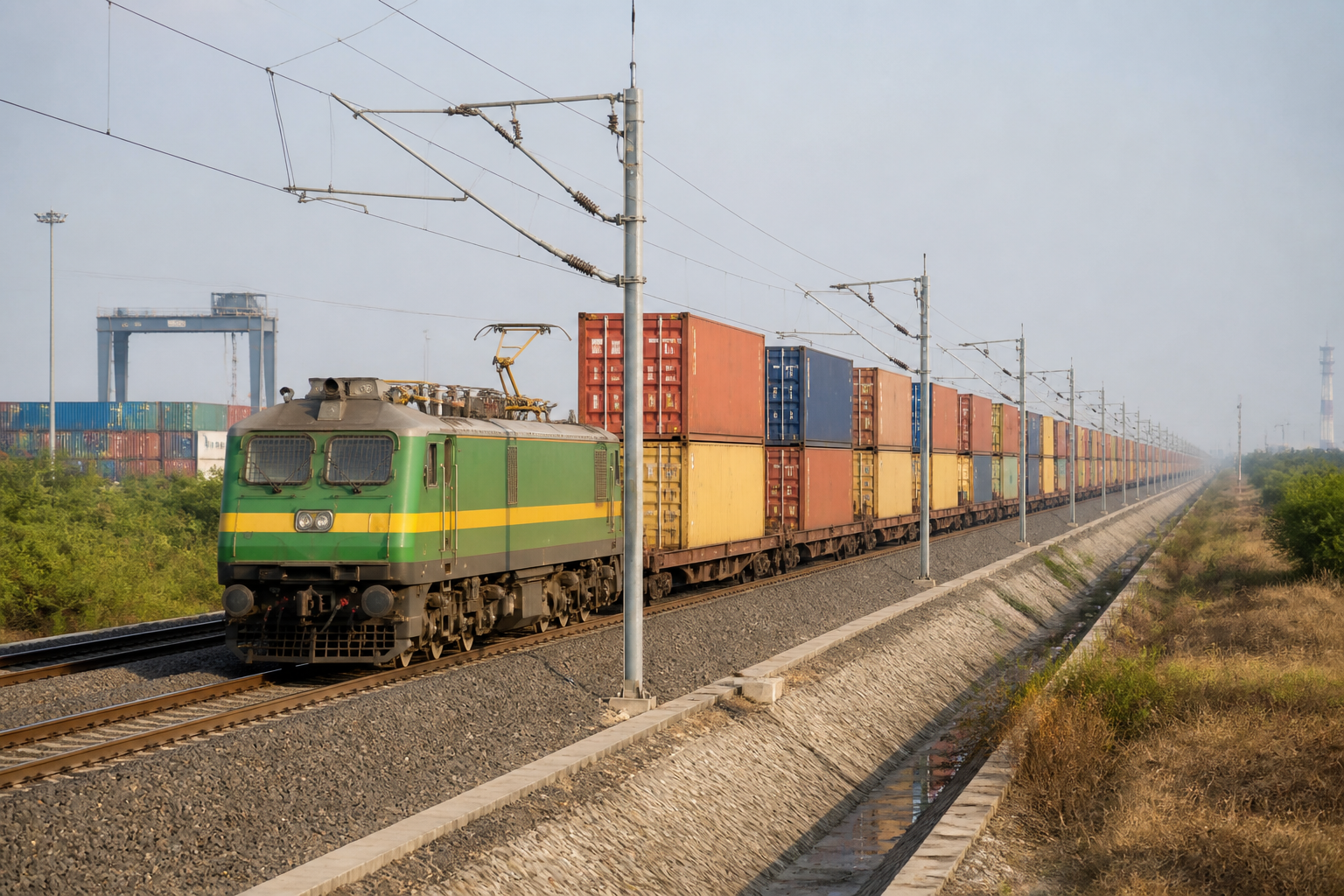
The completion of India’s Eastern and Western Dedicated Freight Corridors marks the end of a long construction phase, but not the end of the infrastructure story. The 2,843-km network is now operational across two of the country’s most important economic axes. Its larger significance will depend on whether businesses, ports, industrial clusters and logistics operators can reorganise around the faster and more predictable movement of goods.
The Dedicated Freight Corridors were created to address a structural constraint in the Indian railway system. Passenger and freight trains historically shared the same busy routes, forcing goods trains to wait for passenger services and limiting the length, weight and frequency of freight operations. The new corridors separate much of that traffic onto dedicated, high-capacity railway lines.
The Western Dedicated Freight Corridor runs 1,506 km from Dadri in Uttar Pradesh to Jawaharlal Nehru Port near Mumbai. The Eastern corridor runs 1,337 km from Ludhiana in Punjab to Sonnagar in Bihar. Together, they cross manufacturing, agricultural, mineral and consumption belts, linking inland production centres with ports and major markets.
This geography matters because logistics infrastructure does more than shorten journeys. It influences where factories can operate, how much inventory businesses must hold, how reliably exporters can meet shipping schedules and whether raw materials can move economically over long distances. The DFC network therefore represents an attempt to change the operating conditions of the wider economy, rather than simply add another railway route.
The corridors’ design is central to that ambition. They have double tracks, automatic signalling, stronger infrastructure, higher axle-load capability and the capacity to operate double-stack container trains. On the Western corridor, high-clearance overhead electrification allows containers to be placed one above another. Indian Railways estimates that the DFCs can handle more than 120 trains in each direction.
The network was carrying 443 freight trains a day when the final Western sections were inaugurated, according to the supplied report. That figure indicates that the corridors are already operating as a significant freight system. It does not, however, establish the full economic benefit. That will depend on the type of cargo moved, the reliability of terminal connections and the extent to which companies redesign their supply chains around the network.
The clearest immediate advantage is time. Container trains on the DFCs take about 2.44 hours per 100 km, compared with 5.25 hours on the conventional network, according to figures cited in the report. For coal trains, the corresponding figures are around 3.15 hours and 6.48 hours. The difference is not merely a matter of faster delivery. Predictability can be as important as speed.
A manufacturer that cannot depend on delivery schedules typically carries additional inventory to protect production. A retailer may hold more goods in warehouses because replenishment is uncertain. An exporter may move containers to a port well before a vessel’s sailing date to reduce the risk of missing the shipment. More reliable freight movement can reduce some of this safety stock and release working capital, even when the direct railway charge is only one part of the saving.
The broader logistics-cost picture explains why the corridors have attracted attention beyond the railway sector. A 2025 DPIIT-NCAER assessment cited in the report estimated India’s logistics costs at 7.97% of GDP in 2023-24. It placed rail logistics costs at about Rs 1.96 per tonne-km, compared with Rs 11.03 for road. Those figures do not mean every shipment can shift from road to rail. Small, high-value or time-sensitive consignments will continue to depend on roads and air freight. The advantage is strongest for heavy and long-distance cargo.
The Western corridor is particularly important for India’s export geography. It connects the northern manufacturing belt with Jawaharlal Nehru Port and the western port system. Dadri, an inland logistics centre, handled more than 1.7 lakh TEUs of exports in 2025-26, including garments, food products, tractor parts, tyres, auto components and furniture, according to the report. It also handled more than 1.5 lakh TEUs of imports.
A dependable rail connection means an industrial unit does not necessarily need to be located close to a seaport to participate in export supply chains. Northern factories can remain closer to labour, land and existing industrial ecosystems while gaining a more reliable route to maritime gateways. For international buyers, consistent delivery windows can be more valuable than a small reduction in the freight bill because production and shipping schedules depend on reliability.
This could gradually influence India’s manufacturing map. Industrial activity has often concentrated near ports, metropolitan markets and established transport corridors because long-distance movement of inputs and finished products was expensive or uncertain. The DFCs weaken part of that constraint. If logistics parks, freight terminals and industrial corridors develop around the routes, smaller industrial towns could gain better access to national and international markets.
That outcome is not automatic. A railway line alone cannot create a complete supply chain. Factories require warehouses, customs and freight-handling facilities, road links, reliable power, labour and access to customers. The economic effect of the DFCs will therefore depend on how effectively the corridors connect with inland container depots, ports, ordinary railway lines and first- and last-mile road networks.
The Eastern corridor has a different economic role. It reaches the mineral and energy belt and connects it with industrial centres in the north. Coal, steel, cement, fertiliser and other bulk commodities depend heavily on rail. A dedicated heavy-haul network can allow larger loads to move without being held up by passenger traffic, reducing the cost of transporting raw materials across hundreds of kilometres.
The resulting benefit may appear in industries far removed from the railway’s own accounts. Lower transport costs for coal can affect power generation. Cheaper movement of inputs can influence steel and cement costs, which in turn can affect construction and infrastructure. The DFC’s economic value therefore cannot be measured only by freight revenue. Part of its potential lies in lowering the cost structure of sectors that use the network.
Agriculture offers another test. Food grains, fertilisers and other agricultural commodities already move by rail between production and consumption regions. Faster and more predictable freight can reduce one layer of friction in those supply chains. It cannot, by itself, solve food inflation, which is also shaped by weather, crop yields, storage capacity and global commodity prices. Its contribution will depend on integration with warehouses, cold chains, agricultural markets and road-based distribution.
The DFCs may also create capacity outside their own tracks. Moving freight onto dedicated lines can release space on conventional railway routes for additional passenger services and for freight that is not suited to the new corridors. The network could also shift some long-distance bulk and container traffic away from highways, reducing pressure on road infrastructure if rail becomes sufficiently competitive for shippers.
The environmental case follows the same modal-shift logic. The corridors are electrified, reducing dependence on diesel for long-distance freight operations. An official Indian Railways assessment cited in the report estimates that the two corridors could save about 457 million tonnes of carbon dioxide emissions over 30 years. The scale of that benefit will depend on actual utilisation and on the extent to which freight moves from road to rail.
Early private-sector use provides an indication of how this transition could develop. Amazon began operating a daily service on the Western DFC in August, linking its logistics network across Delhi, Ahmedabad and Surat with onward connections towards Pune, Mumbai and Goa, according to the report. One service does not establish a national trend, but it illustrates the type of commercial integration required for the corridors to become part of regular supply-chain planning.
The central question is therefore not whether India has built dedicated freight infrastructure. It has. The question is whether businesses will treat the DFCs as the backbone of redesigned supply chains or merely as an additional transport option. The difference will determine whether the network produces only faster train journeys or a wider reduction in inventory, congestion and industrial logistics costs.
The corridors also show the limits of infrastructure-led economic transformation. They address congestion along selected freight axes, but they do not solve every weakness in India’s logistics system. First- and last-mile connections, terminal capacity, warehousing, road access and coordination among railway, port and industrial authorities remain essential. The physical network creates capacity; institutions and businesses must convert that capacity into dependable service.
What the evidence establishes is that the DFCs have created a faster, heavier and more predictable rail option across major economic routes. They can support exports from inland manufacturing centres, reduce the cost of bulk commodities, release capacity on conventional railway lines and potentially draw freight away from roads. What remains uncertain is the scale and distribution of those gains.
The next phase will be measured through utilisation, terminal connectivity, private-sector adoption and the emergence of industrial activity around the corridors. The construction milestone is complete. The more consequential test is whether India’s ports, factories, markets and logistics operators can use the network well enough to change the economics of moving goods across the country.

