


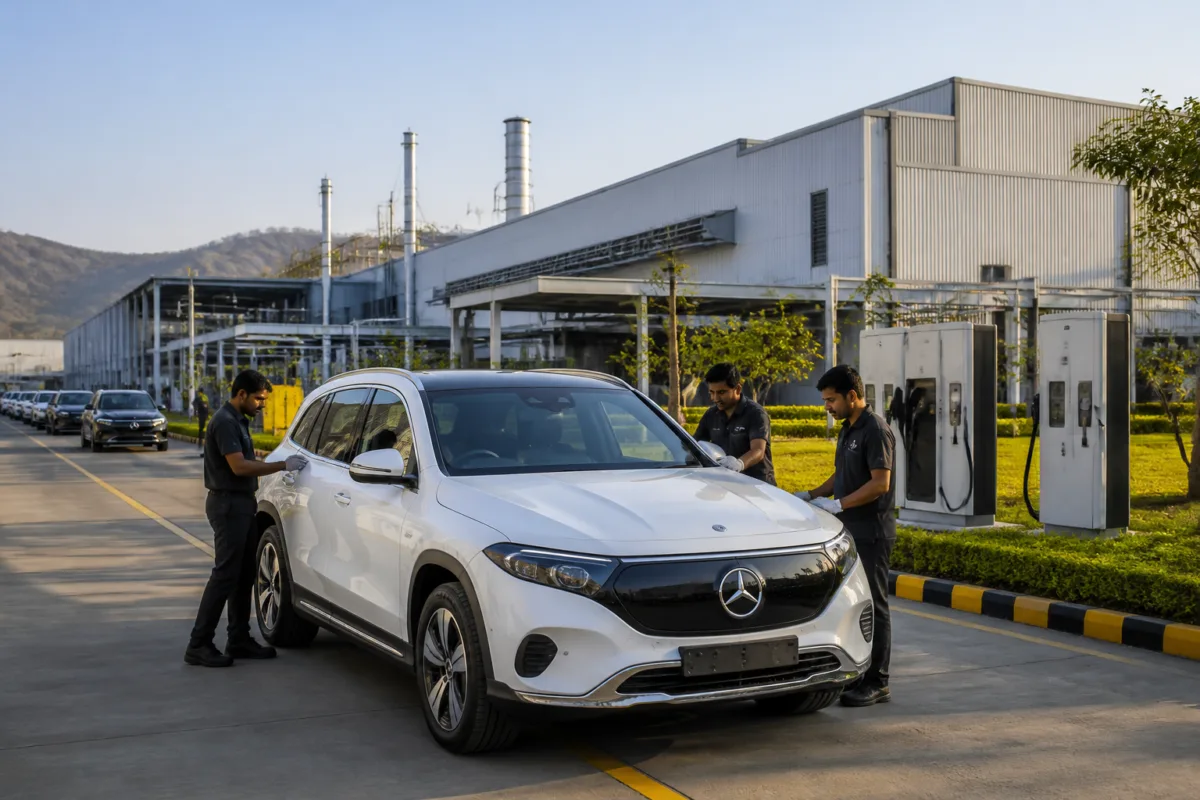
Mercedes-Benz has signalled that India could eventually become a global manufacturing and export hub for the luxury carmaker, although the company has not yet decided to export fully built vehicles from the country. The immediate opportunity, global chief Ola Källenius said, lies in expanding component exports, technology sourcing and engineering operations from India.
Källenius, chairman of the board of management of Mercedes-Benz Group AG, made the remarks at a media roundtable at the company’s Chakan plant near Pune on Wednesday. He said India’s growing luxury-car market, supplier ecosystem and engineering capabilities could support a larger manufacturing role in the future.
“I think it is more a question of when, as opposed to a question of if. But I want to make clear, we have not made such a decision at this point in time,” Källenius said, according to Business Standard.
His comments followed an invitation from Maharashtra Chief Minister Devendra Fadnavis for Mercedes-Benz to use the state not only as a manufacturing base for the Indian market, but also for developing technologies and producing vehicles for global markets. Fadnavis urged the company to consider investments in next-generation battery technologies, automotive artificial intelligence, electronics and software.
Mercedes-Benz has previously used the Chakan plant for limited exports. In 2018, it shipped small quantities of the locally manufactured GLC SUV to the United States as a backup arrangement to meet demand. The facility has otherwise remained primarily focused on the Indian market.
The company’s India sales have strengthened alongside the renewed export discussion. Mercedes-Benz sold 5,422 vehicles in India between July and September 2026, a 6 per cent increase year-on-year and a 17 per cent rise sequentially. Sales during the first nine months of the year rose 8 per cent to a record 15,190 units.
India’s luxury-car market remains small compared with the wider passenger-vehicle market. The country sells around 5 million passenger vehicles annually, while premium and luxury vehicles account for just over 1 per cent of sales, or approximately 60,000 vehicles. Mercedes-Benz sells around 20,000 vehicles a year, giving it roughly one-third of that segment.
Källenius said a larger domestic market, combined with suitable product and price positioning, could eventually justify expanded local manufacturing. Before that, India could take on a larger role in the company’s worldwide supply chain. “We can, if you will, export out of India on a component basis before you ask a question on a full vehicle,” he said.
Mercedes-Benz’s February 2026 global strategy presentation identified regional sourcing and service hubs, together with greater use of trade agreements, as priorities for overseas markets including India. Källenius said a proposed India-European Union free trade agreement could improve the economics of cross-border sourcing and manufacturing by reducing trade friction.
The company’s technology base is also expanding. Mercedes-Benz Research and Development India is its largest research and development centre outside Germany, with Indian teams working across mechanical engineering, electronics, powertrains, software and artificial intelligence. Källenius said the Indian operation was increasingly working on an equal footing with engineering centres in Germany and other locations.
Mercedes-Benz India Managing Director and Chief Executive Officer Santosh Iyer said the company’s cumulative investment in India had reached ₹3,200 crore. This included ₹200 crore invested in 2026 for manufacturing operations, new product introductions and digitisation. The company has sold more than 240,000 vehicles in India since beginning operations, with most produced locally at Chakan.
The plant has also begun producing the electric GLC 400 4MATIC, priced at ₹78.50 lakh ex-showroom. The model has a claimed range of up to 711 km, with deliveries scheduled to begin in mid-November. Mercedes-Benz said it received more than 550 expressions of interest within the first 36 hours of opening registrations, while Källenius cited around 1,000 pre-orders for an electric model before customers knew its price.
Källenius expects electric vehicles to account for about 20 per cent of Mercedes-Benz India’s sales in 2027, compared with a high-single-digit share expected this year. The company plans to offer an electric alternative across every meaningful passenger-vehicle segment by the end of the decade, while continuing to sell vehicles with combustion engines for several years.
The next confirmed milestones are the start of electric GLC deliveries in mid-November and the company’s continuing expansion of local manufacturing, supplier and engineering operations. A decision on exporting fully built vehicles from India has not yet been announced.

