


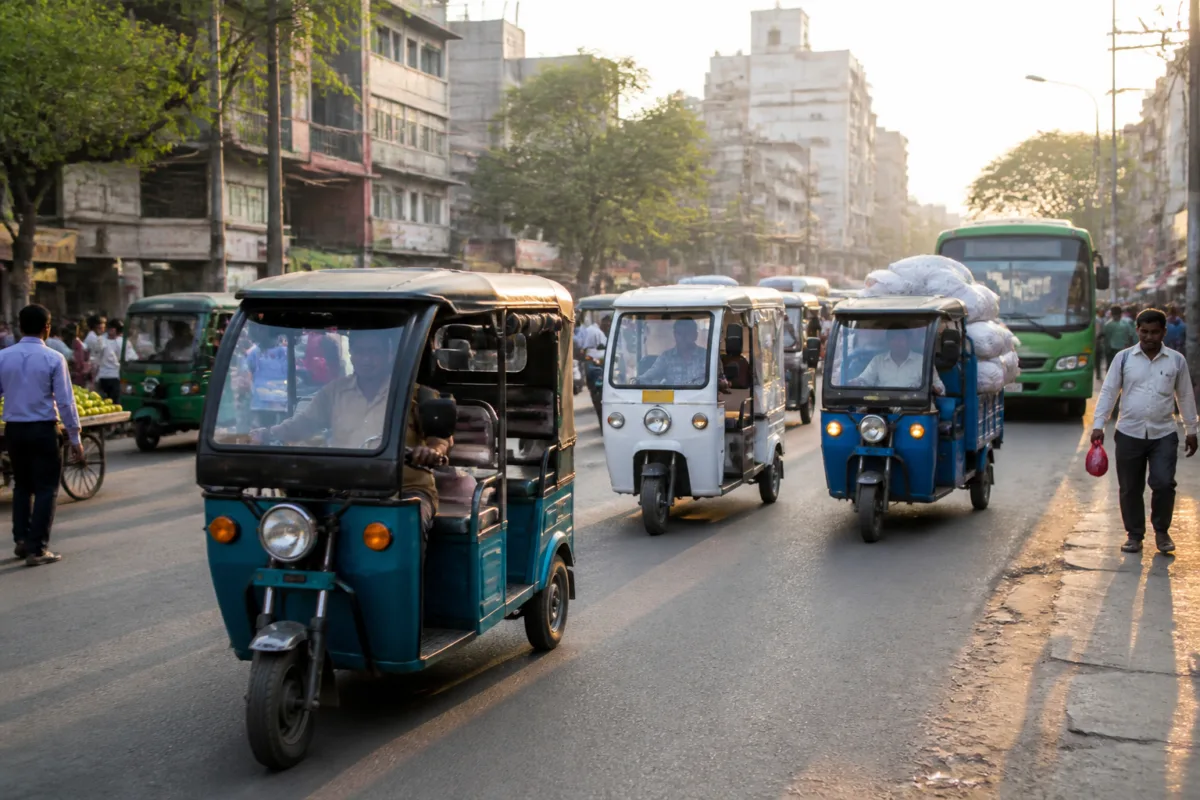
India’s electric three-wheeler market is growing rapidly, but the latest registration data shows that electrification is not benefiting manufacturers evenly. Between January and October 2026, registrations rose 85.4 per cent to 3,44,157 units from 1,85,627 a year earlier. Within that expansion, Bajaj Auto overtook Mahindra Last Mile Mobility, TVS Motor accelerated sharply, and several smaller or established manufacturers lost ground.
The shift matters because electric three-wheelers are closely connected to the everyday functioning of Indian cities. They serve passenger routes, last-mile connections and cargo movement, linking residential areas with markets, transit stations and employment centres. Registration growth therefore reflects more than a competition between vehicle brands. It indicates a widening commercial market in which manufacturers are being tested on product availability, distribution, financing, operating economics and their ability to respond to different urban transport needs.
The most visible change is the reversal between Bajaj and Mahindra. Bajaj’s electric three-wheeler registrations increased 85.2 per cent to 1,17,234 units during January–October 2026, compared with 63,306 in the same period a year earlier. Mahindra’s registrations rose 58.3 per cent to 1,11,146 units from 70,200. Bajaj consequently moved from a deficit of 6,894 vehicles against Mahindra last year to a lead of 6,088 vehicles in the latest period.
The numbers show that Bajaj’s lead was not created by a collapse in the overall market or by a sharp contraction at Mahindra. Both companies increased their volumes. The difference was their pace of growth: Bajaj broadly matched the industry’s expansion, while Mahindra grew more slowly. In a rapidly expanding market, that gap was enough to change the ranking.
The shift was also visible in the financial year. During the first half of FY27, from April to September 2026, overall electric three-wheeler registrations nearly doubled to 2,23,964 units from 1,13,605 a year earlier, a 97.1 per cent increase. Bajaj registered 75,886 vehicles, up 91.6 per cent, while Mahindra registered 73,666, up 73.4 per cent. The difference was narrower than the January–October gap, but it established the direction of the change before the full-period numbers were recorded.
October reinforced the trend. Industry registrations increased 86 per cent to 48,755 units. Bajaj led with 15,188 vehicles, an 86.4 per cent increase, while Mahindra recorded 14,443 units, up 32.7 per cent. The monthly figures suggest that Mahindra’s slower growth was not limited to the accumulated January–October comparison. However, the supplied data does not establish whether the divergence resulted from product mix, production capacity, pricing, financing, geographic concentration, fleet relationships or other operational factors.
TVS Motor represents the other important part of the market’s restructuring. Its January–October registrations jumped 145.7 per cent to 38,664 units from 15,739. During the first half of FY27, TVS more than doubled its registrations to 25,330 units. In October, it registered 5,067 vehicles, up 69.7 per cent from a year earlier.
TVS remains behind Bajaj and Mahindra in absolute registrations, but its growth rate is substantially higher. This distinction is important in a market where the total pool is expanding quickly. A company does not need to displace the largest manufacturers immediately to change the competitive structure; sustained growth at a faster rate can steadily increase its share and strengthen its position among dealers, fleet operators and commercial drivers.
The data also shows that market expansion is not lifting every participant. Omega Seiki Mobility’s October registrations rose 128.4 per cent to 1,094 vehicles from 479 a year earlier. Its January–October registrations increased 50 per cent to 8,292 units from 5,526, but that was below the industry’s 85.4 per cent growth. The company’s Chairman and Founder, Uday Narang, attributed the increase to growing market readiness for electric mobility amid global uncertainty around petrol and diesel prices. He said the transition could reduce dependence on imported fossil fuels, conserve foreign exchange and help commercial operators manage running costs.
Those comments identify the operating logic behind electric three-wheelers. For commercial users, the case for electrification is tied to recurring running costs and the ability to keep vehicles in service. But the registration data also indicates that demand alone does not guarantee equal growth for manufacturers. Omega Seiki increased volumes while losing ground relative to the wider market, suggesting that the competitive test is not simply whether customers are adopting electric vehicles, but which companies can capture that adoption at scale.
Euler Motors presents a similar contrast. Its electric three-wheeler registrations rose 24.8 per cent to 4,193 units during January–October 2026 from 3,361 a year earlier. That growth was well below the industry’s 85.4 per cent increase. Its first-half FY27 registrations rose 37.7 per cent to 2,734 units, but October registrations fell 33.2 per cent to 251 units from 376.
Euler’s Founder and CEO, Saurav Kumar, said the company was seeking to consolidate its position in electric light commercial vehicles while continuing to focus on electric passenger and cargo three-wheelers. However, e-LCV registration data was unavailable at the time of filing. That limitation prevents a complete assessment of the company’s wider electric commercial vehicle performance. The available three-wheeler data shows underperformance against the overall market, but it does not by itself explain the company’s product-level or segment-level position.
The sharpest contraction among the named manufacturers appears among smaller and legacy players. TI Clean Mobility’s January–October registrations were almost unchanged at 5,426 units, compared with 5,432 a year earlier. Atul Greentech’s registrations declined 66.5 per cent to 477 units from 1,423, while Kinetic Green’s registrations fell 84.6 per cent to 95 units from 615.
This divergence creates a two-speed market. At one end are manufacturers adding large volumes as demand expands. At the other are companies whose registrations are flat or falling despite the same broad market conditions. The supplied evidence does not identify the reasons for each company’s performance, but it clearly establishes that industry growth is becoming concentrated among stronger performers and fast-growing challengers.
The institutional signal comes from the source of the numbers: Vahan registration data tracks vehicles that have entered the registration system, making it a useful measure of market uptake. It does not, on its own, provide a complete account of deliveries, vehicle utilisation, fleet profitability, charging access, battery performance or the ownership profile of buyers. Nor does it establish whether registrations translate into equal levels of passenger or cargo activity across cities.
That distinction is important for urban policy. Electric three-wheelers can support cleaner and potentially lower-cost local mobility, but their usefulness depends on how they operate within the wider transport system. Passenger vehicles may serve short urban trips and feeder journeys, while cargo three-wheelers support deliveries and market access. The registration data covers both electric passenger and cargo three-wheelers, but the supplied figures do not separate the two segments for each manufacturer.
The numbers also leave several questions open about the infrastructure and financial conditions supporting the market. The source records strong national registration growth but does not provide city-wise data, charging infrastructure counts, financing terms, subsidy details, vehicle prices or operating-cost comparisons. It is therefore possible to establish the scale and competitive direction of the market, but not to determine from this evidence alone which urban conditions are producing the strongest adoption.
What the evidence confirms is narrower but significant. Electric three-wheelers are no longer a small, static segment in registration terms: the market reached 3,44,157 units in the first ten months of 2026, compared with 1,85,627 a year earlier. Bajaj has overtaken Mahindra because its growth has kept pace with the market while Mahindra’s has not. TVS is expanding faster than both, although from a smaller base. At the same time, several companies are failing to convert broad market growth into higher registrations.
The larger urban question is whether India’s electric three-wheeler transition will produce a broad-based ecosystem or a market dominated by a small number of manufacturers. The latest Vahan data points towards a competitive shake-up, but it does not yet explain the causes or reveal how evenly the transition is reaching cities, operators and vehicle segments. Future assessments will need to track registrations alongside segment-wise demand, city-level adoption, commercial vehicle utilisation and the infrastructure that allows electric three-wheelers to operate reliably.

