


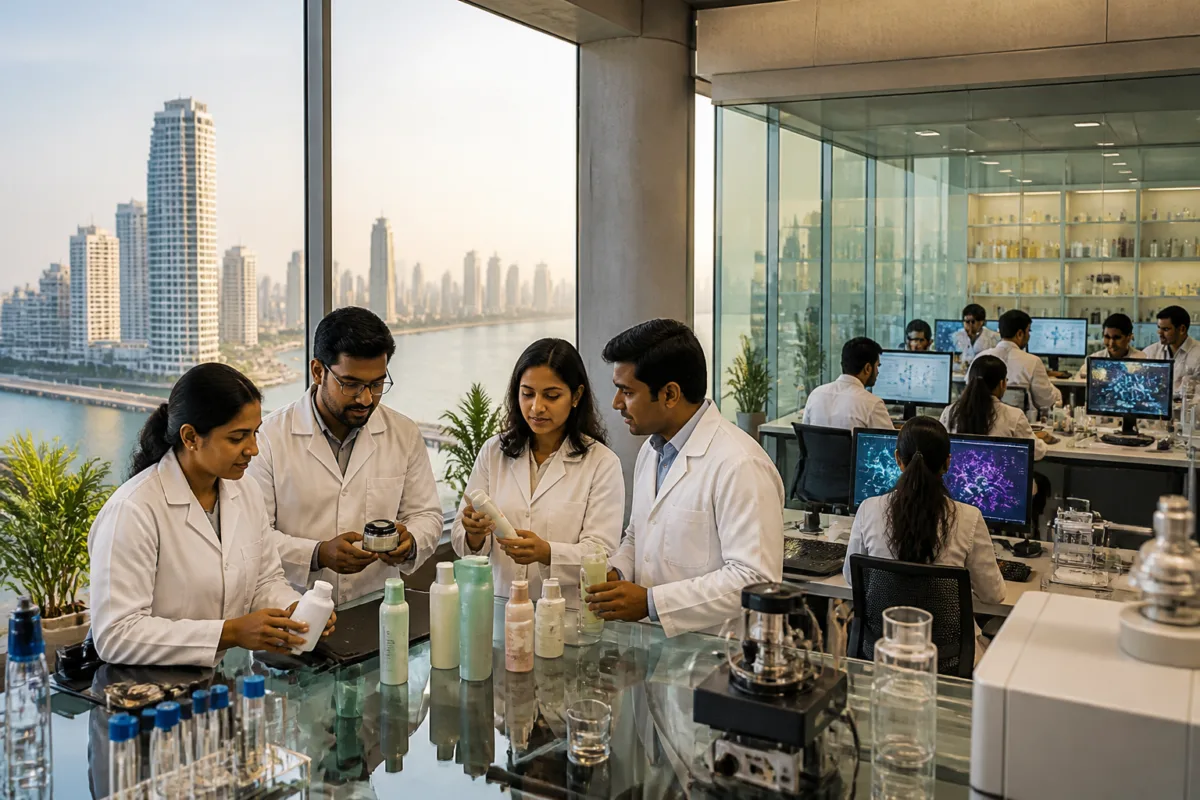
Unilever’s India R&D investment will do more than upgrade two corporate laboratories. It will deepen the role of Mumbai and Bengaluru as specialised urban centres for product science, digital experimentation, bioscience and industrial innovation, while creating new links between a global consumer company and India’s research ecosystem.
The company said it would invest an additional €35 million in its Indian research and development capabilities to transform its Mumbai and Bengaluru hubs into next-generation research and innovation centres. The announcement also includes a separate €5 million investment over five years in a Bio-Futures partnership connecting Unilever with scientific institutions, start-ups, advanced infrastructure and talent in India.
The supplied announcement does not clarify whether the €5 million Bio-Futures commitment is included within the additional €35 million or represents a separate allocation. What it does establish is the direction of the investment: Unilever wants its Indian facilities to function as integrated parts of its global R&D network, rather than as sites limited to local product adaptation.
That shift matters because advanced corporate research is increasingly organised around dense ecosystems. A modern R&D hub depends not only on laboratory space but also on specialised researchers, digital systems, testing facilities, suppliers, academic partnerships, start-ups and the ability to move an idea from experimentation to commercial scale. Unilever’s plans bring these requirements into sharp focus in two cities that already host different but complementary innovation functions.
Unilever said India is one of its largest global R&D hubs, with more than 800 scientists, researchers, digital specialists and designers. Over the past five years, the company has deployed more than €20 million in facilities and capabilities including a Liquids Lab of the Future, a Fragrance House, an Advanced Manufacturing Center for Bars, a Packaging and Flexibles Design Lab, and artificial intelligence and digital modelling platforms.
The additional investment therefore represents an expansion of an existing urban research footprint, not the creation of an entirely new one. It also indicates that corporate innovation infrastructure is being assembled through several connected layers: physical laboratories, product and packaging design, automated experimentation, software platforms and market-facing deployment.
Mumbai is expected to receive a particularly visible institutional upgrade. The existing hub will be transformed into a Product Innovation Centre bringing together AI- and digitally powered foresight, consumer insights, measurement approaches, product and format science, product and packaging design, rapid prototyping, scale-up capabilities and market-facing deployment.
The proposed centre will also create spaces for partnerships with academia, experts, suppliers, start-ups and the wider design ecosystem. This is significant for the city’s built environment because it expands the functional meaning of a corporate campus. The facility is not described simply as an office or laboratory. It is planned as a platform where research, design, supplier networks and commercial deployment operate within one connected environment.
The Mumbai centre’s proposed functions also show how urban innovation spaces are changing. The conventional separation between laboratory, design studio, testing facility and production planning is being replaced by a more integrated model. Rapid prototyping and scale-up require physical infrastructure, while AI, digital modelling and predictive systems require a parallel digital infrastructure. The announcement links both within a single centre.
Bengaluru’s role will remain different. The company said its Bengaluru centre would continue to evolve as a global science, technology and partnership hub for foundational and application science platforms, digital and AI capabilities, India foods R&D, and collaborations with academia, start-ups and Unilever’s global innovation network.
The distinction between the two locations suggests a distributed urban model rather than a single headquarters strategy. Mumbai is being positioned around product innovation, design, prototyping and market-facing deployment. Bengaluru will continue to focus on science, technology, food research, digital capabilities and partnerships. The evidence supplied does not specify new headcount, construction area or capital expenditure by city, so the physical scale of the transformation cannot yet be measured.
The Bio-Futures partnership extends the investment beyond Unilever’s internal facilities. It will focus on human biology, microbiome science, biotechnology, biomanufacturing, and digital and AI-enabled biology. These fields require access to specialised talent and research infrastructure that typically exists across multiple institutions rather than inside one company.
By proposing a platform connecting global R&D capabilities with scientific institutions, start-ups and advanced infrastructure, Unilever is describing an ecosystem approach to innovation. The company’s value from the partnership would not come only from owning new equipment. It would also come from being able to access complementary scientific capabilities and move research between institutions, corporate teams and commercial applications.
This model places new demands on the cities hosting it. R&D-led urban development depends on more than the presence of a large employer. It requires a reliable talent pipeline, institutions capable of collaboration, suppliers that can support specialised experimentation, and physical spaces that can accommodate laboratories, design work and prototyping. The announcement identifies these components, but does not provide details on the participating institutions, locations, procurement arrangements or public support involved in the partnership.
The investment also highlights the importance of corporate R&D in India’s urban economy. The company’s workforce at the two hubs includes scientists, researchers, digital specialists and designers, indicating a mix of specialised occupations rather than a single technical profile. The expansion may therefore strengthen demand for different forms of expertise across science, technology, design, data and product development, although the announcement does not provide employment projections.
For municipal and regional institutions, such facilities present a different governance challenge from conventional industrial projects. The central requirement is not only land or building approval. It is the coordination of talent, education, research, digital infrastructure, industrial suppliers and intellectual property. Unilever’s stated intention to work with academia, start-ups and experts illustrates how the city’s innovation capacity is distributed across public, private and institutional actors.
The announcement also places Bengaluru and Mumbai within the company’s global R&D network. Unilever said both Indian hubs undertake consumer understanding, product adaptation, testing, validation, scale-up and deployment, while drawing on global science and technology platforms, scientific know-how and intellectual property. This means the Indian facilities are being used across multiple stages of the innovation process, not only for final market localisation.
That is the central urban significance of the investment. Cities compete for R&D activity not merely by hosting offices, but by supporting the complete chain from knowledge creation to commercial application. Unilever’s stated plans combine science, design, AI, experimentation, manufacturing knowledge and market deployment. The extent to which this generates wider benefits will depend on the strength and openness of the partnerships that are eventually formed, details that were not provided in the announcement.
The company’s use of AI, automated and cobot-powered experimentation, predictive modelling and digital twins further changes the infrastructure profile of the two hubs. These tools are intended to help scientists and product developers test more possibilities, accelerate learning and move promising ideas towards scalable innovations more quickly. The announcement presents them as operational capabilities, although it does not provide performance benchmarks or a quantified timeline for deployment.
The available evidence therefore confirms a clear investment direction but leaves several implementation questions open. It is not yet known how the €35 million will be divided between Mumbai and Bengaluru, whether the Bio-Futures allocation is additional to that amount, how many new roles will be created, which academic or start-up partners will participate, or what physical expansion each hub will require.
Those details will determine whether the announcement remains primarily an internal corporate upgrade or becomes a broader urban innovation platform. For now, Unilever’s decision demonstrates how established global companies are using Indian cities as integrated nodes in international research networks. Mumbai and Bengaluru are not being assigned identical roles: one is being developed around product innovation and deployment, while the other continues as a science, technology and partnership hub. The next measurable milestones will be the allocation of the investment, identification of Bio-Futures partners and implementation of the planned capabilities at both sites.

