


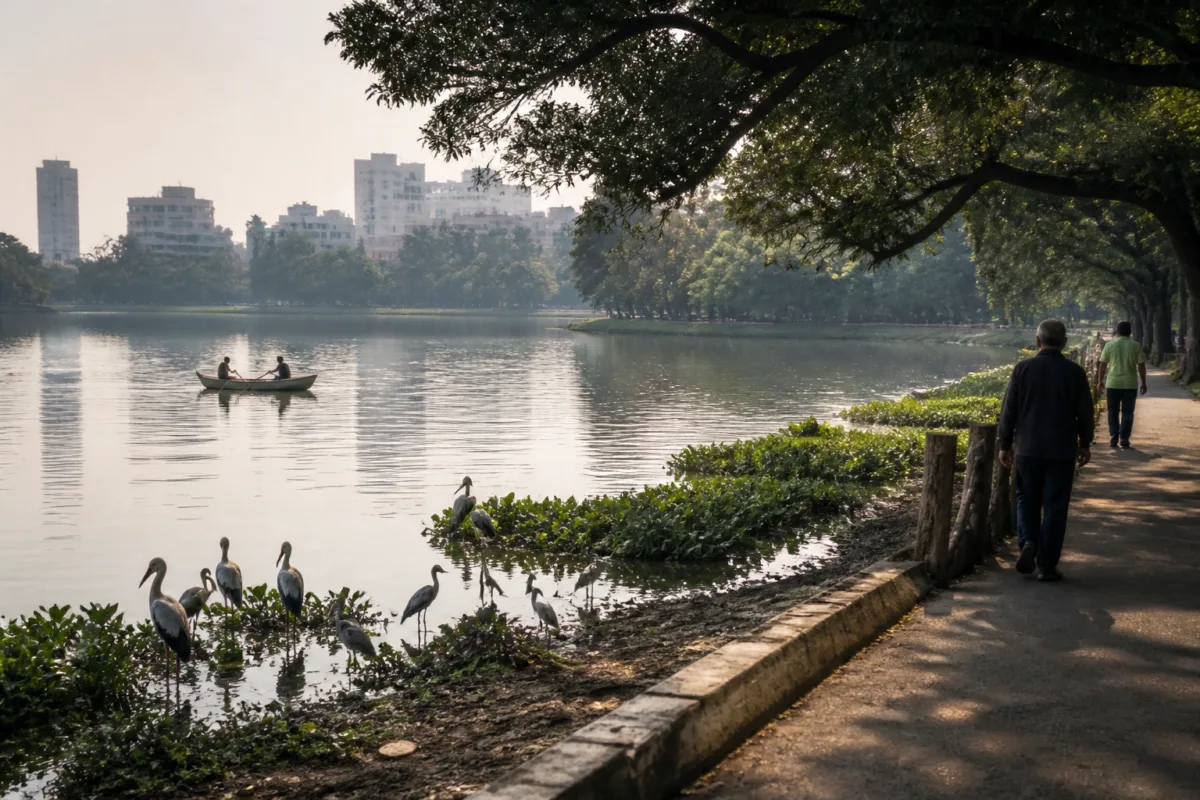
The Bengal government’s openness to allowing Chhath Puja at Rabindra Sarobar has reopened a conflict that Kolkata has not resolved: how should a city share a sensitive public lake between cultural use, everyday recreation and ecological protection? Urban development minister Agnimitra Paul has said the festival could return if adequate pollution-control precautions are put in place. Environmentalists, however, argue that the proposed permission risks colliding with restrictions upheld by the National Green Tribunal, Calcutta High Court and Supreme Court.
If permitted, the festival would return to the south Kolkata lake after six years. The Kolkata Metropolitan Development Authority imposed the ban in 2020 following an NGT order. The restrictions were intended to protect the lake from pollution linked to ritual offerings, immersion of materials and large gatherings. Rabindra Sarobar is not only a festival venue. It is used by morning walkers, rowers and nature lovers, and is regarded as one of the city’s green lungs.
That combination makes the dispute larger than a question of whether one event can be accommodated. It concerns the limits of public access in an ecologically sensitive urban space, the authority of environmental orders, and the practical ability of city agencies to enforce conditions when thousands of people gather at once.
The immediate proposal comes from the state government. Paul questioned why local devotees should be excluded from the lake and asked where residents of surrounding neighbourhoods would go to observe the festival. According to the report, she said permission would depend on precautions to prevent pollution and that an amicable solution could be found in relation to the NGT’s order.
The source does not establish that permission has been formally granted. It records the government’s willingness to consider allowing the festival under pollution-control conditions. That distinction matters because the lake’s restrictions were not created only as an administrative preference. They followed proceedings before the NGT and were subsequently upheld by the Calcutta High Court and the Supreme Court.
The legal background reaches back to 2017. The NGT’s November 3 order permitted Chhath Puja at Rabindra Sarobar for that year only. The event was held at the 73-acre lake on November 13 and 14, 2018, after which a contempt petition was filed before the tribunal’s Eastern Bench. The petition, filed by Sumita Bandyopadhyay and supported by 1,178 morning walkers, alleged that the celebrations violated the tribunal’s direction.
The petition described thousands of people gathering at the lake, offering flowers, fruits, sweets and oily substances, while crackers were burst and loud music was played. These activities are central to the environmental concern: pollution is not limited to the quantity of waste left behind. Large gatherings can also produce noise, crowd pressure and disruption around water and surrounding habitat.
The 2018 episode is important because it tests the difference between a condition written into a permission and a condition that can actually be enforced on the ground. A promise to control pollution may appear administratively sufficient, but the earlier account cited in the report indicates that crowd management and event regulation were already difficult when the festival was held at the lake.
Green technologist and environmentalist S.M. Ghosh warned that allowing the festival could amount to contempt of the NGT’s 2017 order. He recalled the previous event as a “total mess” and said the same outcome could occur again. His warning was not limited to litter or water quality. He pointed to migratory birds that have begun arriving at the lake and said large gatherings and noise could force them to relocate, with some potentially dying.
Ghosh also cited environmental thresholds for sensitive zones, saying noise should remain below 40 decibels and PM2.5 levels below 5 mg per cubic metre. The report does not provide current measurements from Rabindra Sarobar or an official assessment showing whether those thresholds could be maintained during the festival. It also records his claim that desiltation and dredging directed by the NGT have not been carried out.
Those missing measurements are central to the policy debate. A credible pollution-control plan would need to demonstrate not merely that precautions are proposed, but how they would be monitored, who would enforce them, and what would happen if conditions were breached. The supplied report does not identify such an operational plan, enforcement agency or monitoring system.
The institutional structure is already complicated. The KMDA imposed the ban, while the state urban development minister has now raised the possibility of a return under safeguards. Environmental restrictions, however, operate within a wider legal framework involving the NGT and higher courts. Any new permission would therefore have to be assessed not only as a local event-management decision but also against the orders and restrictions that shaped the existing ban.
This is a recurring problem in Indian cities: public spaces are expected to perform several functions at the same time, but the agencies responsible for those functions often work with different priorities. A lake can be a recreational asset, a cultural gathering place, a habitat and a piece of urban environmental infrastructure. When one use intensifies, the consequences are distributed across users who do not have equal influence over the decision.
For devotees, the question is access. Paul’s argument is based on the location of surrounding communities and their need for a nearby place to observe the festival. For morning walkers and environmental groups, the question is whether an established ecological restriction can be relaxed without undermining the lake’s protection. For the city, the practical issue is whether a high-footfall event can take place without repeating the pollution and crowd-control problems documented in the earlier proceedings.
The lake’s size also helps explain the stakes. Rabindra Sarobar covers 73 acres, but its area alone does not determine its capacity to absorb a festival. The relevant limits include the water body’s ecological sensitivity, the number of people entering, the materials brought into the site, noise, waste collection, access routes and the presence of birds and other wildlife. The report identifies these pressures but does not provide a carrying-capacity assessment.
The festival is scheduled for November 15 and 16 this year, according to the report. That leaves the government’s position at a consequential stage: a political and administrative willingness to consider permission has been expressed, but the exact legal and operational framework remains unstated in the supplied material.
The dispute also exposes a gap between city-level inclusion and site-level suitability. The argument that local devotees should not be excluded from a neighbourhood lake is a question of access and representation. It does not, by itself, establish that Rabindra Sarobar is suitable for a large ritual gathering. Conversely, ecological sensitivity does not eliminate the need for the city to provide practical alternatives for residents. The two questions have to be handled together, but they are not the same question.
Jawhar Sircar, a former Rajya Sabha member, described Rabindra Sarobar as an environmentally sensitive inland water body and said activities that could compromise its ecology should be restrained as much as possible. He also said environmentalists and morning walkers were likely to protest against the proposed move. His intervention indicates that any permission could trigger a further public dispute beyond the government’s stated intention.
What the evidence confirms is that Rabindra Sarobar has a documented history of conflict between festival use and ecological protection. The ban followed tribunal proceedings, the restrictions were upheld by higher courts, and the earlier festival generated allegations of pollution, excessive noise and inadequate control. What remains unclear is whether the government has developed a legally compliant, independently monitored and enforceable plan that addresses those specific failures.
The next significant development will be the government’s formal decision and the conditions attached to it, if permission is granted. The city will also need clarity on how any proposed safeguards relate to the NGT’s order, who will monitor pollution and crowds, and whether the lake’s ecological requirements—including the arrival of migratory birds—have been assessed before the November festival dates.

