


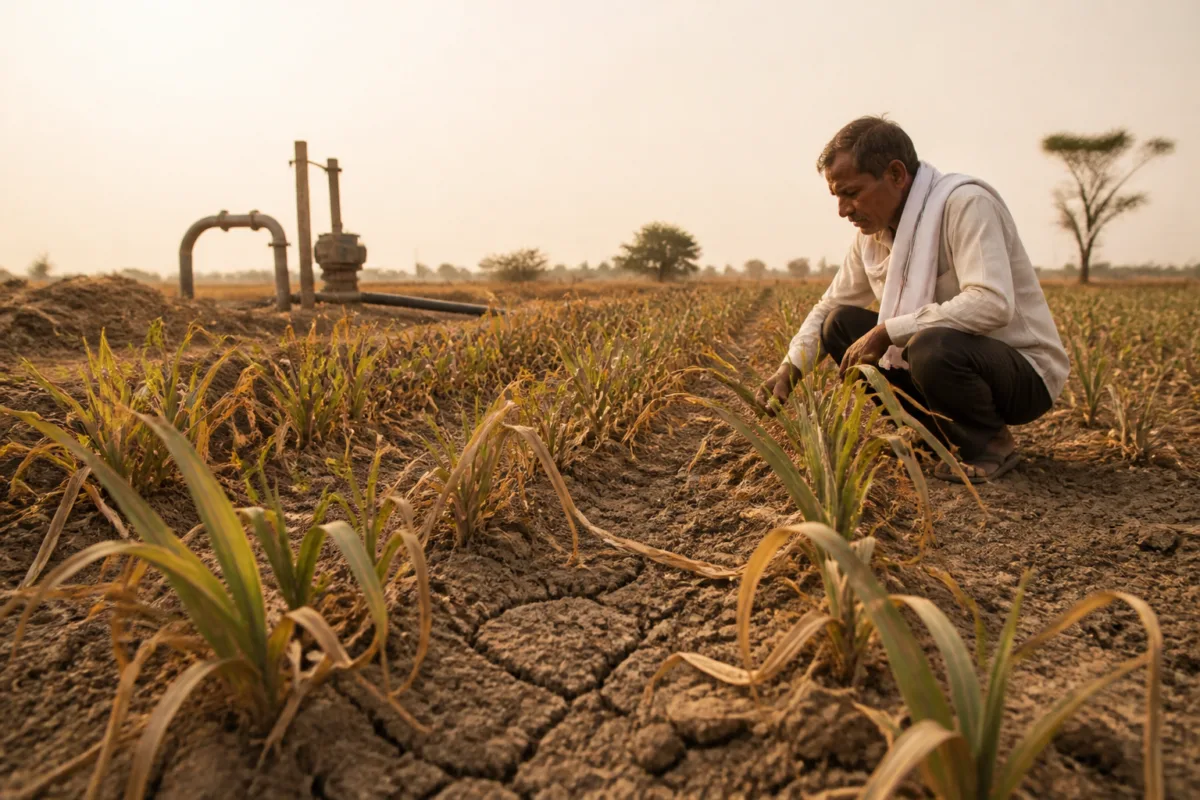
Sugarcane cultivation in drought-prone Marathwada expanded by 36% over five years even as the region faced widespread water stress, exposing a conflict between crop economics, groundwater dependence and Maharashtra’s ability to regulate water-intensive farming.
The area under sugarcane rose from 2.8 lakh hectares in 2021-22 to 3.8 lakh hectares in 2025-26, according to data from the state agriculture department cited in a Times of India report. Marathwada now accounts for 27.5% of Maharashtra’s sugarcane cultivation and has 68 sugar factories, or 32% of the state’s 208 factories.
The expansion comes as 86.6% of Maharashtra’s talukas have been affected by drought, with all 76 talukas in Marathwada reported to be impacted. In Beed district, farmer Vivek Sasawade told the report that a 40% rainfall deficit had left his sugarcane field scorched and that he expected a 50% loss. He said the crop required watering every fortnight.
The figures point to a water-allocation problem rather than only a bad agricultural season. Sugarcane is a long-duration crop that requires regular irrigation, making its expansion particularly consequential in a region that depends heavily on rainfall and groundwater. Water expert Pradeep Purandare said the crop was contributing to the “desertification” of an already arid region and advocated pulses and oilseeds as more drought-resistant alternatives.
A 2020 NITI Aayog task force report on the sugar industry estimated that producing 1 kg of sugar requires about 1,500-2,000 kg of water. Purandare also said that the water needed to irrigate one hectare of sugarcane could irrigate 5.5 hectares of rabi jowar. These comparisons underline the opportunity cost of allocating scarce irrigation and groundwater resources to cane in a drought-prone area.
The Maharashtra Irrigation Act, 1976, gives the government powers to restrict cultivation of water-intensive crops such as sugarcane during acute water scarcity. However, Purandare said statutory rules needed to implement those powers had not been put in place even after five decades. The gap leaves the state with a legal instrument whose practical use remains limited, according to the report.
For farmers, the choice is shaped by more than water availability. Sugarcane offers a Fair and Remunerative Price set by the Centre, providing a level of price certainty that many alternative crops may not offer. Sasawade said the crop was relatively easy to manage when water was available, could be grown for three years and was harvested by cane-cutters paid by sugar factories.
The expansion was also supported by plentiful rainfall in recent years, according to the report. Critics cited in the story said political interests encouraged sugarcane cultivation in an effort to build a farmer vote base. The push to blend ethanol has further provided sugar factories with a market for surplus cane.
That production system is now under pressure from the drought. Sanjay Khatal, managing director of the Maharashtra State Cooperative Sugar Factories Federation, said low cane productivity was expected to reduce the crushing season from six months to three. He said factories would earn less while still being required to pay farmers the Fair and Remunerative Price, and that the federation had sought a government subsidy.
The consequences extend beyond farms and factories. Groundwater depletion and unreliable irrigation can increase pressure on rural drinking-water systems and make drought management more difficult for local administrations. A shorter crushing season can also affect the seasonal employment and transport networks linked to sugar factories, although the report does not quantify those effects.
The immediate response from some farmers may be a shift away from cane. Sasawade said he expected to switch to soyabean and tur dal after this year’s losses. Whether such changes become widespread will depend on the reliability of alternative-crop markets, procurement arrangements and irrigation support.
Marathwada’s sugarcane expansion therefore presents a policy test: whether drought response will remain focused on managing shortages after they occur, or whether crop planning, groundwater regulation and industrial incentives will be aligned before water stress becomes more severe. The reported figures show that the region’s agricultural economy has moved in the opposite direction over the past five years, even as its water risks have intensified.

