


Marathwada’s microfinance crisis is no longer only a question of household debt. The cases reported from Dharashiv, Nanded and Latur show how drought, weak access to formal bank credit and aggressive recovery practices can combine to turn a short-term loan into a wider crisis for rural households, including loss of assets, interrupted education and alleged farmer suicides.
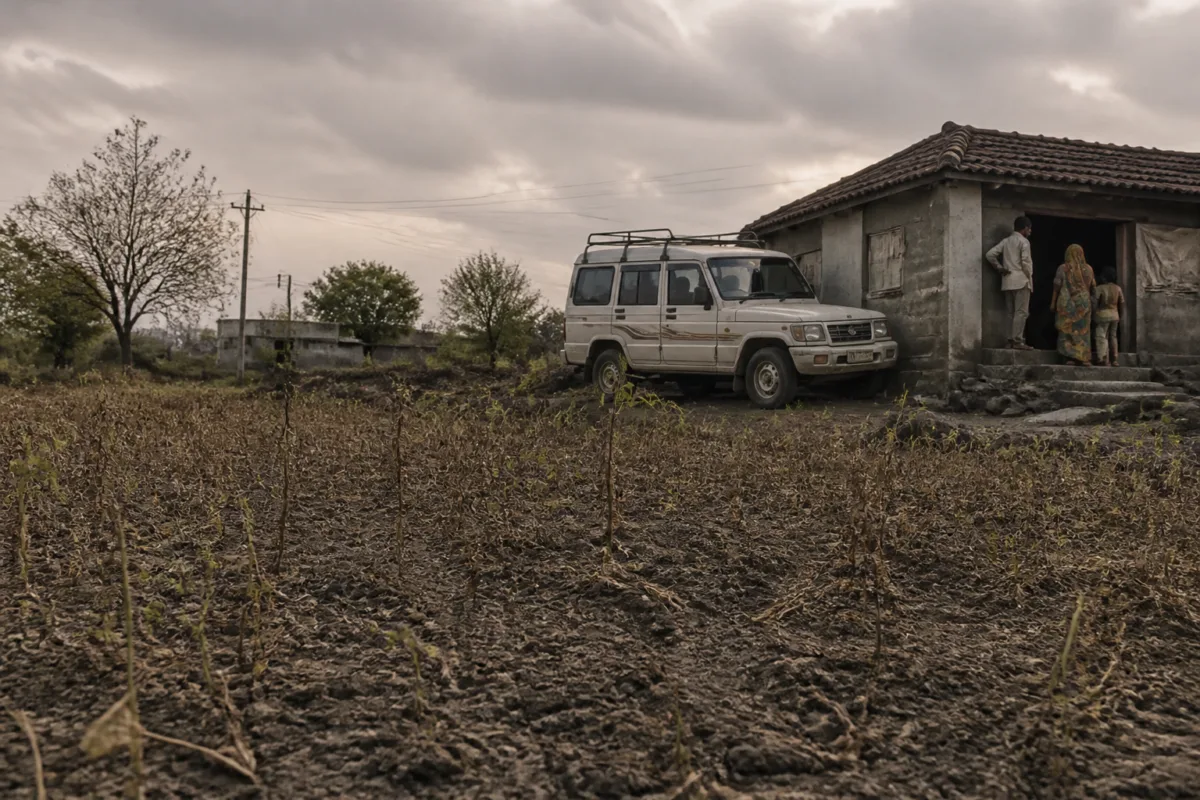
The report centres on Milind Rokade, a 43-year-old farmer from Dharur village in Dharashiv district. After an accident injured his leg two years ago, Rokade borrowed Rs 6 lakh from a finance company to purchase a transport van. The vehicle was intended to supplement his farm income by carrying agricultural produce. But a severe drought destroyed most of his crop and left him with little produce to transport.
Rokade had planted soyabean on two acres at a cost of Rs 30,000 and recovered only Rs 4,000. He then missed a monthly instalment of Rs 14,750 due on October 15. According to his wife, Rukmini, collection agents began calling repeatedly from the following day. The family alleges that an agent also sat outside their home for hours when payments were delayed and threatened to take away the van. Rokade died by suicide in the early hours of October 20, according to the report.
The case illustrates the vulnerability created when repayment schedules are fixed but farm incomes are exposed to weather shocks. The loan was not taken for a purely speculative purpose: it was intended to create a second source of income after a health-related setback. Once the drought damaged both the farm and the transport activity dependent on agricultural output, the family’s capacity to service the debt collapsed.
### How drought converts credit into household distress
The report places Rokade’s case within a wider series of incidents. On October 24, a Nanded-based farmer with unpaid dues of Rs 10,000 was found hanging from a ceiling fan in the office of microfinance company K F Enterprises. In the same month, police registered a case against four microfinance companies after the suicide of a 26-year-old farmer in Latur. One of the entities named in that case was a finance application, according to the report.
The scale of the agricultural shock is central to understanding these cases. More than 85% of Maharashtra’s talukas were reported to be drought-affected, while all 76 talukas in Marathwada were affected. The report does not establish that debt collection caused each death. It records, however, that families and local participants linked several incidents to repayment pressure and alleged coercive tactics.
The financial terms described in the report also show why recovery pressure can become particularly damaging. In Rokade’s case, the annual interest rate worked out to 29.5%. The family of the Nanded farmer alleged that Rs 70,000 was being demanded on a loan of Rs 10,000. That allegation has not been independently established in the supplied material, but it points to the need for clarity on loan pricing, fees, penalties and the actual outstanding amount communicated to borrowers.
For households with limited assets, repayment often means selling productive or essential property. Rukmini told the report that she had sold three goats and all her jewellery to meet instalments. She sold her mangalsutra a month before her husband’s death to raise money for a payment. The household’s remaining financial pressure has also affected the educational aspirations of the couple’s children, Prachi and Sudarshan, who hope to join the army.
### Why formal credit remains out of reach
The expansion of microfinance in the region is connected to a gap in formal lending rather than simply to borrower preference. Tanaji Gaikwad, a member of a village conflict resolution committee, told the report that farmers find it difficult to obtain bank loans because of low CIBIL scores. As a result, they turn to microfinance companies despite the higher interest rates.
This creates a cycle in which previous financial stress restricts access to lower-cost credit, while the available alternative may carry repayment conditions that are difficult to meet during a crop failure. The report also refers to multiple loan applications and microfinance companies operating in the area. Gaikwad alleged that some applications were fronts for other companies, although the supplied material does not provide documentary details or establish the ownership structures involved.
The problem is therefore institutional as much as individual. A farmer with a damaged credit history may be treated as a high-risk borrower by banks, even when the immediate cause of repayment failure is a drought or medical emergency. The resulting dependence on non-bank lenders shifts the cost of vulnerability onto the borrower, whose income is already uncertain and seasonal.
### Regulation exists, but enforcement is the test
Government intervention followed the Nanded case. Maharashtra Chief Minister Devendra Fadnavis instructed police officials to book senior officials of microfinance companies if they harassed farmers over repayment. He also said he had asked the Reserve Bank of India to tell microfinance companies not to take coercive steps.
Dharashiv collector Kirti Kiran Pujara said the district administration had met representatives of finance companies and told them they could not force farmers to pay instalments given the drought. These statements establish an official response, but the report also shows the practical difficulty of translating a prohibition on coercive recovery into protection at household level.
The alleged visits to borrowers’ homes are significant because they move collection from a formal financial process into a public and social one. When an agent sits outside a house for hours, threatens the seizure of a vehicle or pressures a family to borrow from neighbours, the consequences include humiliation and reputational damage in addition to financial loss. Such conduct, if established, would make repayment a matter of social coercion rather than a transparent settlement between lender and borrower.
The supplied material does not detail the enforcement mechanism, complaint process, penalties imposed or the division of responsibility between police, district administration, the RBI and other authorities. Those gaps matter because a government instruction can provide a policy signal without automatically creating an accessible remedy for a borrower facing a collection agent at home.
### The data story is about exposure, not only interest rates
The figures in the report reveal several overlapping forms of exposure. Rokade’s family faced a Rs 6 lakh loan, a Rs 14,750 monthly instalment, a 29.5% annual interest rate and a crop return of Rs 4,000 against Rs 30,000 spent on cultivation. The Nanded case involved alleged unpaid dues of Rs 10,000 and a disputed demand of Rs 70,000. These numbers are not directly comparable, but together they show how repayment obligations can quickly exceed the cash generated by a failed crop.
The geographic spread also matters. The reported cases extend across Dharashiv, Nanded and Latur, while the drought affected all 76 talukas in Marathwada. This is not presented as a single village dispute or one lender’s isolated action. It is a pattern emerging in a region where agricultural incomes are vulnerable and the demand for emergency credit is growing.
At the same time, the evidence supplied does not establish the total number of affected borrowers, the volume of microfinance lending in Marathwada, the number of farmer suicides attributable to loan recovery, or the proportion of loans held by regulated and unregulated entities. Those missing figures prevent a complete assessment of the sector’s scale. They also make it important to distinguish documented incidents, family allegations, police cases and broader claims about the industry.
The immediate urban question is often overlooked because these events occur in villages. Yet the crisis concerns the functioning of financial, administrative and transport systems that connect rural households to towns and cities. Rokade’s van was meant to move farm produce. A failed harvest reduced the vehicle’s use, while the loan taken to purchase it remained payable. Rural distress therefore affects mobility, supply chains, local markets and the survival of small transport-dependent enterprises.
### What remains unresolved
The report confirms that drought has intensified repayment stress in Marathwada and that families have described alleged coercive recovery practices in connection with suicides and asset sales. It also records government instructions and district-level meetings intended to curb such practices. What remains uncertain is how many lenders are operating under which regulatory framework, whether the alleged demands comply with loan agreements, and how effectively borrowers can challenge harassment or obtain restructuring during a drought.
The next stage of the crisis will depend less on the existence of official warnings than on whether borrowers can access affordable formal credit, whether drought-related repayment relief is implemented transparently, and whether complaints lead to timely action. Until those mechanisms are visible at the household level, the region’s credit system will continue to expose its most vulnerable borrowers to the combined risks of crop failure, high-cost debt and coercive recovery.

