


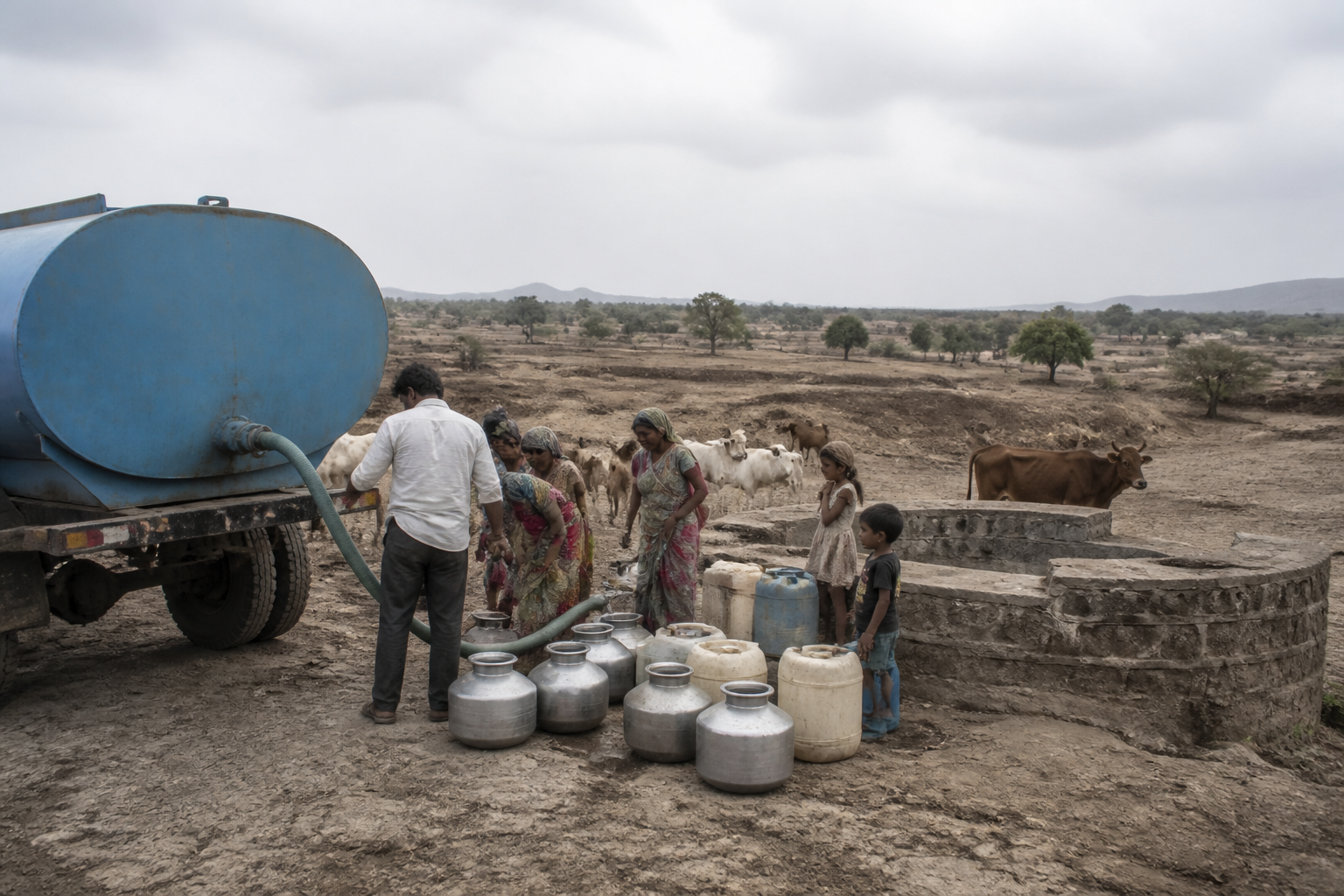
Marathwada’s water crisis is arriving before the monsoon has formally ended, forcing villages to depend on tankers while farmers watch wells dry, crops fail and household costs rise. The immediate emergency is visible in the numbers: 74 of the region’s 76 talukas have been declared drought-affected, 277 tankers are supplying 160 villages, and more communities are seeking tanker support as local water sources run out.
The crisis is not simply a story of inadequate rainfall. It is also a test of how rural water security is organised, financed and delivered across a region where household needs, livestock, agriculture and public infrastructure compete for the same increasingly uncertain sources. The Indian Express reported that Maharashtra received 18 per cent less rainfall than normal this year, while Marathwada recorded a deficit of 38 per cent. The shortfall was higher in Latur, at 48 per cent, and Parbhani, at 43 per cent.
Those figures explain the pressure on local wells, but they do not by themselves explain why the response is moving so quickly towards privately operated tankers. In Chhatrapati Sambhajinagar, 77 villages are being supplied by 120 tankers, while 65 villages in Beed are receiving 127. Jalna has 22 tankers supplying villages. Of the 277 tankers deployed across the region, only three are owned by the government. The rest are operated by private owners and paid for by the state government.
That arrangement offers an immediate way to move water to settlements where fixed supply systems are unavailable or have failed. It also makes the state’s response dependent on a recurring transport and procurement network. Tankers can address an urgent shortage, but their deployment is a measure of distress rather than a permanent water-supply system. The scale of private dependence therefore becomes an important administrative indicator: the more villages that require tankers, the more the government must coordinate vehicles, routes, payments and source availability under pressure.
The burden is being felt most sharply by households that also depend on agriculture and livestock. In Shahapur in Chhatrapati Sambhajinagar, farmer Badrinath Bharat is spending Rs 3,000 a day on two tankers to keep his ginger crop alive. The same water is used by his family and 10 cattle. Bharat told the Indian Express that his cotton and maize had already been lost, along with crops including tomato, and that his well was dry. He said he could continue paying for tankers for about a month in the hope of obtaining some yield, after which he would stop.
In Siddhanath Vadgaon, farmer Sachin Bilwal has been buying tanker water for more than a month for his family and three cattle. He pays Rs 1,000 for a tanker that lasts about a week. Bilwal had cultivated cotton, maize and tur, but said the crops produced no output because of inadequate rain. His well, like Bharat’s, has also run dry. He said the village had asked the gram sabha to seek government tankers, while acknowledging that many villages were facing a similar situation before the monsoon had ended.
The examples show how water stress crosses the usual boundaries between drinking water, farming and livestock. A tanker sent to a village is not serving a single use. It may be required for household consumption, animals and the attempt to save a crop that represents a farmer’s investment and future income. When a family pays for water, the cost is therefore not limited to domestic use. It may also be the cost of delaying crop loss or keeping livestock alive.
Jalna demonstrates why irrigation equipment alone cannot protect farms from a failed rainfall cycle. Farmer Abasaheb Dinkar Rathod from Govindpur had installed drip lines beneath his crops and used mulching and protective covers for tomatoes. He had planted tomatoes on one acre and coriander and ladyfinger on another plot. Yet the lack of rain left him with a few stunted coriander plants and a single cart of tomatoes that he said would fetch less than Rs 100.
Rathod’s experience reveals the limits of farm-level efficiency measures when the larger water system cannot provide a dependable source. Drip irrigation can reduce the amount of water required by crops, but it cannot substitute for water that is not available. Rathod said he planned to remove the tomato plants and try another crop during the rabi season, although that would depend on finding water. He also said there was no irrigation option for his farm and that his family depended on a local well two kilometres from home for personal use.
This is where the region’s immediate tanker response meets its longer infrastructure problem. The administration in Chhatrapati Sambhajinagar has said there is currently no water shortage or water cut in the district and that additional tankers will be deployed if required. At the same time, the report says work under the Jal Jeevan Mission remains incomplete in the region. Data from the Marathwada divisional administration indicates that only about half of the work under the scheme has been completed, with lack of funds and other reasons cited for the delay.
The contrast is significant. Reservoir storage may be sufficient for drinking and domestic requirements, as the administration has maintained with reference to major reservoirs including the Jayakwadi dam near Paithan. But reservoir availability does not automatically translate into a functioning village water supply. Water must still be sourced, treated where necessary, conveyed through infrastructure and delivered reliably to households. A village can be located within a region that has water stored in a major reservoir and still depend on tankers if local wells, pipelines or distribution systems are not functioning.
That distinction also explains why a declaration of drought and a tanker deployment are only parts of the response. The state has declared drought in 265 of its 358 talukas and announced relief measures including tanker deployment for drinking water wherever required. These measures provide an administrative basis for emergency supply. They do not, however, resolve the infrastructure gap indicated by the incomplete Jal Jeevan Mission work or address the loss of agricultural output caused by rainfall deficits.
The region’s water crisis therefore has at least three separate layers. The first is the climatic shortfall: Marathwada’s rainfall deficit has reduced recharge and depleted local sources. The second is the livelihood impact: farmers are losing cotton, maize, tur, tomatoes and other crops, while continuing to bear costs for livestock and household water. The third is the delivery gap: permanent water-supply work remains incomplete, leaving the government to rely heavily on privately operated tankers when wells and local sources fail.
These layers matter because they generate different administrative responsibilities. Rainfall deficits require drought assessment and relief. Dry wells and failed crops affect farmers, livestock owners and rural households. Incomplete water-supply schemes require funding, construction and implementation monitoring. Tanker deployment requires procurement, payment and daily operational oversight. Treating all of these as a single water-shortage problem can make the response appear adequate when one part of the system is being addressed and another remains unresolved.
The available evidence does not establish how long the current tanker operation will continue, how much it will cost the state, or whether reservoir reserves can sustain demand through the next phase of the dry period. It does establish that the demand is already expanding before the monsoon has ended, that private tankers constitute almost the entire deployed fleet, and that farmers are paying directly for water while losing crops. It also establishes that permanent scheme implementation is only about halfway complete according to divisional administration data.
For Marathwada, the central urban and infrastructure question is not only whether water exists in the region. It is whether water can be moved reliably from available sources to villages, farms and households before local scarcity becomes a crisis. The present response is keeping some settlements supplied, but the dependence on tankers shows that emergency logistics are filling gaps left by weak or unfinished fixed systems. The next milestones are the deployment of additional tankers where required, the administration’s assessment of reservoir sufficiency and the completion of pending Jal Jeevan Mission work. Until those systems improve, the region’s water security will remain tied to rainfall, dry wells and the ability of families and the state to keep paying for tankers.
