


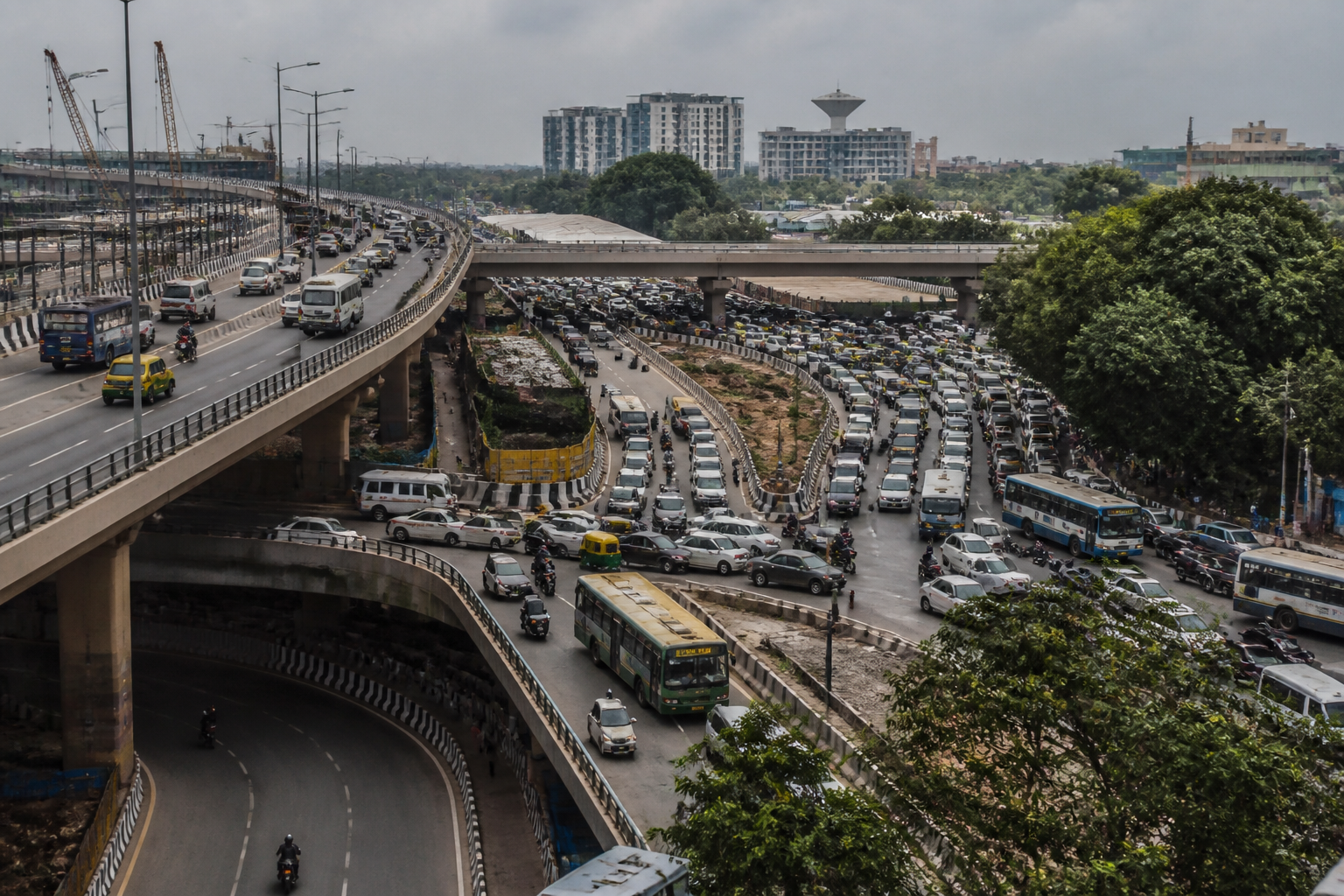
Bengaluru’s proposed Hebbal tunnel-and-flyover project is now facing a more consequential question than whether it can move traffic faster: whether the evidence used to support it is strong enough to justify a major intervention in the city’s road network. An IIT Bombay study commissioned for the project predicts higher average speeds, while the Indian Institute of Science’s Sustainable Transportation Laboratory has criticised the study’s assumptions and said its recommendations lack supporting evidence.
The disagreement matters because the project is being evaluated not only as a road-building exercise but as a forecast of how vehicles will behave across a complex urban corridor. The available material shows that the two institutions differ over traffic diversion, road capacity, the geographical limits of the assessment and the period for which the project’s benefits have been tested. Those differences go to the foundation of the project’s case.
The proposed work includes a 2.2-kilometre short tunnel between Hebbal Junction and the staff quarters of the University of Agricultural Sciences. The project also involves a flyover. According to the report reviewed by IISc, at least 1,128 trees would need to be cut for the tunnel. That makes the quality of the traffic assessment central to any public discussion: the city is being asked to weigh an irreversible environmental cost against projected mobility gains.
The IIT study, conducted by Archak Mittal for Ritwik Projects Private Limited, the project contractor, examined a series of possible traffic shifts. It considered situations in which 50%, 60%, 70% and 80% of traffic would use the proposed tunnel-and-flyover system, according to the report. Under the study’s assumptions, if half of the vehicles used the new infrastructure, average traffic speed in 2027 could rise from the current 13.74 kilometres per hour to 20.64 kilometres per hour. If 80% of vehicles used it, the projected average speed would rise to 22 kilometres per hour.
These figures present the project in terms of a substantial improvement in corridor-level mobility. But they are not forecasts independent of the assumptions built into the model. They depend on how many vehicles the new facilities can accommodate, how traffic is expected to distribute itself and whether the surrounding road network can absorb the resulting movements. The available report does not establish that all of these conditions have been demonstrated in the same level of detail.
That is the central concern raised by IISc’s Sustainable Transportation Laboratory. Its coordinator, Ashish Verma, said the study did not properly explain how the number of vehicles that could use the tunnel and flyover had been determined. He also said the figures had been assumed without a clear basis. The criticism is particularly focused on the different capacities of the two structures: the tunnel is planned with three lanes in each direction, while the flyover is planned with two lanes in each direction.
That distinction is not a technical footnote. A three-lane tunnel and a two-lane flyover cannot automatically be treated as though they will carry the same number of vehicles. If the traffic assigned to each facility is not linked to its actual capacity, the combined estimate may give a misleading impression of how much demand the project can handle. IISc’s objection therefore concerns the connection between physical design and projected traffic use, rather than merely a disagreement over the final speed figure.
The controversy also exposes a second weakness: the difference between studying a corridor and studying a network. The IIT study reportedly examined the existing road network, the tunnel, the flyover and a combined tunnel-and-flyover option. However, Verma said the analysis considered the existing road network and the proposed tunnel-and-flyover arrangement but did not adequately explain what would happen beyond the immediate stretch.
The route assessed runs from Mekhri Circle to Hebbal Junction. That is an important section, but traffic does not stop at the boundaries of a study corridor. If a new facility allows vehicles to move more quickly towards a junction, the resulting pressure may appear elsewhere in the network. The supplied material does not establish whether congestion would spread to other connecting roads or whether that possibility was adequately tested. Without that information, a faster average speed on one stretch cannot by itself demonstrate a citywide mobility benefit.
The time horizon is another unresolved issue. The IIT study refers to travel time conditions in 2027, but IISc has questioned what the project would mean in 2047. This is a substantial gap for a piece of infrastructure expected to shape the city for decades. A project can show improvement in an initial operating year and still face a different demand picture later. The available material does not provide a long-term traffic assessment, nor does it explain how the project’s performance would be reviewed if actual vehicle use diverges from the assumptions.
This is where the Hebbal project becomes a test of infrastructure decision-making. The immediate question is whether the proposed road can increase speed under selected traffic-use scenarios. The larger question is whether the project appraisal has measured the full system that the road will alter. The difference between the two questions is significant. A corridor-level model can produce an attractive result while leaving the effect on adjacent roads, alternative modes and future demand insufficiently examined.
IISc has also criticised the study for not adequately considering alternative transport systems. The report supplied does not identify which alternatives should have been assessed or provide a comparative estimate for them. It does, however, make clear that the debate has not been limited to choosing between an existing road and a new tunnel. It also concerns whether the project has been evaluated alongside other ways of addressing movement through the area.
That omission matters because road capacity is only one possible response to congestion. When a project’s justification depends on a high share of vehicles shifting to a new facility, the assessment needs to make clear why that shift is likely, what constraints will determine it and whether other transport options would change the demand pattern. The IIT study considered traffic diversion percentages from 50% to 80%, but the supplied material does not explain the basis for those percentages. IISc’s criticism directly challenges that missing link.
The institutional structure behind the study also deserves attention. The analysis was conducted for Ritwik Projects Private Limited, which is identified as the project contractor. IISc’s laboratory reviewed the study and described it as biased, arguing that the recommendations were not backed by adequate evidence. These positions do not, by themselves, establish that either institution has conclusively resolved the project’s merits. They do show that the project’s evidence base is contested by a leading research institution and that the disagreement needs to be addressed before the projected benefits are treated as settled.
For the authorities considering the tunnel and flyover, the issue is therefore not simply whether one study supports construction. It is whether the underlying assumptions are transparent, reproducible and broad enough to cover the network and time period affected by the investment. The current material identifies several points requiring clarification: how vehicle capacity was calculated, how the different lane configurations were handled, how traffic impacts beyond Mekhri Circle and Hebbal Junction were tested, why 2027 was used as the principal horizon and how conditions in 2047 were considered.
The tree count raises the stakes further. The proposed tunnel alone would require at least 1,128 trees to be cut, according to the report. That figure does not decide the transport question, but it changes the standard of evidence that citizens can reasonably expect. Where a project involves a large environmental cost, projected travel-time gains need to be clearly tied to transparent assumptions and a sufficiently wide assessment of consequences.
The available evidence does not establish that the Hebbal project will fail, nor does it establish that the IIT projections will be achieved. It establishes a sharper point: the project’s claimed mobility gains rest on assumptions that IISc says are inadequately explained, and the study’s scope does not clearly answer what happens to the wider network or to demand over the longer term. Until those questions are addressed, the debate should not be reduced to whether Bengaluru needs more road capacity. It should focus on whether this particular capacity has been assessed with enough rigour to warrant the project’s financial, spatial and environmental consequences.
