


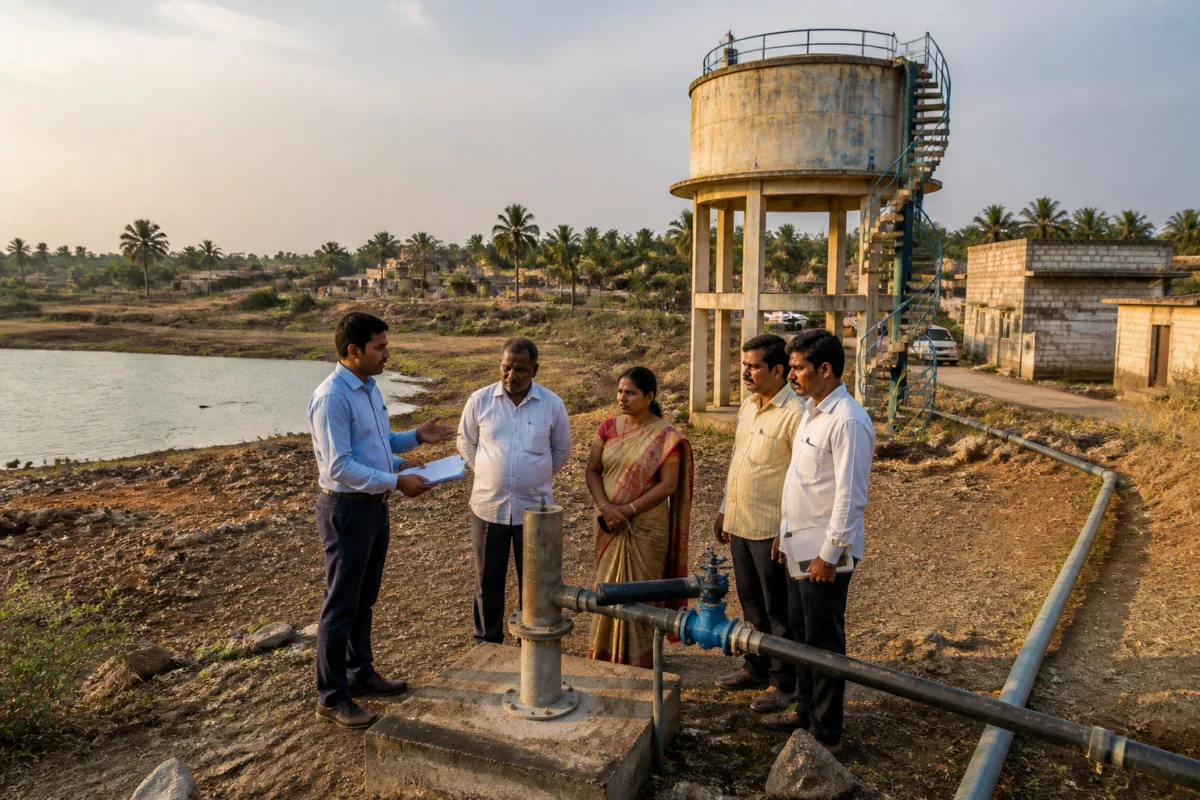
Karnataka Rural Development and Panchayat Raj Minister Eshwar Khandre has directed officials to prepare village-level water budgets and verify whether Jal Jeevan Mission supplies are reaching every household, amid concerns over falling water levels and delayed delivery of rural drinking-water projects.
Chairing a departmental progress review meeting at the Mysuru Zilla Panchayat auditorium, Khandre questioned Jal Jeevan Mission engineers on their understanding of water budgeting and expressed dissatisfaction with their responses. He said planning could not be limited to laying pipelines without assessing the availability and future demand for water.
Khandre explained that a village water budget should record the number of borewells and open wells, the status of groundwater, other available water sources and the water requirement for the next one and five years. The assessment should also account for population growth and the needs of schools, colleges, anganwadis, hospitals and industries. Officials should further examine whether surface water could provide clean drinking water to rural residents over the next 30 years, he said.
The minister said the state government was spending a combined ₹67,000 crore on single-village and multi-village drinking-water schemes. “What is the use if water does not reach people despite the expenditure?” he asked, according to the report. He directed deputy secretaries to visit villages personally and check whether the Jal Jeevan Mission was reaching every village and the last household.
The review comes as officials assess the impact of deficient rainfall attributed to El Niño. Khandre said water storage in existing sources had declined and instructed departments to ensure that drinking-water shortages did not occur until May. He also ordered officials to test borewell water levels in every village and estimate the extent of groundwater decline.
The minister asked authorities to accelerate the completion of single-village and multi-village water-supply works, warning that projects costing thousands of crores would fail their purpose if households did not receive water. The directions place emphasis on monitoring actual service delivery rather than treating construction progress as the sole measure of project performance.
Khandre also reviewed lake protection in the district. Of the 2,822 lakes under the control and maintenance of gram panchayats, 82 have reportedly faced encroachment involving 200 acres of land. He instructed officials to take steps to remove the encroachments and protect the water bodies.
At a separate introductory meeting of the Abdul Nazir Sab State Institute of Rural Development and Panchayati Raj, Khandre advised the institution to use artificial intelligence and other modern technologies in its training programmes. He said the institute should study the implementation of centrally and state-sponsored departmental schemes instead of limiting its role to training. The institute was also asked to incorporate modern technology into the curriculum and guide panchayat development officers on new methods for implementing 375 works permitted under VBG Ramji.
The meetings were attended by Rural Development and Panchayati Raj Department Secretary D. Randeep, Commissioner Y.S. Patil, Mysuru Zilla Panchayat Chief Executive Officer Yukesh Kumar, institute director Sheikh Tanveer Asif and VBG Ramji director Diddimani. Officials were instructed to undertake field verification, monitor groundwater and complete pending water-supply works so that rural households do not face a drinking-water shortage through May.

