


Twelve years after Make in India was launched to turn India into a global manufacturing base, the initiative has produced a strikingly uneven record. Electronics production, mobile manufacturing, foreign investment, exports and startup formation have expanded sharply, but manufacturing has not reached its promised share of the economy and its contribution to employment remains limited. The result is an industrial model that has demonstrated the ability to scale output in selected sectors without yet creating the broad-based urban and regional jobs that made the original promise politically and economically significant.
The distinction matters because manufacturing is not only a production statistic. It shapes the growth of industrial towns, logistics networks, supplier markets, rental housing, transport demand and the livelihoods of workers moving between cities and smaller urban centres. When production rises without a comparable increase in employment or domestic value addition, the benefits of industrial growth can remain concentrated among a narrower set of firms, locations and skills.
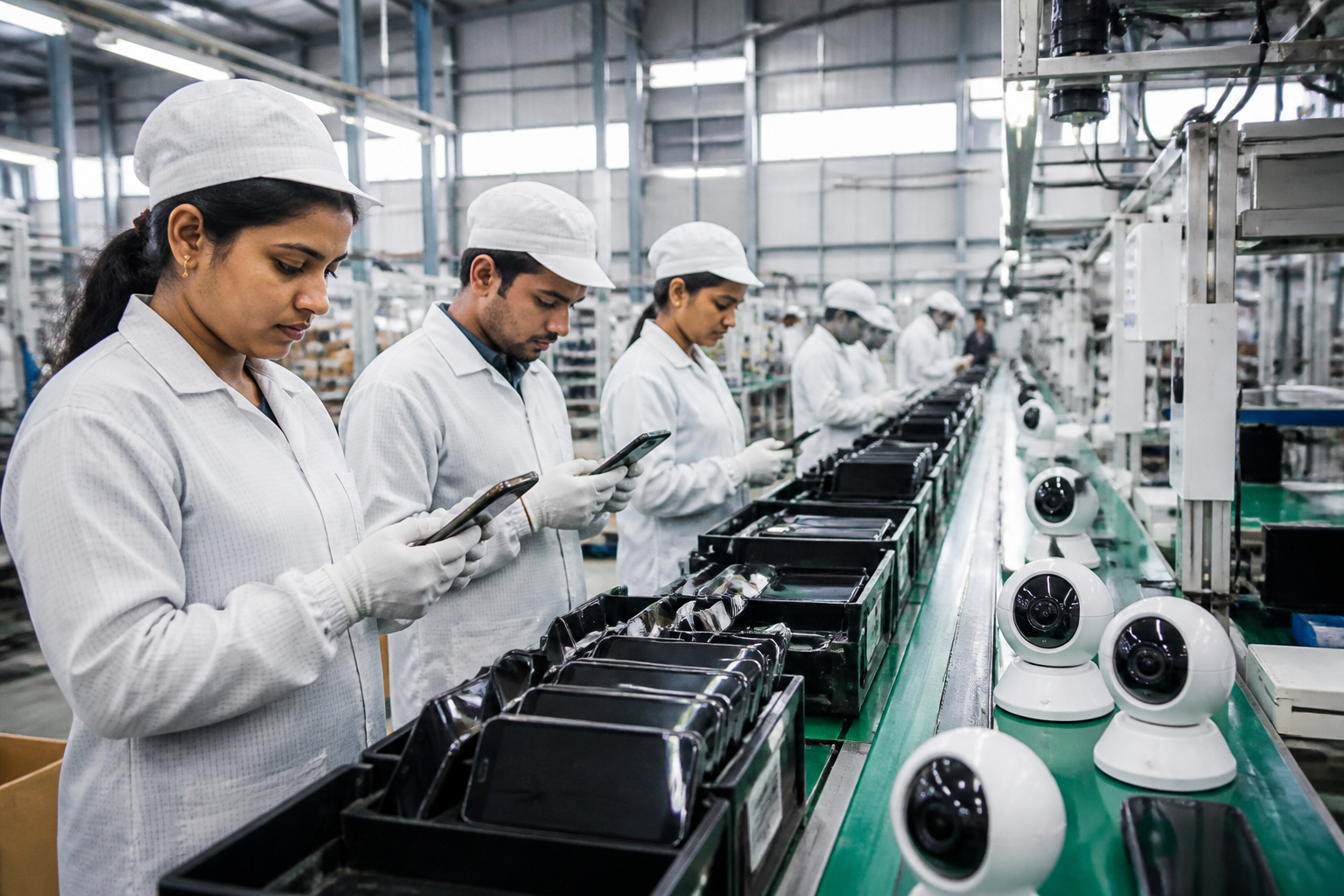
The strongest evidence of Make in India’s success comes from electronics. According to the figures reported by NDTV Business, electronics production increased from about Rs 1.9 lakh crore in 2014-15 to nearly Rs 13.11 lakh crore in 2025-26. Mobile phone production rose from roughly Rs 18,000 crore to Rs 6.27 lakh crore over the same period. India has moved from importing most of the phones used domestically to manufacturing nearly all of them within the country.
This expansion was supported substantially by the Production Linked Incentive, or PLI, schemes. By March 2026, the schemes had attracted approximately Rs 2.40 lakh crore in actual investment, generated around Rs 23.8 lakh crore in production and sales, supported exports worth nearly Rs 15.2 lakh crore, and contributed to more than 14.6 lakh direct and indirect jobs, according to the report. These numbers establish that targeted industrial policy can alter production geography and attract investment when incentives are aligned with a sector capable of rapid scale.
However, the same figures also show the limits of using production growth as a proxy for industrial transformation. The reported employment supported by PLI is significant, but it is far below the scale of employment implied by the original manufacturing ambition. The growth of output has therefore been faster and more visible than the growth of work opportunities. For cities and smaller industrial centres, this raises a basic question: whether new factories are creating sufficiently deep local ecosystems of suppliers, technicians, service providers and stable workers, or whether they are primarily assembling products within relatively narrow production chains.
Foreign investment has also increased. India attracted cumulative foreign direct investment of $843 billion between 2014-15 and 2025-26, a 169 per cent increase over the previous 12-year period. The inflow reached a reported record of $94.53 billion in 2025-26. The expansion signals stronger international confidence in India as a production and investment destination, but foreign capital alone cannot guarantee domestic industrial depth. Its wider economic effect depends on how much technology, design capability, supplier capacity and research activity becomes embedded within Indian firms.
The startup economy provides another indicator of the changing industrial landscape. More than 2.23 lakh startups had been recognised by March 2026, with over 23.36 lakh jobs created. The report also notes that 55,200 new startups were added in 2025-26, while almost half of the recognised startups were associated with smaller Tier-2 and Tier-3 towns. This spread matters for urban development because industrial and technology-led growth is no longer restricted to the largest metropolitan markets. Yet the existence of startups does not automatically mean that smaller cities have acquired the finance, infrastructure, procurement access and skilled labour markets needed to help those firms scale.
Industry accounts cited in the report point to a similar transition. CP PLUS Managing Director Aditya Khemka said the company’s Kadapa plant produces more than 2.5 million surveillance devices a month. BenQ India’s Rajeev Singh described a shift from cost and compliance towards capability and resilience, with the India-made share of the company’s interactive panel business expected to nearly double in two years. These examples suggest that India is building manufacturing capability in selected electronics segments, but they also highlight the difference between assembling products domestically and developing the engineering, design and component ecosystems that support higher-value manufacturing.
That distinction is central to the next phase of the policy. Khemka has called for deeper backward integration, more domestic research and development, and technology designed in India rather than merely assembled in the country. Singh has similarly emphasised local engineering, innovation and value creation. Their comments point to a structural challenge: localisation percentages can rise without a proportional increase in domestic technological ownership if critical components, designs or production systems remain dependent on external suppliers.
The central shortfall is visible in manufacturing’s share of the economy. Make in India initially set a target of raising manufacturing to 25 per cent of GDP by 2022, a deadline later moved to 2025. That target was not achieved. The share has remained in the range of roughly 13 to 17 per cent, according to the figures cited in the report. Congress president Mallikarjun Kharge put the share at 12.83 per cent in 2023, compared with 15.25 per cent a decade earlier, and argued that several PLI-supported sectors, including solar modules and specialty steel, had underperformed.
The political criticism does not cancel out the evidence of sectoral gains, but it exposes the difference between concentrated success and economy-wide transformation. Electronics can expand rapidly while manufacturing as a whole remains relatively small. A handful of high-growth sectors can improve exports without lifting the average productivity, wages or employment prospects of the wider industrial workforce. The policy question is therefore not whether Make in India worked in any sector, but whether its successes have been broad enough to change the structure of the economy.
Employment data makes that gap sharper. The share of the workforce employed in manufacturing declined from 12.6 per cent in 2011-12 to 10.9 per cent in 2020-21, before recovering slightly to 11.6 per cent the following year. Those figures remain distant from the earlier ambition of generating 100 million new manufacturing jobs. Jairam Ramesh, the Congress general secretary, has argued that the expected private investment boom and broad-based job growth did not materialise, and that manufacturing growth measured through Gross Value Added and the Index of Industrial Production generally trailed overall economic growth during the period.
For urban India, the employment gap has practical consequences. Manufacturing-led urbanisation depends on more than factory gates. It requires affordable housing near employment, reliable transport for workers, industrial land, power and water supply, logistics links, vocational training and access to finance for smaller suppliers. If investment is concentrated in final assembly, cities may experience higher freight movement and land demand without developing the full range of local enterprises that create resilient employment. The pressure then falls on workers to travel farther, move between informal jobs or migrate repeatedly in search of stable work.
The MSME financing problem is therefore not a peripheral demand from industry. It is linked to whether manufacturing gains can spread beyond large firms and anchor firms. Moglix Managing Director Rahul Garg has called for timely and accessible finance for startups and MSMEs, faster access to markets and procurement, and greater policy focus on execution. Smaller firms are often the part of the industrial system that turns a factory into a wider economic network, but they are also more exposed to delayed payments, limited credit and uneven access to public and private procurement.
The experience of the past 12 years suggests that industrial policy is most effective when it combines incentives with institutional capacity. PLI schemes have helped attract investment and scale production in targeted sectors. The next challenge is to ensure that incentives generate deeper domestic supply chains, local engineering, research capability and employment rather than only higher assembly volumes. This requires clearer attention to which sectors can create large supplier networks and which can support growth beyond a small number of major plants.
The geographical spread of manufacturing will also determine whether Make in India produces more balanced urban growth. The reported expansion of startups in Tier-2 and Tier-3 towns is encouraging, but smaller cities require the supporting systems that allow firms to survive beyond their initial formation. Without dependable infrastructure, industrial services, skilled labour pools and finance, the location of a registered startup does not necessarily indicate the presence of a durable local industrial ecosystem.
The evidence therefore supports two conclusions at once. Make in India has changed India’s manufacturing position in electronics and has helped attract investment, increase exports and expand startup activity. Yet it has not achieved the larger transformation promised in manufacturing’s share of GDP or employment. The next measure of success will be whether India can move from assembling more products to creating more value, suppliers, technologies and stable jobs across a wider range of cities and industrial regions.
The figures cited in the 12-year review do not establish that this transition has happened yet. They show a manufacturing system with visible islands of success and persistent structural gaps. Future assessments will need to track not only investment, production and exports, but also domestic value addition, MSME scale-up, local engineering capacity and the quality and distribution of jobs created.
