


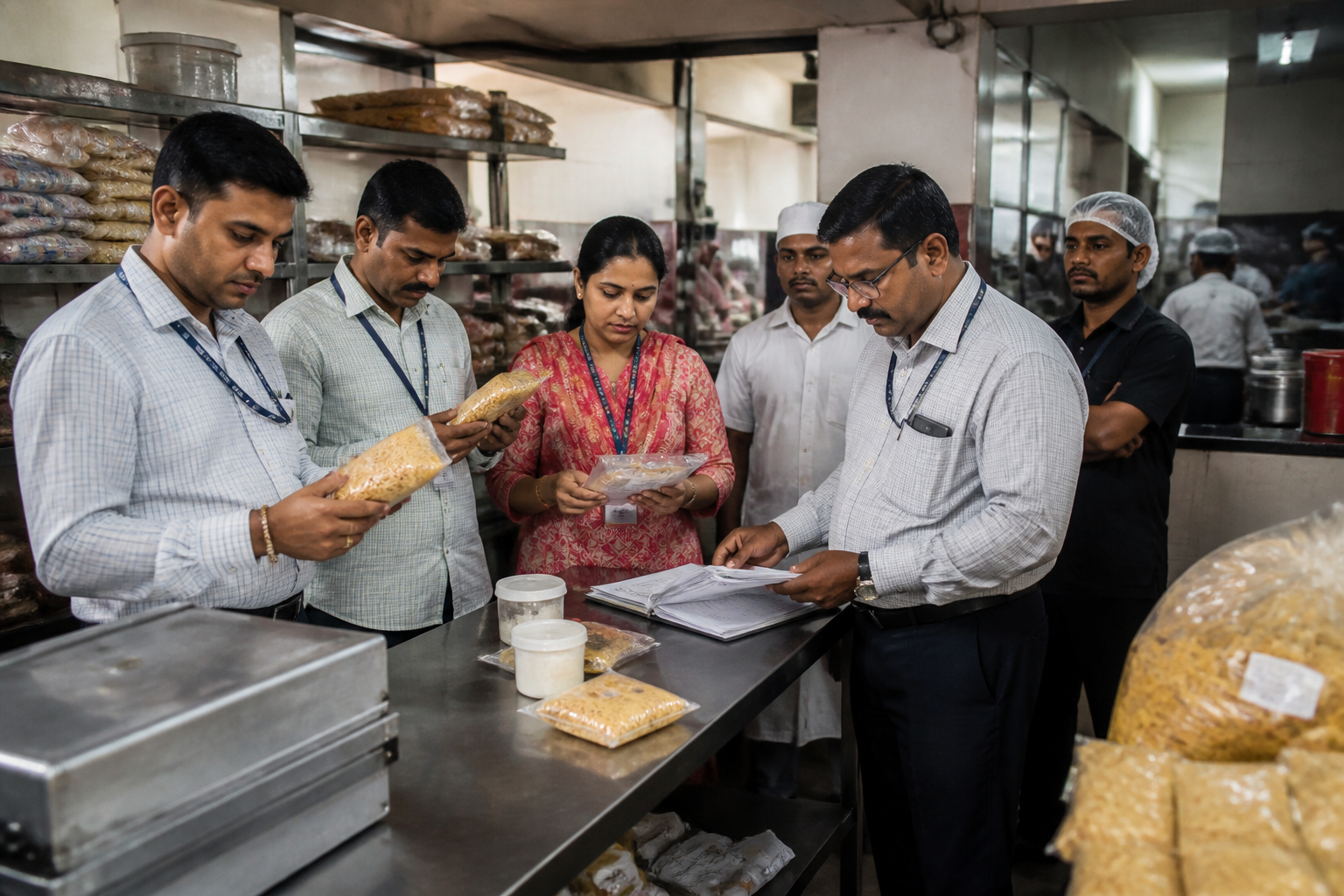
The international attention around Maharashtra Food and Drug Administration chief Tukaram Mundhe has brought an unusually visible regulatory campaign into focus. The New York Times has described the IAS officer as a “rockstar” and “food safety celebrity” for his surprise inspections, but the more consequential story lies in the administrative machinery being built behind the publicity: inspections, licence suspensions, seizures, digital case tracking and an attempt to use artificial intelligence to stretch a workforce that the department says is far smaller than its regulatory needs.
That distinction matters because food and medicine safety are not occasional enforcement problems. They are routine urban governance functions involving restaurants, pharmacies, warehouses, caterers, manufacturers, street-food sellers, hospitals and consumers. The Maharashtra FDA’s current campaign indicates an effort to move from sporadic action against visible violations towards a system that continuously identifies risk, records decisions and tracks whether officers respond within prescribed timelines.
The numbers supplied by the department show the scale of the push. Between June 1 and August 31, it conducted 12,083 food inspections and collected 37,604 food and drug samples. It issued 5,269 improvement notices, suspended 603 food licences, seized food stock worth Rs 67.2 crore and reported 875 arrests in food-related cases. These figures cover enforcement activity across Maharashtra, rather than a single city, but they describe a regulatory system operating across a dense and varied food economy.
The figures also show why enforcement cannot be reduced to restaurant raids. The department conducted 2,902 inspections on the drug side and seized illegal medicines and cosmetics worth Rs 11.41 crore. Its action against banned gutkha and pan masala resulted in 644 FIRs, 867 arrests and the seizure of stock worth Rs 19.62 crore. During a separate festive-season operation between September 23 and 27, the FDA suspended food licences and seized 50,601.78 kg of food stock valued at Rs 1.19 crore across several divisions.
These operations reflect the visible end of regulation. The less visible challenge is deciding where limited officers, laboratories and administrative capacity should be deployed. The FDA’s sanctioned strength is 1,271 personnel, while a roadmap submitted by the commissioner estimates that nearly three times as many staff would be required to meet regulatory needs across Maharashtra. That gap changes the meaning of every inspection figure. A high volume of action may indicate stronger enforcement, but it also raises a basic administrative question: can the system maintain consistent coverage when its required staffing level is substantially above its sanctioned strength?
The department’s answer is to combine enforcement with digital systems. Its online platform tracks complaints, assigns them to officers and sets response deadlines. Higher authorities are alerted when action is delayed, while an audit trail allows senior officials to monitor cases in real time. The FDA is also examining how inspection records, laboratory results, complaints, licensing information and previous violations can be brought together to identify establishments and products requiring greater scrutiny.
This is an important shift in the operating model. A conventional inspection system largely depends on individual officers deciding where to go and how quickly to act. A case-management system creates a record of the complaint, the assigned officer, the response deadline and the eventual action. That does not by itself guarantee better enforcement, but it makes delays more visible and creates an institutional trail that can be reviewed by senior officials.
Mundhe has described artificial intelligence as a tool to help the existing workforce “see more, respond faster”, rather than replace officers. The distinction is significant. The department’s stated technology strategy is not based on removing human inspection, sampling or decision-making. It is based on combining information that already exists in different parts of the regulatory process so that officers can prioritise their attention.
The source material does not establish how accurately such a system identifies risk, how the data is cleaned, or whether the technology is already fully operational. It does, however, show the direction of travel: complaints, test results, licences and past violations are being treated as connected information rather than isolated files. For a regulator with a large staffing gap, that connection is central to any attempt to expand coverage without simply adding more paperwork.
The campaign also extends the regulatory perimeter beyond the locations most commonly associated with food safety. The FDA has acted against pharmacies selling antibiotics without prescriptions, and hundreds of pharmacy licences have been cancelled or suspended. Mundhe has raised concerns about high margins on hospital consumables and recommended bringing such products under regulated pricing. On the food side, the department has imposed a one-year ban on the manufacture, storage, distribution and transportation of analogue paneer.
Packaging is another example of how food regulation intersects with everyday urban consumption. The FDA is working on measures to improve food packaging, including a proposal for food-grade, non-toxic ink in newsprint used to wrap street food. The issue is not limited to formal restaurants or large manufacturers. It reaches the informal and low-cost food economy through which many urban residents buy meals and snacks every day.
Large gatherings have also been brought into the department’s field of attention. Weddings, community events and other functions require caterers and event operators to comply with registration and safety requirements. This expands the focus from permanent premises to temporary food-service arrangements, where large numbers of people may be served in a short period. The administrative challenge is different, but the principle is the same: food safety has to be monitored wherever food is prepared, stored, distributed or served.
The FDA’s approach therefore combines three forms of state capacity. The first is enforcement: inspections, notices, seizures, licence action and criminal cases. The second is enabling infrastructure: digital complaint management, audit trails, information systems and proposed technology tools. The third is public awareness. Under its “Safe Food for Every School Child” initiative, the department conducted 270 workshops involving 60,990 schools across Maharashtra between April 1 and September 11.
The department describes this wider strategy through three pillars — Empower, Enable and Enforce. The wording captures a significant institutional ambition. Enforcement deals with violations after they are detected. Enabling systems are intended to help officers and businesses meet regulatory requirements. Empowerment, including awareness among consumers and students, seeks to make food and medicine safety a continuing public-health concern rather than an issue that appears only during raids or after an incident.
The data supplied in the report shows strong activity, but it does not yet establish the long-term outcomes of the campaign. It does not say how many improvement notices led to corrected practices, whether suspended licences were restored after compliance, how many seized products were unsafe, or how inspection coverage is distributed between urban and rural areas. Nor does it provide a comparison with earlier periods that would show whether the enforcement drive represents a sustained change or a temporary surge.
Those missing measures are important because regulatory performance is not captured by arrests and seizures alone. Action figures demonstrate activity, while safer food and medicines would demonstrate outcomes. A mature system would need to connect inspections and enforcement to follow-up compliance, laboratory findings, complaint resolution and repeat violations. The digital audit trail described by the FDA could make that kind of monitoring possible, but the supplied material does not confirm whether such outcome reporting is already available.
The public profile of the FDA chief has made the campaign easier to notice. The New York Times coverage highlighted the contrast between diners who admire Mundhe and restaurant owners who fear his inspections. Mundhe, in response, said that “good governance is not about making headlines” and that food safety is about protecting people, upholding standards and building public trust. His statement points to the central test for a high-visibility enforcement model: whether attention remains attached to consistent institutional practice rather than to one official’s public image.
That test is especially relevant when enforcement crosses multiple sectors. Restaurants, pharmacies, manufacturers, caterers and hospitals operate under different commercial pressures and may interact with different parts of the regulatory system. A campaign that produces visible action in one category but lacks consistent follow-up elsewhere could create publicity without building durable compliance. The information system, staffing plan and public-awareness programme are consequently as important as the raids that attract headlines.
What the evidence confirms is that Maharashtra’s FDA is pursuing a broad enforcement and administrative reform agenda, supported by substantial inspection and seizure activity and accompanied by efforts to digitise oversight. What remains unclear is whether the department has the staffing, data quality and follow-up capacity to sustain that agenda across the state. The next measure of success will not be the international profile of its chief, but whether the system can turn enforcement activity into reliable, transparent and continuing protection for consumers.
