


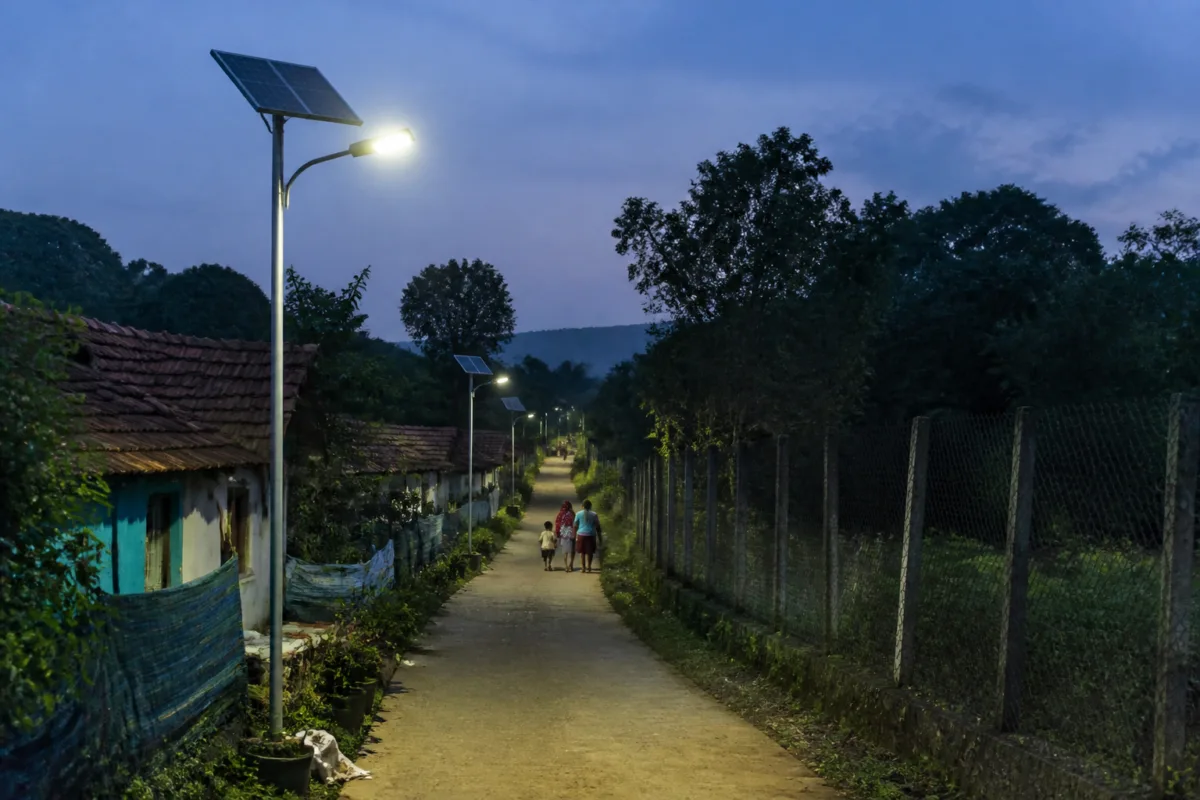
Twenty solar-powered street lights have been installed in Kudamulla, a remote tribal hamlet in the western Nilgiris, improving visibility along internal pathways and access routes used by residents near the Mudumalai Tiger Reserve.
The first phase of Project Ray, described as a sustainable streetlight mission, was launched by C.K. College of Engineering and Technology (CKCET), Cuddalore, a unit of the CKGroup of Educational Institutions, in partnership with the Sustainable Development Council (SDC). The initiative was proposed by Seerakku, the environmental and sustainability unit of SDC.
Kudamulla is home to 120 tribal families. Before the project, the settlement had only four streetlights, leaving several pathways inadequately illuminated after dark. The limited lighting made it difficult for residents to identify the presence of wild animals in and around the settlement, according to the report.
The new installations are intended to address the most important visibility gaps within the hamlet. The lights have been placed at village entry and exit points, along pedestrian routes, near forest boundaries and on pathways commonly used by schoolchildren.
The location gives the lighting project a specific safety dimension. Kudamulla lies in an area characterised by wildlife movement near the Mudumalai Tiger Reserve, making visibility on routes between homes, forest edges and access points particularly important for residents. The project therefore combines a basic public infrastructure intervention with the use of renewable energy in a remote settlement.
The installation also highlights the uneven distribution of essential urban and rural infrastructure across settlements. While street lighting is a routine municipal service in many built-up areas, remote tribal hamlets can have far fewer fixtures and more difficult access conditions. In Kudamulla, the increase from four streetlights to 24 changes the coverage of the settlement’s internal routes, although the supplied report does not specify the lighting technology, operating capacity, maintenance arrangement or total project cost.
Project Ray’s first phase has focused on the areas where darkness creates the greatest practical difficulty: routes used by pedestrians and schoolchildren, access points to the hamlet and stretches adjoining the forest. The placement indicates an effort to connect infrastructure provision with the way residents move through the settlement rather than installing lights only at a central location.
The initiative has been presented as a sustainable energy solution for tribal communities. Solar-powered lighting can be deployed in locations where conventional electricity infrastructure may be difficult to extend, but the report does not provide details on battery storage, lighting duration, seasonal performance or responsibility for repairs. Those factors will determine how consistently the new lights serve residents over time.
For Kudamulla’s families, the immediate change is improved illumination after dark along selected routes. The next stage of the project, including any further installations or maintenance plan, has not been detailed in the supplied report.

