


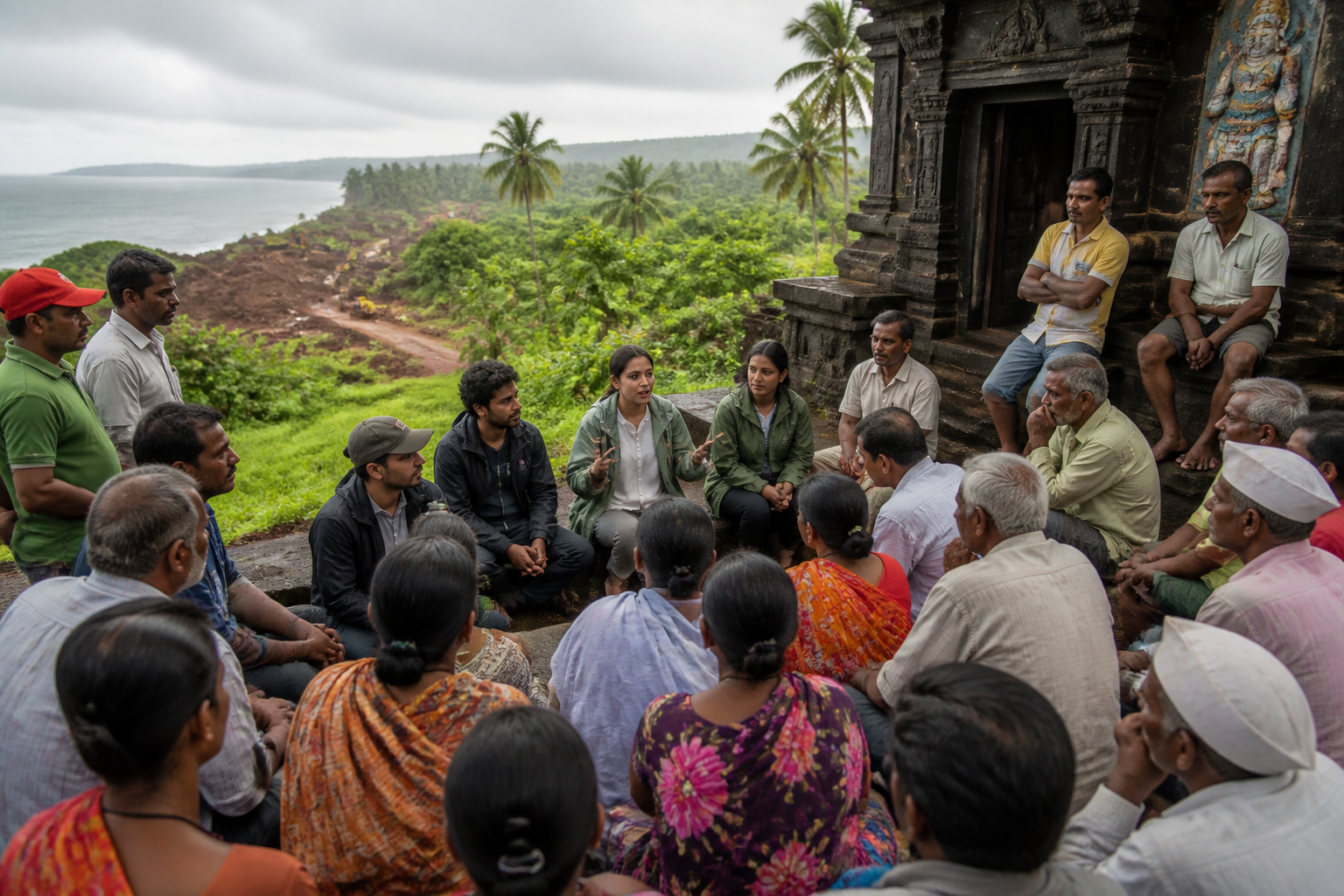
The Rakhandar Yatra, a village-to-village campaign across the Konkan region, is turning a cultural idea of guardianship into a response to the pressures created by river diversion, mining, large industrial projects, coastal land transactions and unplanned development. Its significance lies not in one protest, but in the attempt to connect several local disputes through a common question: who gets to define development in a region where land, water, agriculture, fishing and cultural life are closely linked?
The yatra began in June at the Mauli temple in Kankumbi village on the Goa-Karnataka border and entered Maharashtra in July. Its organisers include farmers, environmentalists, entrepreneurs and young professionals. They travel through villages for four to five days each month, meeting residents, farmers and fishing communities and discussing concerns that range from land and forests to addiction among young people and social harmony.
That format matters because the conflicts identified by the group are geographically dispersed and administratively divided. A proposed diversion of water from the Mandovi River towards the Malprabha basin is located on the Goa-Karnataka border. Mining and unplanned development concerns have emerged in Sindhudurg. Ratnagiri has been the site of opposition to a proposed nuclear power plant and a chemical refinery, while the state government is considering private nuclear power projects in the region. Coastal land sales and the future of fishing communities add another layer to the debate.
Taken separately, each issue belongs to a different policy system: water allocation, mining regulation, industrial planning, energy infrastructure, land markets or coastal management. Taken together, they represent a regional land-use question. The yatra’s central argument is that these decisions are changing the conditions that support Konkan’s settlements and livelihoods, even when projects are evaluated individually.
The campaign’s name comes from the Marathi and Konkani idea of a rakhandar, or protector, and from Vetoba, also known as Vetal, a guardian deity worshipped in parts of Konkan and Goa. In the organisers’ telling, Vetoba represents a protector at the village boundary. The symbolism allows the group to speak about environmental protection through a cultural vocabulary that is already familiar in local communities.
Malhar Indulkar, a young biologist from Chiplun in Ratnagiri and one of the core members of the team, said Kankumbi was selected because of its association with the Mandovi River. He said local residents and environmentalists were opposing the proposed diversion and alleged that water was being planned for industrial use in the name of mitigating drought. The campaign’s stated objective is to protect what it describes as the region’s natural wealth.
The report does not establish the final status, approval or technical design of the proposed diversion. It does, however, show how water infrastructure can become a question of regional identity and livelihood. Rivers in the Konkan are not only channels for water supply. They shape settlement patterns, agriculture, fisheries, religious traditions and the ecological systems on which villages depend. A change in the natural course of water therefore has consequences that may extend beyond the immediate project corridor.
The yatra moved through Dodamarg and Banda in Sindhudurg, where coordinator Satyajit Chavan said villages were exposed to the threat of mining and unplanned development. It then travelled through Malvan and Vengurla, holding discussions with fishing communities. These locations illustrate a recurring challenge in regional planning: environmental and social impacts are experienced locally, while permissions, investment decisions and project approvals are often handled through institutions operating at state, national or sectoral levels.
This institutional distance can make public participation difficult. Residents may experience a project through changes in access to land, water or coastal space before they see its full implications in official planning documents. Communities may also understand cumulative impacts differently from the way individual project applications define them. The Rakhandar Yatra is attempting to create a shared public conversation across villages that would otherwise be treated as separate administrative cases.
In August, the group travelled through Ratnagiri, including Jaitapur, Madban and Barsu. These areas have been associated with protests over projects including a proposed nuclear power plant and a chemical refinery. The state government is also considering private nuclear power projects in the region, according to the report. The presence of large energy and industrial proposals raises questions about the relationship between regional infrastructure needs and the distribution of environmental and social costs.
The evidence supplied in the report does not provide project-level figures for land acquisition, employment, investment, resettlement, water demand or environmental impact. It therefore cannot establish whether any individual project is viable, unlawful or harmful in its final form. What it does establish is that a number of communities are interpreting different proposals as part of a common transformation of the Konkan landscape.
The yatra’s village meetings begin, in most cases, at a local temple. After prayers to the gramdaivat, or village deity, members sit with residents and discuss problems affecting the settlement. The practice reflects the way local institutions and cultural traditions can function as entry points for public engagement. It also indicates that environmental politics in the region cannot be understood only through formal consultations, regulatory hearings or technical reports.
Konkan’s village deities, including Sateri, Sukai, Chatkai, Kalkai, Zolai and Janai, are closely linked to local landscape and community life. The organisers use this connection to frame protection not as opposition to every form of development, but as a responsibility towards the social and ecological systems that make village life possible.
This distinction is important. Development conflicts are often reduced to a binary between infrastructure and resistance. The Rakhandar Yatra presents a more layered position. Its organisers oppose what they describe as forced development projects, but they also promote agriculture, local food, sustainable livelihoods and cultural practices. Prasad Gawde, a key member of the yatra and the creator of the Konkani Ranmanus YouTube channel, said the campaign was not only about resistance and should also support people preserving Konkan’s lifestyle.
That broader agenda places the yatra within a wider debate about what regional development should measure. Conventional project assessments generally focus on land, cost, construction, output, compliance and direct economic benefits. Local communities may measure development through the continued viability of farms, fisheries, forests, water sources, village institutions and access to ancestral land. These are not always captured adequately by project-level metrics.
The campaign has also adopted visual references from Konkan’s ancient rock art. Its logo is inspired by petroglyphs found on laterite plateaus. The Geoglyphs of Konkan Region of India were added to UNESCO’s Tentative List in 2022, with sites including Kasheli, Rundhye Tali, Devache Gothane and Barsu in Maharashtra. This connection gives the campaign another way to link contemporary land-use decisions with the region’s archaeological and cultural landscape.
The inclusion of Barsu in that list is particularly relevant to the yatra’s route through Ratnagiri, although the supplied material does not establish how heritage protection is being applied to any specific proposed project. It does show that the region’s development question involves more than environmental clearance. Cultural landscapes, archaeological features and community memory can also influence how land is valued and protected.
The government’s role in this landscape is distributed across multiple authorities and policy areas. Water diversion involves river-basin planning and inter-state considerations. Mining requires regulation of extraction and land use. Nuclear and chemical projects involve industrial, energy, environmental and safety frameworks. Coastal land and fishing livelihoods intersect with land administration, coastal regulation and local governance. The report does not identify the final decisions taken by each authority, but the range of issues explains why local communities may see a need for a coordinated regional platform.
The Rakhandar Yatra does not replace formal institutions, statutory approvals or technical assessments. Its importance is that it is building a network of local testimony around decisions that are usually processed project by project. By travelling between villages, the organisers are making the case that water, land, culture and livelihoods should be considered together rather than as isolated concerns.
The campaign also reveals a data gap. The supplied report records the locations, concerns and participants involved, but it does not provide a consolidated assessment of how much agricultural land, forest, coastal property or water could be affected by the different proposals. Nor does it present a common framework for comparing the benefits and costs of mining, industrial development, energy projects and local livelihoods. Without such information, public debate remains vulnerable to both official simplification and activist generalisation.
That gap is central to the larger urban question. Konkan is not only a rural landscape separate from India’s urbanisation story. Its land and natural resources are connected to cities through energy demand, industrial supply chains, tourism, food systems, migration, real estate and transport infrastructure. Decisions made in or for the region can therefore affect urban economies while imposing costs on communities that are not the primary beneficiaries.
The yatra’s work suggests that regional planning needs to account for cumulative change. A river diversion, a mine, an industrial project, a coastal land transaction and a road or tourism expansion may each be assessed independently, yet their combined effect can alter settlement patterns and local livelihoods. The report does not quantify that cumulative impact, but the campaign’s route is effectively an attempt to map it through community conversations.
What the Rakhandar Yatra confirms is the emergence of a shared civic language around Konkan’s development pressures. What remains uncertain is how the concerns raised by communities will enter formal decision-making, whether project authorities will respond through transparent evidence, and how competing claims over land, water and livelihoods will be reconciled. The next important developments will be the decisions and consultations attached to the proposed water diversion, mining activity and large projects in Ratnagiri and Sindhudurg, as well as the yatra’s continuing village meetings.
