


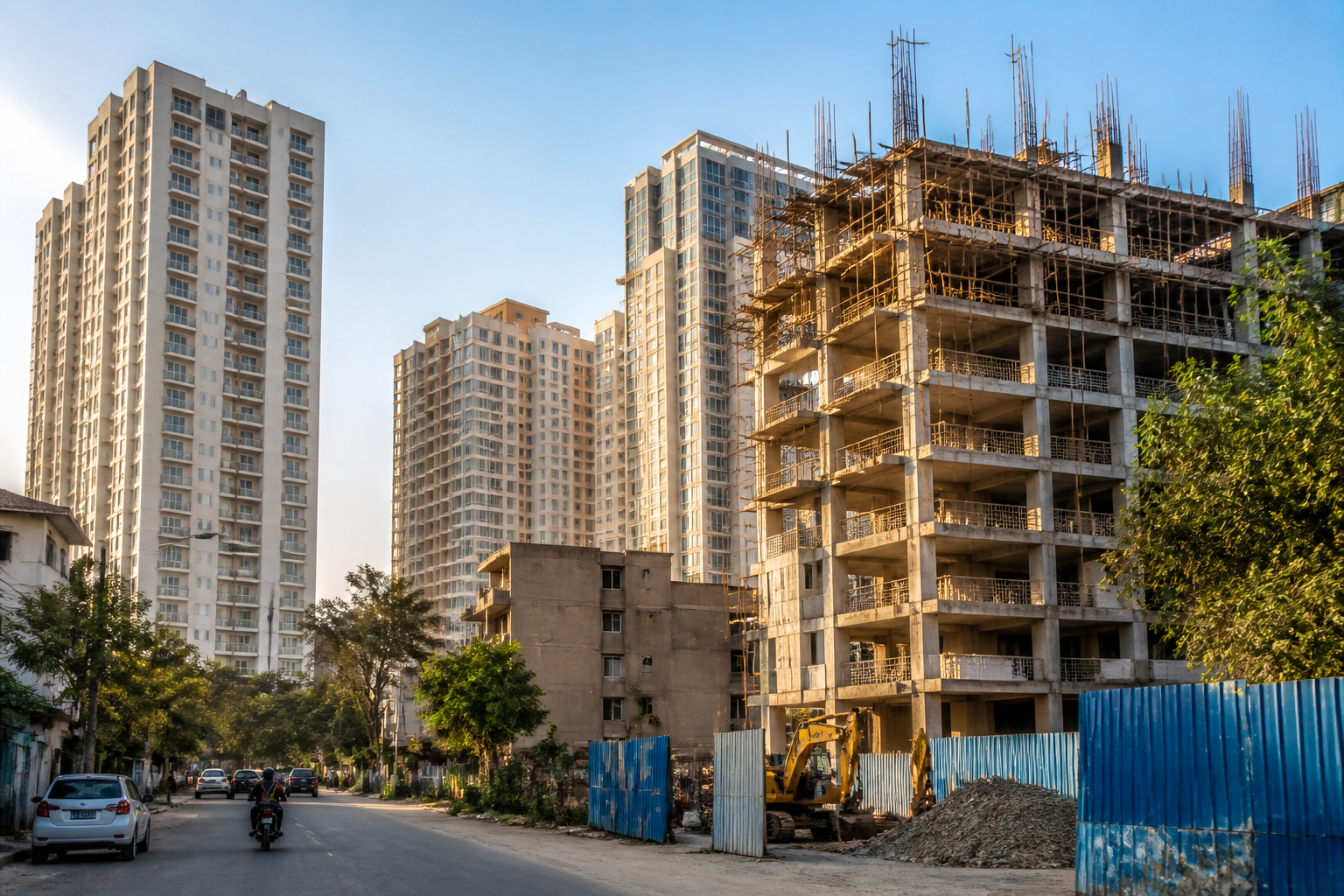
Kolkata’s housing market is gaining strength without the sharp price escalation seen in some other major Indian markets. Sales rose 4% to 13,022 units between January and September 2026, while unsold inventory fell 10% to about 18,100 units, according to the latest assessment by Knight Frank India. The combination of rising sales, controlled new supply and relatively moderate price growth points to a market where demand is improving faster than developers are adding homes.
The figures matter because they show more than a short-term increase in transactions. They offer a snapshot of how Kolkata’s residential market is balancing demand, supply and affordability at a time when homebuyers are increasingly segmenting themselves by price, quality and lifestyle. The city recorded the second-highest sales growth among eight major Indian residential markets covered in the assessment, although the supplied report does not identify the market that ranked first.
The market’s performance was spread across all three quarters. Kolkata recorded sales of 4,043 units in the first quarter, 4,325 units in the second and 4,654 units in the third. Sales in the third quarter were 6% higher than in the same period a year earlier. This sequential rise suggests that the market did not depend on a single quarter or one isolated burst of transactions during the nine-month period.
New supply moved in the opposite direction. Developers launched 11,503 residential units between January and September, down 2% from 11,751 units during the corresponding period of the previous year. Quarterly launches stood at 3,475 units in the first quarter, 3,841 in the second and 4,187 in the third. While launches increased through the year, the nine-month total remained below the previous year’s level.
That gap between sales and launches is central to the market’s current position. Developers sold 1,519 more homes than they launched during the first nine months of 2026. The resulting reduction in available stock helped bring unsold inventory down to approximately 18,100 units. The report also recorded a decline in Kolkata’s Quarters to Sell, or QTS, from 4.7 quarters a year earlier to 4.3 quarters in the third quarter of 2026.
QTS is a measure of how long existing inventory would take to sell at the prevailing pace of transactions. A lower figure indicates faster absorption of available homes, assuming the sales rate remains comparable. Kolkata’s QTS of 4.3 quarters was the lowest among the eight major residential markets assessed, compared with an average of 6.1 quarters across those markets. This gives Kolkata a relatively strong inventory position, though the measure does not by itself establish whether every project or location is performing equally.
### Kolkata housing market shifts towards higher ticket homes
The demand profile is changing alongside the overall improvement in sales. Homes priced between Rs 50 lakh and Rs 1 crore recorded an 11% rise in sales to 4,693 units. This was the largest price segment by reported share, accounting for 36% of total sales. Sales of homes priced between Rs 1 crore and Rs 2 crore increased 6% to 1,970 units.
Together, these two segments accounted for 6,663 units, or more than half of the homes sold during the period. The figures indicate a strong market for mid- and higher-ticket housing, even though homes priced below Rs 50 lakh remained the single largest category. That lower-price segment recorded sales of 4,996 units, representing 38% of total sales.
The comparison between the two measures is important. Homes below Rs 50 lakh continue to form the largest individual segment, but the Rs 50 lakh-to-Rs 2 crore range is larger when the two categories are combined. This suggests that Kolkata’s housing demand is not moving entirely away from affordability-sensitive buyers, but that a substantial portion of the market is now willing or able to purchase more expensive homes.
The report also recorded sharp year-on-year increases in the luxury categories. Sales of homes priced between Rs 5 crore and Rs 10 crore rose 285%, while the Rs 10 crore-to-Rs 20 crore segment increased 7,200%. These percentages need to be read carefully because the report states that both categories had a small base. A large percentage increase from a limited number of transactions does not establish that luxury housing has become a mass-market trend.
However, the direction of the change is consistent with the assessment’s broader account of buyer preferences. Sourced comments from Sакet Mohta, managing director of Merlin Group, said buyers were giving greater importance to quality, lifestyle and long-term value while making purchase decisions. The supplied report attributes the emergence of a gradually strengthening luxury residential market in Kolkata to the rising sales recorded in these categories.
### Prices remain below the pace of inflation
Kolkata’s weighted average residential property price rose 4.2% in the third quarter of 2026 to Rs 5,961 per square foot. The increase was below the reported consumer inflation rate of 4.8%. In practical terms, the assessment places Kolkata among the relatively affordable major residential markets, at least on the relationship between property-price growth and consumer inflation used in the report.
This distinction is significant for the city’s housing market. A rise in prices does not automatically indicate deteriorating affordability, but the pace of that rise matters. In Kolkata’s case, the reported price increase was lower than consumer inflation, while sales grew and inventory declined. The combination suggests that demand strengthened without a corresponding surge in average prices during the period covered.
The available evidence does not establish how affordability varies across neighbourhoods, project types or household-income groups. It also does not provide information on mortgage rates, household incomes, rents or the distribution of homes within each price category. Those factors would be necessary to assess affordability from the perspective of individual households rather than the citywide market average.
The data nevertheless identifies a market with a relatively short inventory cycle. Kolkata’s 4.3-quarter QTS was 1.8 quarters below the eight-market average of 6.1 quarters. If sales and new launches remain broadly balanced, this could limit the accumulation of unsold homes. But the current data covers only the first three quarters of 2026 and does not establish how the market will perform over a longer period.
### Supply discipline is shaping the market
The most important institutional feature in the assessment is the relationship between developer launches and actual sales. New launches fell 2% year on year even as sales increased 4%. This indicates that supply did not expand at the same pace as demand during the nine-month period. The effect was visible in both the decline in unsold inventory and the fall in QTS.
For developers, lower inventory can reduce the pressure to offer discounts or carry completed but unsold homes for extended periods. For buyers, however, a declining stock of available homes can have different effects depending on location and price segment. It may indicate healthier absorption, but it may also reduce choice in projects where new supply is not replacing completed inventory. The supplied assessment does not provide enough detail to determine which of these effects is dominant across Kolkata.
The quarterly launch figures show that developers were still adding supply as the year progressed. Launches increased from 3,475 units in the first quarter to 4,187 units in the third. The market therefore was not characterised by a complete withdrawal of new projects. Rather, the nine-month data points to measured supply growth alongside stronger sales.
That balance is particularly relevant in a city where buyers appear to be distributing demand across multiple price bands. The largest individual share remained below Rs 50 lakh, while the combined Rs 50 lakh-to-Rs 2 crore categories represented more than half of sales. Developers responding to this demand would need to align not only the total number of units launched but also the size, location, specification and price of those homes. The report, however, does not provide a detailed breakdown of launches by price segment.
### What Kolkata’s numbers establish—and what they do not
The Knight Frank India assessment establishes four clear trends for the period from January to September 2026: sales increased, new launches declined slightly, unsold inventory fell and the time required to sell available stock shortened. It also records a 4.2% increase in weighted average prices in the third quarter and identifies increased activity in the Rs 50 lakh-to-Rs 2 crore categories.
Together, these indicators describe a market with improving absorption and controlled price movement. They do not establish that all segments are equally strong, that all buyers are experiencing improved affordability or that the city has entered a broad-based luxury housing boom. The exceptionally high growth rates in the most expensive categories are explicitly subject to a small-base effect.
The assessment also does not explain the precise reasons behind the sales increase. It records comments that buyers are placing greater emphasis on quality, lifestyle and long-term value, but the supplied material does not quantify the role of income growth, credit conditions, employment, migration, infrastructure access or specific housing projects. Those factors may shape demand, but they cannot be treated as established explanations on the available evidence.
For Kolkata’s urban economy, the immediate significance lies in the market’s alignment between demand and supply. A city’s housing system is affected not only by how many homes are sold but also by whether new construction produces homes that match what households can and want to buy. The reported sales mix suggests that this question is becoming more important as demand expands across both affordable and higher-ticket segments.
The next indicators to watch are the final-quarter sales and launches, whether unsold inventory continues to fall, and whether price growth remains below consumer inflation. The market’s current strength is supported by a nine-month rise in transactions, a 10% reduction in unsold homes and the lowest reported QTS among the eight assessed cities. Its longer-term direction will depend on whether developers maintain supply discipline while continuing to meet demand across Kolkata’s distinct price segments.
