


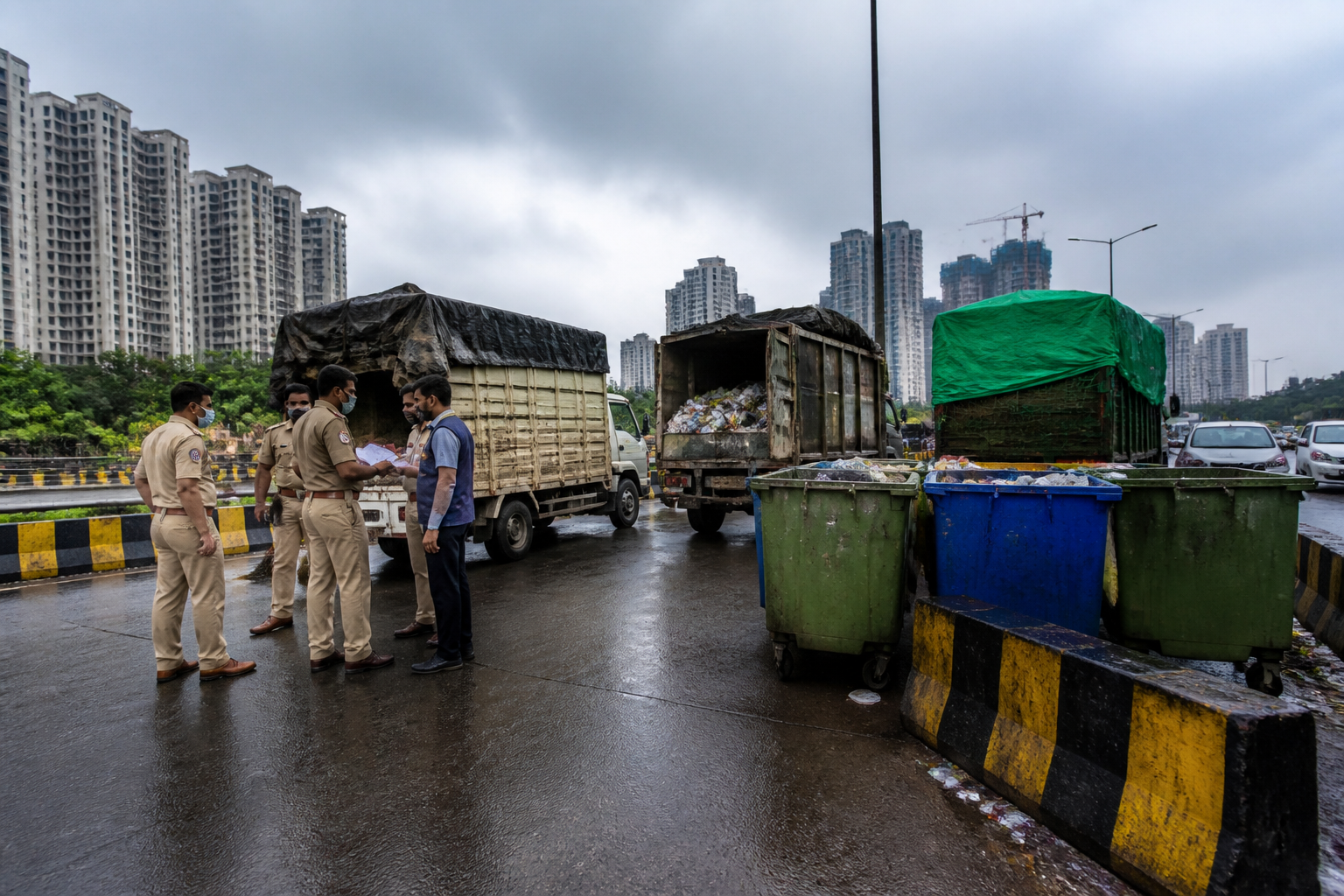
The arrests of 10 people and seizure of seven vehicles in a suspected Delhi-to-Gurugram waste-dumping network reveal more than an unauthorised movement of garbage. They point to how urban waste can travel across administrative borders when collection, transport, recovery and disposal systems remain poorly coordinated.
According to Gurugram Police, vehicles carrying municipal waste and plastic waste from Delhi were bringing it into Gurugram, where plastic and other reusable material were allegedly separated and sold. The police said the action was carried out on Sunday evening after officials were instructed to prevent Gurugram from becoming a dumping ground for waste generated elsewhere.
The case is significant because the reported network appears to have combined two activities that are often treated separately: illegal dumping and informal material recovery. The allegation is not merely that waste was deposited outside the place where it was generated. It is also that the waste was moved through a coordinated chain, sorted for valuable material and then sent to other buyers. That makes the issue one of urban logistics and accountability, not only enforcement.
### A waste chain crossing city borders
The police action followed a review meeting chaired by Haryana Chief Minister Nayab Singh Saini on Friday, at which officials were directed to ensure that Gurugram did not become a dumping ground for waste from other areas. Gurugram Police subsequently began checking vehicles at multiple locations without waiting for a formal complaint, according to the report.
Four first information reports have been registered across three police station areas, the report said. Two were filed at Bajghera police station and one each at Udyog Vihar and Rajendra Park. Police spokesperson ASI Sandeep Kumar said the checking and roadblock operations were conducted under the direction of the police commissioner and supervision of the deputy commissioner of police, west.
The locations matter because waste movement is rarely confined to one municipal boundary. A vehicle may be hired in one city, loaded at multiple points, routed through adjoining districts and unloaded at a private or informal site. Responsibility can become fragmented between the waste generator, contractor, vehicle owner, driver, intermediary and receiving site. The reported investigation is now attempting to identify those links.
Police are examining the ownership of the seized vehicles and have issued notices to their owners to join the investigation. They are also checking whether any of the vehicles were connected to a Delhi government or private agency. The report said no prima facie link with a Delhi municipal body had emerged so far. That distinction is important: the arrests establish police action and allegations against those detained, but they do not by themselves establish institutional involvement by a civic agency.
### Gurugram’s existing waste burden
The reported network has emerged in a city already struggling with the volume and treatment of its own municipal waste. Civic data cited in the report puts Gurugram’s daily municipal solid-waste generation at about 1,200 tonnes. That is a substantial operational burden even before waste from outside the city is added to the system.
Gurugram’s largest waste-management challenge is the legacy waste accumulated at the Bandhwari landfill site. The site has been associated with concerns over groundwater contamination, toxic leachate and recurring fires, and the matter is also before the National Green Tribunal. The result is a waste system carrying both a daily flow problem and a historical accumulation problem.
These two pressures interact. Daily waste must be collected and moved without interruption, while old waste must be processed or cleared over time. If collection, segregation and processing capacity do not keep pace, material can be diverted to unauthorised sites or informal sorting locations. The alleged Delhi-Gurugram chain shows how gaps in one city’s waste system can become an operational and environmental problem for another.
The report also notes that household waste is still not fully segregated at source across most parts of Gurugram. This weakens the value of downstream processing because wet waste, dry recyclables, plastic and other materials arrive mixed together. Once mixed waste enters a vehicle or landfill, separating useful material becomes more difficult, costlier and potentially unsafe.
### Enforcement is only one part of accountability
The arrests represent an enforcement response, but the investigation’s next stage will determine whether it can identify the full supply chain. Police are seeking to establish where the waste was collected in Delhi, who transported it to Gurugram and how many intermediaries were involved. That inquiry could clarify whether the activity was organised around individual vehicle operators, private contractors, scrap buyers or a wider set of handlers.
The vehicle trail is likely to be central to that process. Vehicle ownership records, notices issued to owners and any links with public or private waste agencies may help establish who controlled the movement of material. However, the supplied report does not establish the final legal responsibility of the arrested people, the vehicle owners or any organisation. Those questions remain part of the investigation.
The institutional challenge is that waste management is divided across several stages and authorities. Municipal bodies are responsible for arranging collection and managing local systems, contractors may operate vehicles or processing facilities, police handle criminal allegations, and environmental regulators or tribunals may examine pollution and compliance. When these functions operate without a shared chain-of-custody system, it becomes difficult to know where waste originated and where responsibility changed hands.
The reported use of the phrase “dumping ground” also raises a planning question. A city can become a receiving point not because it has formally agreed to accept outside waste, but because it has open land, vulnerable edges, weak monitoring or an established informal recovery economy. Preventing such movement therefore requires more than roadside checks. It requires reliable records of waste generation, collection, transport, processing and final disposal.
### The gap between waste generation and waste control
Gurugram’s reported 1,200-tonne daily waste load provides the clearest measure of the scale involved. Yet the number alone does not show how much waste is segregated, processed, recycled, landfilled or diverted. The report indicates that collection and processing arrangements have depended on interim systems and short-term tenders over the past two years. That administrative instability can make long-term capacity planning harder.
Short-term arrangements may keep services running, but they can also create uncertainty over who is responsible for infrastructure, performance monitoring and continuity. Waste collection is a daily public service; its contracts, routes and processing arrangements must work every day, including when facilities are full, tenders expire or disposal sites face environmental restrictions.
The alleged interstate network also shows why waste should be tracked as a material stream rather than treated only as a sanitation problem. Plastic and other recoverable materials have economic value, which creates incentives for sorting and resale. But when recovery happens outside authorised facilities, the same process can be linked to unsafe working conditions, uncontrolled residue dumping and unclear environmental responsibility.
At the other end of the chain, Bandhwari’s legacy waste and the concerns before the National Green Tribunal demonstrate the consequences of accumulated failures. Fires, leachate and groundwater risks are not isolated landfill events; they are outcomes of a system in which waste reaches its final destination without sufficient segregation, processing or monitoring.
The immediate police action may disrupt one reported network, but the wider test is whether authorities can trace waste movements beyond this case. The investigation’s findings on collection points, vehicle owners, intermediaries and buyers will show whether the alleged operation was an isolated criminal arrangement or a symptom of wider weaknesses in the regional waste economy.
For residents, the central issue is not simply whether waste from Delhi entered Gurugram. It is whether both cities can demonstrate where their waste goes after it leaves homes, markets and institutions. The evidence currently confirms arrests, vehicle seizures, four FIRs and an investigation into the supply chain. It does not yet establish the complete network or any municipal agency’s involvement. The next official steps—identifying the waste sources, tracing the intermediaries and determining the role of vehicle owners—will be crucial to understanding the scale of the problem.
