


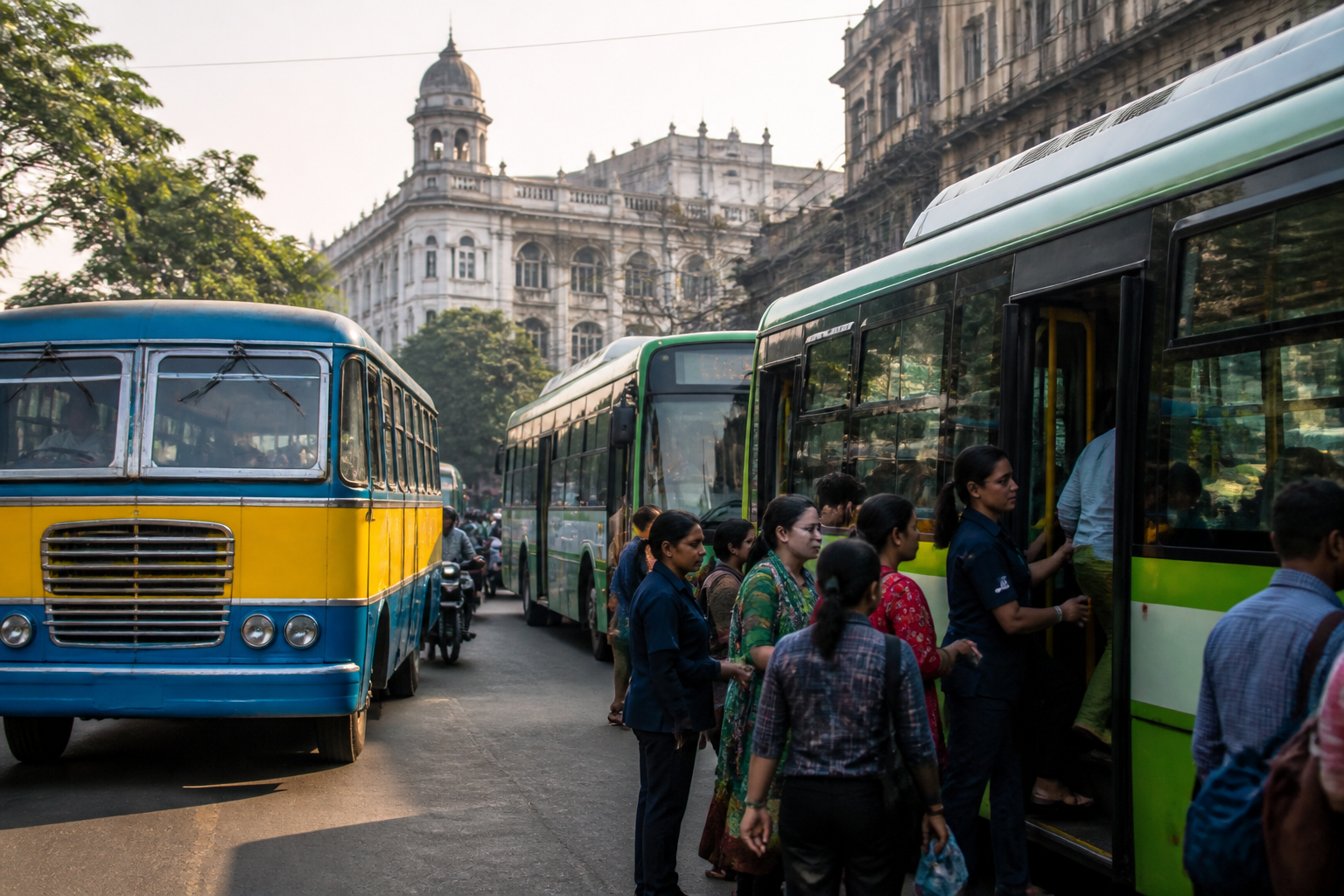
Kolkata Bus Jatra 4.0 will bring together heritage buses, contemporary public transport and women working behind the wheel on October 2, turning an enthusiasts’ event into a useful reminder of how deeply buses remain embedded in the city’s urban life. The annual journey will run from Howrah Maidan to Rabindra Sadan and back, but its significance extends beyond a ceremonial ride: it places the history, labour and changing technology of Kolkata’s bus system in the same frame.
Organised by the Kolkata Bus-o-Pedia Foundation, Bus Jatra began in 2023 to celebrate the heritage and continuing evolution of buses in the city. The fourth edition will feature four vehicles representing different aspects of Bengal’s bus history and public transport. A minibus on Route 29, connecting Tikiapara and Salt Lake, will participate for the first time. A Route 57 bus owned and operated by Dolly Rana, a Route 52 bus and a vehicle from the 103-year-old Ramrajatala-Esplanade route will also be part of the journey.
The event’s historical premise is unusually long-term. Kolkata’s bus history, according to the organisers’ account reported by The Telegraph, reaches back to a horse-drawn omnibus service introduced in 1830. That history is not simply a matter of preserved vehicles or old routes. It reflects how public transport has adjusted to the city’s changing geography, commuter needs and operating realities. Routes that survive across decades become more than lines on a map: they are part of the everyday structure through which people reach work, education, markets and interchange points.
That continuity is now being presented alongside a more contemporary question: who performs the work that keeps the system moving? At least five women bus conductors are expected to attend Bus Jatra 4.0. Their presence is notable because bus operations remain an overwhelmingly male-dominated trade, according to the organisers. The event will also attempt to bring women drivers, including one working on the Diamond Harbour-Calcutta route. Women have previously driven buses on routes including Diamond Harbour-Calcutta, Nimta-Howrah and Route 34C between Noapara and Esplanade, although some of those drivers are no longer in service.
Rana’s account gives the labour dimension a concrete shape. A resident of Belgachhia in Howrah, she has owned her bus since 2017 and works as its conductor on Route 57, which runs from Kona to Esplanade. She told The Telegraph that she decided to take on the job herself during the 2020 lockdown after conductors she employed allegedly cheated her and people pressured her to sell the vehicle. Her decision shows how ownership and operation can overlap in the private bus sector, and how the survival of an individual vehicle may depend on the owner taking on work traditionally assigned to someone else.
The account also illustrates why public transport should not be understood only through vehicles, routes and passenger numbers. A bus is an operating asset, but it is also a workplace and a small business. The owner, driver and conductor occupy different positions within that system, with fare collection, vehicle maintenance and route viability shaping daily decisions. When a bus is close to being scrapped, as Rana’s previous vehicle was before she could attend the earlier Bus Jatra, the issue is not merely the loss of an old machine. It can affect the livelihood attached to the vehicle and the continuity of a route’s service.
The event’s route selection brings these different layers together. The four participating buses will travel between Howrah Maidan and Rabindra Sadan, connecting two important urban locations across the Hooghly. The journey is designed for enthusiasts, but it also presents a visible cross-section of the city’s transport geography: a traditional route, a minibus corridor, a privately owned bus and a vehicle associated with a long-running service. The organisers have said that members of the public may board until the buses are full, making the event more than a static display.
The inclusion of a CNG bus supplied by the West Bengal Transport Corporation adds another layer to the programme. The organisers want to highlight West Bengal’s move towards cleaner fuels and greener public transport. The source does not establish the scale or pace of that transition, but the choice of vehicle shows how the public conversation around buses is changing. Heritage is being presented alongside cleaner propulsion rather than as an argument for preserving the past unchanged.
That combination matters because cities often discuss public transport in separate compartments. Historic vehicles are treated as cultural objects; working buses are treated as operational infrastructure; and cleaner fuels are treated as a technology or environmental issue. Bus Jatra brings all three together. Its message is that the bus system has a past worth remembering, a present dependent on workers and owners, and an ongoing need to adapt to changing environmental expectations.
The institutional arrangement behind the event is modest but significant. Bus Jatra is organised by a foundation created by bus enthusiasts, while the West Bengal Transport Corporation is supporting the initiative by lending a CNG bus. This is not the same as a formal transport policy or a government-led public campaign. It is a partnership in which a civic-interest group supplies the heritage and community platform, while a public transport institution contributes an operating vehicle. The arrangement reveals how transport culture can be sustained through collaboration between voluntary organisations and public agencies.
The Kolkata Bus-o-Pedia Foundation itself has grown from a Facebook page started in 2018 into a registered trust. The group says it has 4.92 lakh social media followers and a core group of about a dozen people with administrator rights. Those figures indicate that buses command a public following beyond their immediate function as a means of travel. The foundation’s audience gives it a role in documenting and interpreting a transport system that is otherwise experienced daily but not always systematically recorded.
At the same time, the event should not obscure the difference between visibility and institutional change. Celebrating women conductors and seeking the participation of women drivers can make their work more visible, but the source does not establish whether their numbers are increasing, what employment conditions they face or how many women currently work across Kolkata’s bus network. Similarly, the presence of a CNG bus signals a cleaner-fuel direction without providing figures on fleet composition, conversion costs or emissions outcomes. These remain important questions, but they are not answered by the event itself.
What the available evidence does establish is that Kolkata’s bus system remains a layered urban institution. It includes routes with histories stretching over a century, privately owned vehicles, minibuses serving changing urban connections, public transport corporations and workers whose roles are often invisible to passengers. It also includes a social memory strong enough to support a large digital community around buses and a recurring public event.
Bus Jatra 4.0 therefore matters less as a nostalgic procession than as a public lens on how transport systems endure. Its buses will carry enthusiasts from Howrah Maidan to Rabindra Sadan, but the programme also carries questions about ownership, labour, route continuity, gender access and cleaner fuels. The event cannot answer all of them. It can, however, make the city’s everyday mobility system visible as history, infrastructure and work at the same time.
