


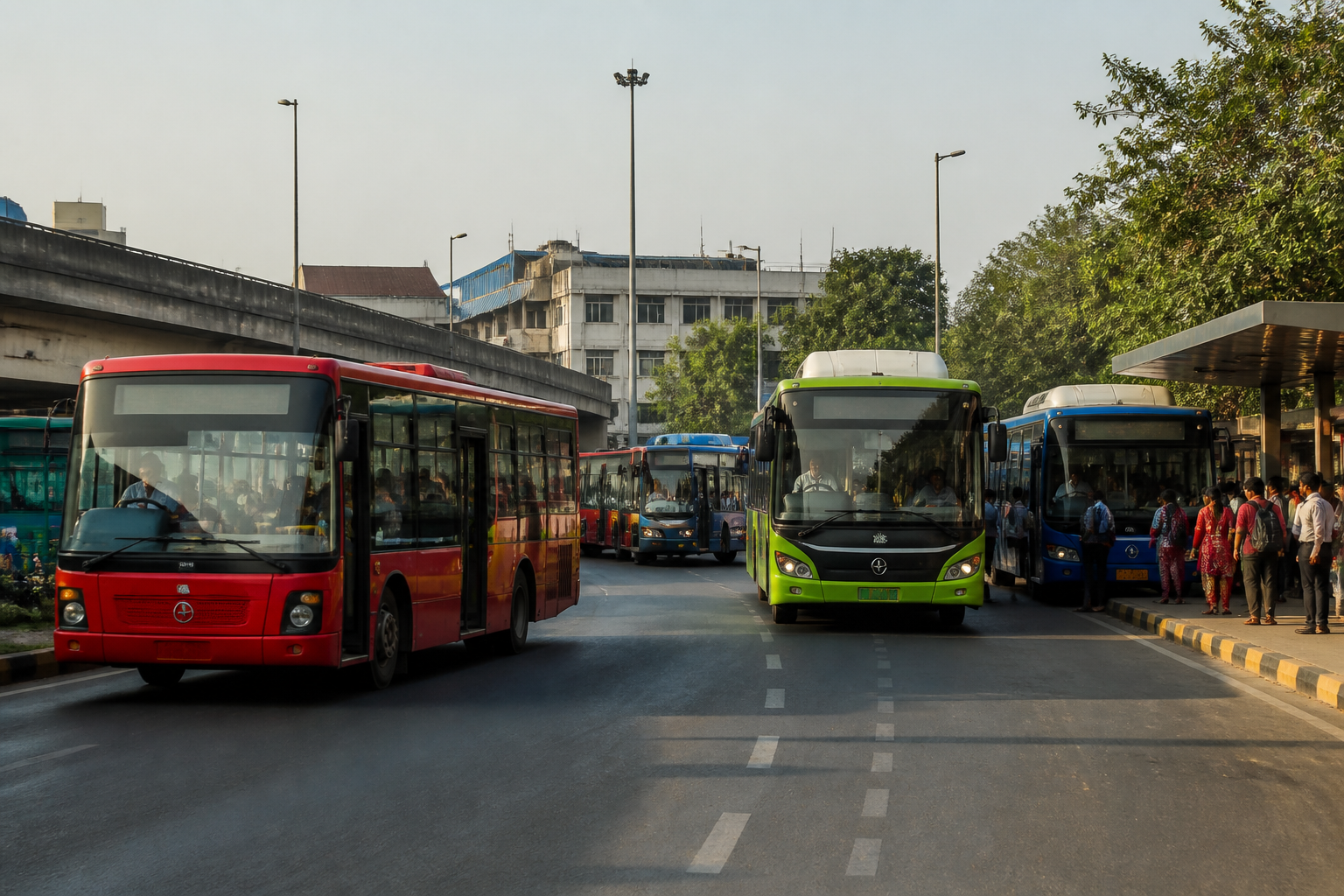
The retirement of DTC bus number 4038 has ended the Delhi Transport Corporation’s ownership of passenger buses, according to a report by Jagran. The last CNG bus owned by the corporation completed its scheduled service from Rajghat Depot-1 on Tuesday, leaving Delhi’s bus network dependent on vehicles supplied and operated by private companies.
The immediate event is simple: the last DTC-owned bus has left service. Its significance is institutional. Delhi’s public bus system will now be delivered through a model in which the corporation no longer owns a bus for passenger operations, while around 17 private companies provide and operate the active fleet. The reported arrangement includes approximately 5,088 electric buses and 1,700 CNG buses.
That shift changes what DTC represents in the transport system. For decades, the corporation was not only a service provider but also the owner of a visible public fleet. The withdrawal of the final owned vehicle therefore marks the completion of a transition from direct public operation towards contracted or privately supplied bus services. The supplied report does not detail the individual contracts, payment terms, performance standards or the division of responsibility between DTC and the private operators. Those details will be important for understanding how the new model works in practice.
The end of the owned fleet also closes a chapter in Delhi’s recent public transport history. The red, air-conditioned, low-floor buses associated with DTC became prominent before the 2010 Commonwealth Games. According to the report, DTC bought 2,500 buses in 2008-09, including 1,000 air-conditioned and 1,500 non-air-conditioned buses. It subsequently acquired another 625 buses, taking that procurement phase to 3,125 vehicles.
Other studies cited in the report place the number of low-floor CNG buses added to DTC between 2007 and 2011 at around 3,700, with approximately one-third being air-conditioned. During the Commonwealth Games, around 600 buses were assigned specifically to Games-related duties. These figures show the scale of the earlier public investment, even though the supplied report does not provide a complete comparison between the historic fleet and the current operational fleet.
The Commonwealth Games-era expansion was presented at the time as a modernisation of Delhi’s bus transport. Low-floor buses improved boarding access compared with older high-floor vehicles, while air-conditioning and newer vehicle designs changed the passenger experience. The buses carried athletes, officials, journalists and everyday passengers during the Games and became part of the city’s public transport identity.
The present transition raises a different question: what does public ownership contribute to a bus system when vehicles are increasingly supplied by private companies? Ownership is only one part of public transport. A city also depends on route planning, scheduling, depot management, maintenance, fares, enforcement, passenger information and the ability to monitor service quality. The available report establishes the change in ownership and operation, but it does not establish whether these functions have also shifted away from DTC or how accountability is organised.
That distinction matters because a bus network is not merely a collection of vehicles. It is a coordinated urban service. Buses connect neighbourhoods to jobs, schools, markets, hospitals and interchange points with other modes. Their usefulness depends on frequency and reliability across the network, not only on the number of buses available. The supplied figures indicate a substantial privately operated fleet, but they do not by themselves show whether routes are adequately served, whether buses are evenly distributed across the city or whether passenger waiting times have changed.
The reported fleet composition also points to an ongoing technology transition. Approximately 5,088 buses are electric and around 1,700 are CNG-powered. This gives the current system a large electric component alongside conventional gas-powered buses. However, the report does not provide the buses’ route allocation, charging infrastructure, availability rates, maintenance performance or operating costs. Without that information, the fleet numbers cannot be treated as a measure of service quality or environmental performance.
The institutional change may also affect how failures are handled. When a public corporation owns and operates buses, responsibility for vehicle availability and maintenance is more directly located within that organisation. Under a privately supplied model, the public authority remains responsible for ensuring that contracts deliver the promised service, but operational responsibility may be distributed among several companies. That can create a need for clear standards, transparent monitoring and effective penalties, although the supplied material does not describe DTC’s current enforcement framework.
The report identifies around 17 companies involved in operating the present arrangement. A multi-operator system can expand fleet supply without requiring the public corporation to purchase every vehicle itself. It can also allow different technologies and procurement models to be introduced at scale. But the number of operators alone does not reveal how well the system is integrated. Passengers experience one citywide network, regardless of which company owns or drives a particular bus. The public interest therefore depends on common standards for routes, fares, accessibility, safety and reliability.
Delhi’s transport history shows why this transition deserves attention beyond the retirement of one vehicle. The buses acquired before the Commonwealth Games represented a period when public ownership was used to rapidly increase and modernise capacity. The final retirement of an owned bus indicates that the city has now moved to a fundamentally different procurement and operating structure. The change is not simply a replacement of CNG vehicles with electric ones; it is also a change in the relationship between the public transport authority and the vehicles serving the public.
What remains unclear from the available report is whether DTC’s role has been reduced to fleet oversight, whether it continues to control network planning and passenger service standards, and how the private operators are paid and evaluated. The report also does not provide information on the age, condition or daily availability of the electric and CNG fleets, nor does it compare present capacity with the number of buses operating during the 2010 Games period.
Those unanswered questions will determine the practical meaning of the transition. If the authority retains strong control over routes, fares and standards, private operation may function as a different delivery mechanism for a publicly planned network. If control and accountability are fragmented, the end of the owned fleet could make it harder for passengers to identify who is responsible when services fail. The supplied facts establish the institutional shift, but not its eventual performance.
For now, the confirmed milestone is that DTC bus 4038 has completed its scheduled service from Rajghat Depot-1, leaving the corporation without an owned passenger bus. Delhi’s bus system is consequently operating through a privately supplied fleet of electric and CNG buses, and the next measure of this new model will be how clearly responsibilities, standards and service outcomes are defined.
