


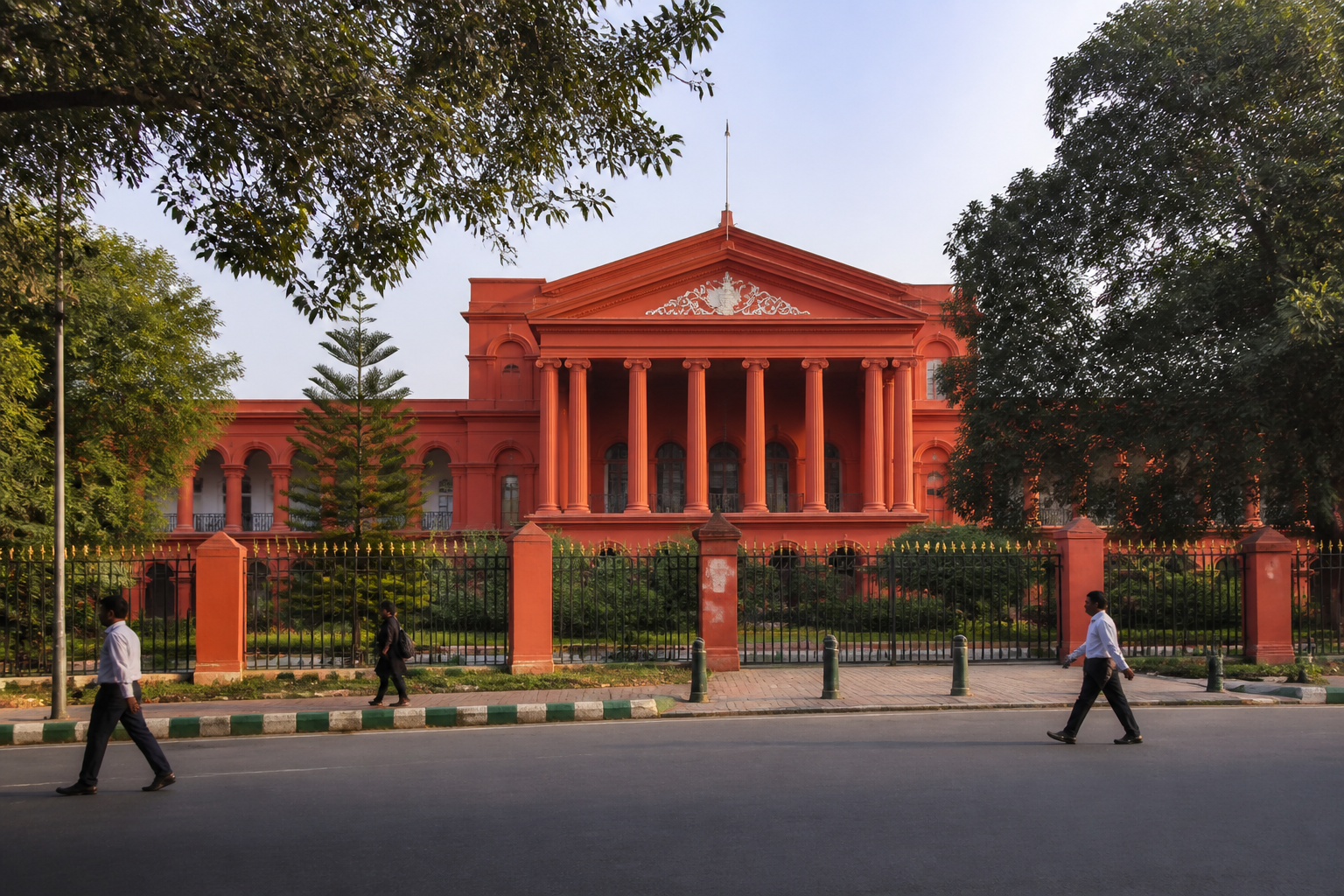
The Karnataka High Court’s decision to return a complaint concerning the alleged irregular allotment of a two-acre Bengaluru Development Authority site to the Siddhartha Vihar Trust has shifted the dispute back to the procedural question at its centre: how should courts handle complaints against elected representatives when the accompanying affidavit contains technical defects?
The order does not determine whether the land was allotted unlawfully. Nor does it establish criminal liability against any of the people named in the complaint. Instead, Justice M. Nagaprasanna’s single-judge bench held that the legislators’ special sessions court should have given the complainant an opportunity to correct defects in the affidavit and should have followed the appropriate legal process rather than proceeding on its own to examine the complaint.
That distinction is important in the Kharge family land case. The underlying allegation relates to a site in Bengaluru’s BTM Layout that, according to the complainant, was allotted by the BDA to the Siddhartha Vihar Trust by describing it as a trust belonging to members of a Scheduled Caste community. The complaint names Congress president Mallikarjun Kharge, his wife Radhabhai M. Kharge, MP Radhakrishna, Rahul M. Kharge and Karnataka Home Minister Priyank M. Kharge as accused. These are allegations recorded in the complaint, not findings established by the High Court.
The immediate legal issue arose after complainant Vijayraghav Marathe challenged the sessions court’s decision to proceed with the matter itself. The complaint had been filed in 2025. The sessions court had referred to defects in the affidavit and to requirements arising from Supreme Court guidelines issued in 2026. Marathe argued that the later guidelines should not be applied retrospectively to a complaint filed the previous year and that the case should be made available for investigation by the competent authority.
The High Court accepted the challenge in part. Its reasoning, as reported in the order, was that an affidavit defect was capable of being corrected by directing the complainant to file one that complied with the legal requirements. The court described the sessions court’s approach as excessively technical and directed it to continue the judicial process after following the appropriate legal procedure.
The order therefore addresses the route the complaint must take, rather than the truth of the land-allotment allegation. That procedural boundary matters because the two questions are easily conflated in politically charged cases. A direction to continue proceedings is not a finding that the accused committed an offence. Equally, a technical defect in an affidavit is not a judicial conclusion that the complaint lacks substance.
The court’s observation that the sessions court had not found the complaint to be without merit is central to the next stage. According to the argument presented for the complainant, the lower court had appeared to accept that the complaint was fit for consideration at a preliminary level, while relying on the affidavit issue to retain the matter for its own examination. The High Court’s response was that the defect should have been cured through a direction to the complainant, not used as a basis for adopting a different procedural course.
This is also a case about the institutional route for examining allegations involving public figures and public land. The complaint concerns a BDA site, placing an urban development authority and the allocation of a valuable Bengaluru property at the heart of the dispute. But the High Court’s order, as described in the source report, does not rule on the BDA’s decision-making process, the eligibility of the trust, the terms of the allotment or whether any statutory requirement was breached. Those questions remain to be examined through the process now ordered to continue.
The available facts show why the land component cannot be separated from the procedural one. A two-acre site in BTM Layout represents a significant urban asset, and any dispute over its allocation raises questions about the rules governing public land, the beneficiaries of institutional allotments and the documentation required to justify such decisions. However, the present order does not provide findings on the valuation of the site, the allotment terms, the trust’s application, the decision-making file or the applicable BDA regulations. Those gaps prevent a conclusion about the legality of the allotment itself.
The case also illustrates how procedural requirements can influence the pace and direction of accountability proceedings. The Supreme Court guidelines cited in the litigation relate to the affidavit accompanying a private complaint. The High Court’s position, according to the report, was not that such requirements could be ignored, but that a curable defect should be addressed by allowing compliance. The distinction is between rejecting or redirecting a complaint because of an incomplete filing and permitting the complainant to meet the prescribed requirement before the matter proceeds.
That distinction may be especially consequential when the complaint concerns legislators or members of a politically prominent family. The special sessions court exists within a framework for handling cases involving elected representatives, but the High Court’s reasoning indicates that the framework does not eliminate the ordinary obligation to apply procedural safeguards fairly. A complaint cannot be advanced without meeting legal requirements, but a correctable filing defect should not automatically determine the substantive fate of the allegation.
The timeline currently established in the supplied material is limited but significant. The private complaint was filed in 2025. The Supreme Court guidelines referred to in the arguments were issued in 2026. The High Court has now returned the matter to the legislators’ sessions court, directing it to proceed in accordance with the law. The next stage will therefore depend on whether the complainant is permitted to correct the affidavit and how the sessions court handles the complaint after that correction.
What remains unresolved is broader than the affidavit. There is no finding in the reported order on whether the Siddhartha Vihar Trust met the conditions for receiving the site, whether the BDA followed its own allotment procedure or whether the allegations against the named individuals can be sustained. The supplied material also does not establish whether a Lokayukta investigation has been ordered, whether the BDA has filed a response or whether any authority has independently reviewed the underlying allotment.
Those unanswered questions define the limits of what can responsibly be inferred from the High Court’s decision. The order restores the complaint to the legal process; it does not validate the allegation or clear the people named in it. The court’s intervention is therefore best understood as a ruling on procedural access and correction of defects, with the substantive dispute over the Bengaluru land allotment still pending.
For the city, the next important development will be the sessions court’s handling of the corrected affidavit and the subsequent decision on how the complaint should proceed. Until the relevant allotment records, eligibility documents and investigative findings are examined, the legality of the BDA’s action remains an unresolved question. The High Court has clarified the route forward, but not the merits of the land-allotment case.
