


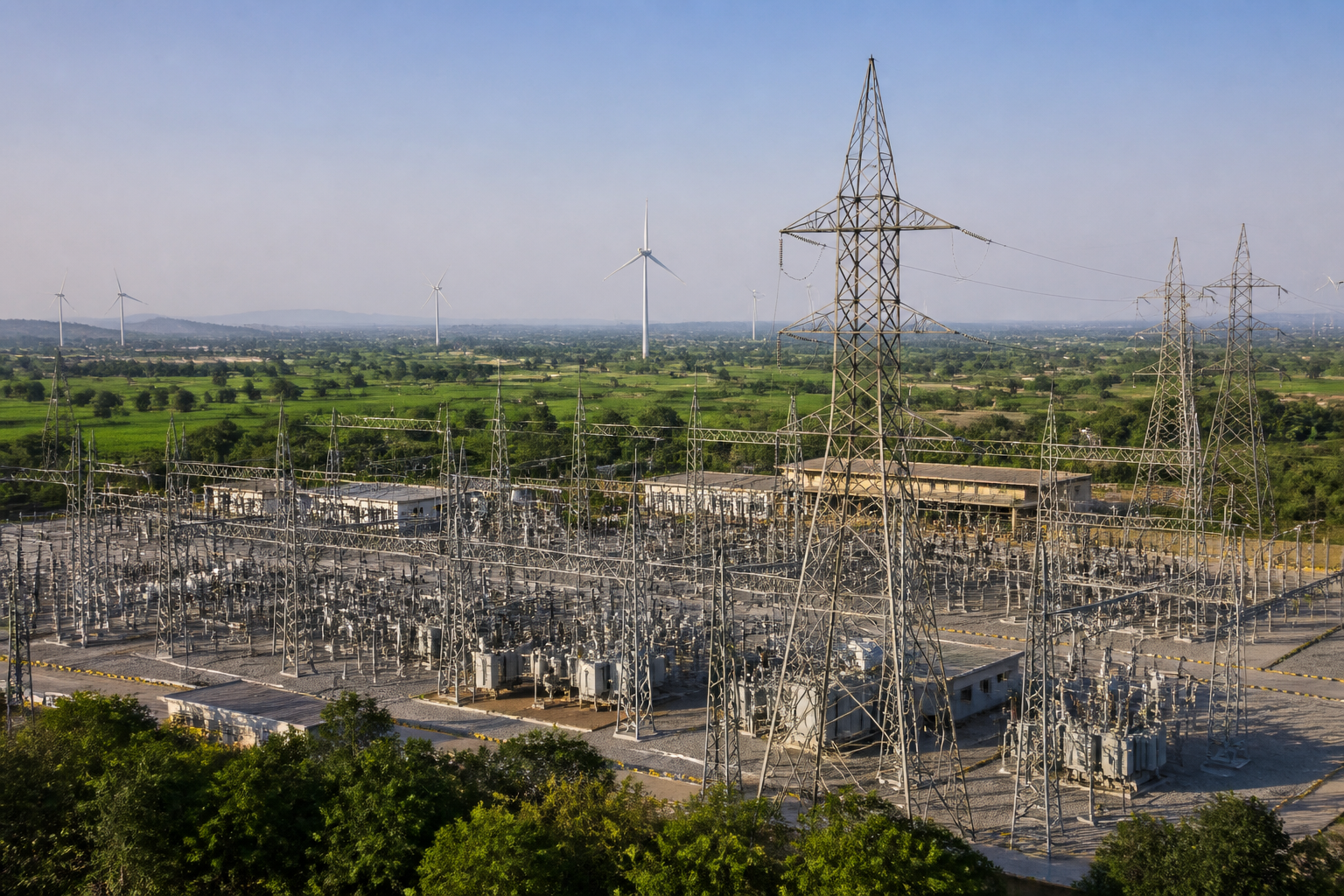
Karnataka’s power supply strategy is entering a more demanding phase. Energy Minister K.J. George has said the state is preparing measures to avoid electricity shortages during drought conditions, while also planning a major expansion of substations, transmission lines and pumped-storage capacity. Taken together, the announcements point to a shift from managing short-term availability to building a grid capable of handling rising demand and a larger share of intermittent renewable energy.
George made the remarks after attending the Bengaluru road show for the Bharat Renewable Energy Summit and Expo 2026. He said Karnataka had not faced a significant electricity problem so far and that a plan was being prepared to prevent shortages in the coming period. The minister’s statement, as reported by Prajavani, combines immediate procurement plans with infrastructure expansion and a review of the state’s free electricity scheme, Gruha Jyothi.
The immediate pressure comes from the relationship between drought and electricity demand. Drought can affect the availability of water-linked generation and increase dependence on other sources, while agricultural users continue to require electricity for pump sets. According to the minister, Karnataka has not cut power supply to agricultural pump sets despite the drought. He acknowledged that some areas without last-mile connectivity experience short disruptions, but said these are generally brief and addressed quickly.
That distinction is important. The statement does not describe a statewide supply failure. Instead, it identifies two separate challenges: ensuring that enough electricity is available to meet demand, and ensuring that electricity can reach consumers through the distribution network. The government’s emphasis on last-mile connectivity suggests that reliability is not determined only by generation capacity. Substations, local lines and the condition of existing infrastructure also shape the experience of households and farms.
The minister said Karnataka had obtained electricity from Uttar Pradesh, Punjab and Haryana through an exchange arrangement during the previous summer. The power was returned between June and September, and the state plans to obtain electricity again from those states through a similar arrangement if required. If the expected supply is not available, the government intends to purchase power from other sources. George said the government was prepared to bear the cost of such purchases.
This approach provides a short-term response to a supply gap, but it also exposes the state to the cost and availability of electricity in external markets. The minister did not provide the expected volume of electricity to be procured, the projected cost, or the duration of the proposed arrangement in the material available for this report. Those details will be important in assessing how much of Karnataka’s power strategy depends on market purchases rather than additional generation or storage.
The longer-term response described by the minister focuses on the distribution and transmission system. Twelve substations are being constructed during the current financial year, while a plan is being prepared to build about 400 substations over the next two to three years. The state also intends to install new electricity lines and upgrade existing ones alongside that construction programme.
Substations are a critical link between the wider power network and local distribution. Their capacity affects how electricity is received, transformed and distributed to connected areas. A larger substation network can support increased demand and reduce pressure on overloaded infrastructure, but the minister’s statement does not establish where the proposed facilities will be located, what their individual capacities will be, or how they will be financed. It also does not specify the expected completion schedule for the 400-substation plan beyond the two-to-three-year planning period.
The scale of the proposal indicates that Karnataka’s power challenge is not limited to one season. The state is preparing for continued demand growth while attempting to maintain supply to agricultural consumers and expand access in areas where last-mile connectivity remains incomplete. The infrastructure programme therefore sits between a reliability measure and a broader effort to improve the physical reach of the electricity network.
The state’s renewable-energy profile adds another layer to the problem. George said Karnataka currently has electricity demand of about 18,000 megawatts and that roughly 70 per cent of the supply comes from renewable sources. He also said renewable power is available mainly during the daytime, creating a need to store electricity and release it during periods of higher demand.
The figures in the minister’s statement describe a system with a substantial renewable contribution but a timing problem. Electricity generated during daylight hours does not automatically meet demand in the evening or at other periods when consumption rises. Without storage or other forms of balancing capacity, the grid must rely on alternative generation, power purchases or demand management when renewable output falls.
Pumped-storage projects are the government’s proposed answer to that mismatch. These projects generally move water between reservoirs at different elevations, using electricity to pump water upward when power is available and generating electricity when it is needed. In the minister’s explanation, pumped storage would allow daytime renewable electricity to be retained and supplied during demand periods.
The minister said some people were opposing pumped-storage projects, but also stated that projects would be taken forward only after receiving the required approvals. According to the report, the state would seek clearances from the State Pollution Control Board and the wildlife board before forwarding proposals to the Union Ministry of Environment and Forests. If approval is not granted, the projects would not be implemented, he said.
This approval sequence places the storage programme within a wider regulatory and environmental framework. The supplied material does not identify the proposed locations, project capacities, affected communities, land requirements or environmental concerns. It therefore establishes the government’s stated process, but not the outcome of any individual project or the basis of the opposition mentioned by the minister.
The power-supply plan is also connected to Gruha Jyothi, Karnataka’s electricity-benefit scheme. George said the chief minister had ordered a review after several people, including government employees, indicated that they did not want the benefit. He said documents had been requested during the review, but that people who did not want the scheme would not need to submit them. At the same time, he said eligible beneficiaries would not be excluded.
The minister stated that between 65 per cent and 70 per cent of the verification process had been completed and that the deadline had been extended to the end of September. The extension creates an immediate administrative milestone. The material does not provide the number of beneficiaries under review, the total financial cost of the scheme, or the criteria being used to determine eligibility. Those details will be necessary to understand how the review could affect household electricity access and the state’s power finances.
The announcements reveal three linked pressures on Karnataka’s electricity system. First, drought conditions require the government to protect supply to agriculture and manage possible shortfalls. Second, renewable generation creates a need for storage and grid balancing because availability is concentrated during daylight hours. Third, increasing demand requires investment in substations and lines so that available electricity can reach consumers reliably.
The government’s response combines power exchanges, market purchases, network construction, renewable-energy storage and beneficiary verification. Each addresses a different part of the system, but the supplied report does not establish how these measures will be coordinated or what their combined cost will be. It also does not indicate whether the proposed 400 substations are linked to specific demand forecasts, renewable-energy zones or areas with existing reliability problems.
What the evidence confirms is that Karnataka is planning beyond a single emergency procurement exercise. The state is maintaining agricultural supply during drought, preparing to buy electricity if exchange arrangements fall short, and proposing a substantial expansion of grid infrastructure. It is also positioning pumped storage as a means of making renewable electricity available beyond daylight hours.
What remains uncertain is the implementation detail: the location and capacity of planned substations, the timetable for the wider network upgrades, the cost of power purchases, the status of pumped-storage proposals and the consequences of the Gruha Jyothi verification exercise. The next relevant milestones are the completion of the verification process by the end of September, the construction of the 12 substations planned for the current financial year, and the regulatory decisions on any pumped-storage projects submitted for approval.

