


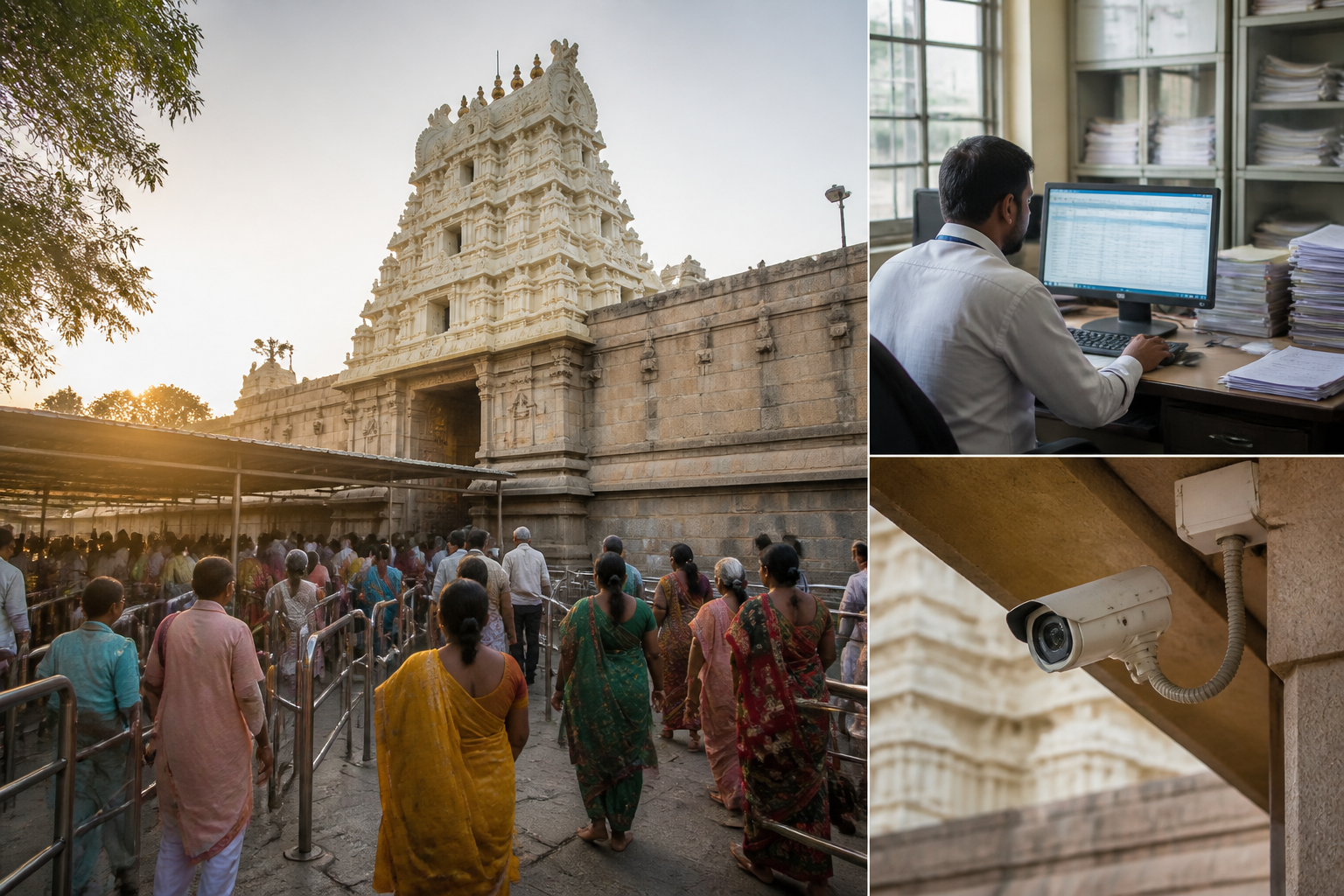
The Karnataka High Court has directed the Muzrai Department to introduce real-time digital accounting, CCTV surveillance and tamper-proof records across temples under its administration, citing weaknesses in the day-to-day management of temple funds, offerings and properties.
Justice Suraj Govindaraj issued the directions while upholding the dismissal of an employee of Sri Durga Parameshwari Temple, a Muzrai institution at Mandarthi in Udupi district. The employee, Rajesh Nayak, had challenged his removal after being accused of misappropriating Rs 8,750 by creating duplicate receipts.
The court directed the Commissioner of the Muzrai Department and the Secretary of the e-Governance Department to file compliance reports by November 2. The directions cover collection systems, financial records, surveillance, jewellery and gold offerings, temple properties and oversight by senior officials.
Under the court’s directions, all collections, including digital payments, must be captured in real time and reflected in a central accounting system. Every collection counter must operate through authorised software integrated with that system. Manual receipts may be issued only in exceptional circumstances, such as a temporary system failure, and must be entered into the electronic system immediately after service is restored.
The reasons for issuing manual receipts must also be recorded and retained as part of the audit trail. The court said the system should make it possible to monitor collections and transactions without relying solely on manual reconciliation or the discovery of irregularities after the event.
The court has further directed the department to establish periodic procedures for weighing, verifying and valuing ornaments. It also ordered the creation of a protocol for the melting or conversion of gold offerings, along with a digitised property register and a system to monitor encroachments on temple land and other assets.
CCTV cameras must cover, at a minimum, collection counters, hundi and counting areas, strong rooms, jewellery rooms, stores and the main points of entry and exit. The court said the surveillance system should have no material blind spots, that recordings must be preserved for a prescribed minimum period, and that the footage must be protected against tampering or erasure. Where feasible, the recordings should be capable of central monitoring.
The directions also call for a centralised dashboard for the Commissioner and Deputy Commissioners. The dashboard is expected to allow officials to examine operations down to the level of an individual collection counter and temple institution.
While dismissing Nayak’s petition, the court described temple funds as trust property collected from devotees and held for the deity and the institution. It said the Karnataka Religious and Charitable Endowments Act, 1997, places a responsibility on the department to supervise and safeguard those funds.
The court said a financial control system that depends on chance discovery and manual reconciliation is inadequate when one employee with exclusive access to a counter and password can defeat it. It added that technology makes real-time capture, monitoring and auditing of transactions feasible.
The Muzrai Department and the e-Governance Department must now report compliance with the directions by November 2.
