


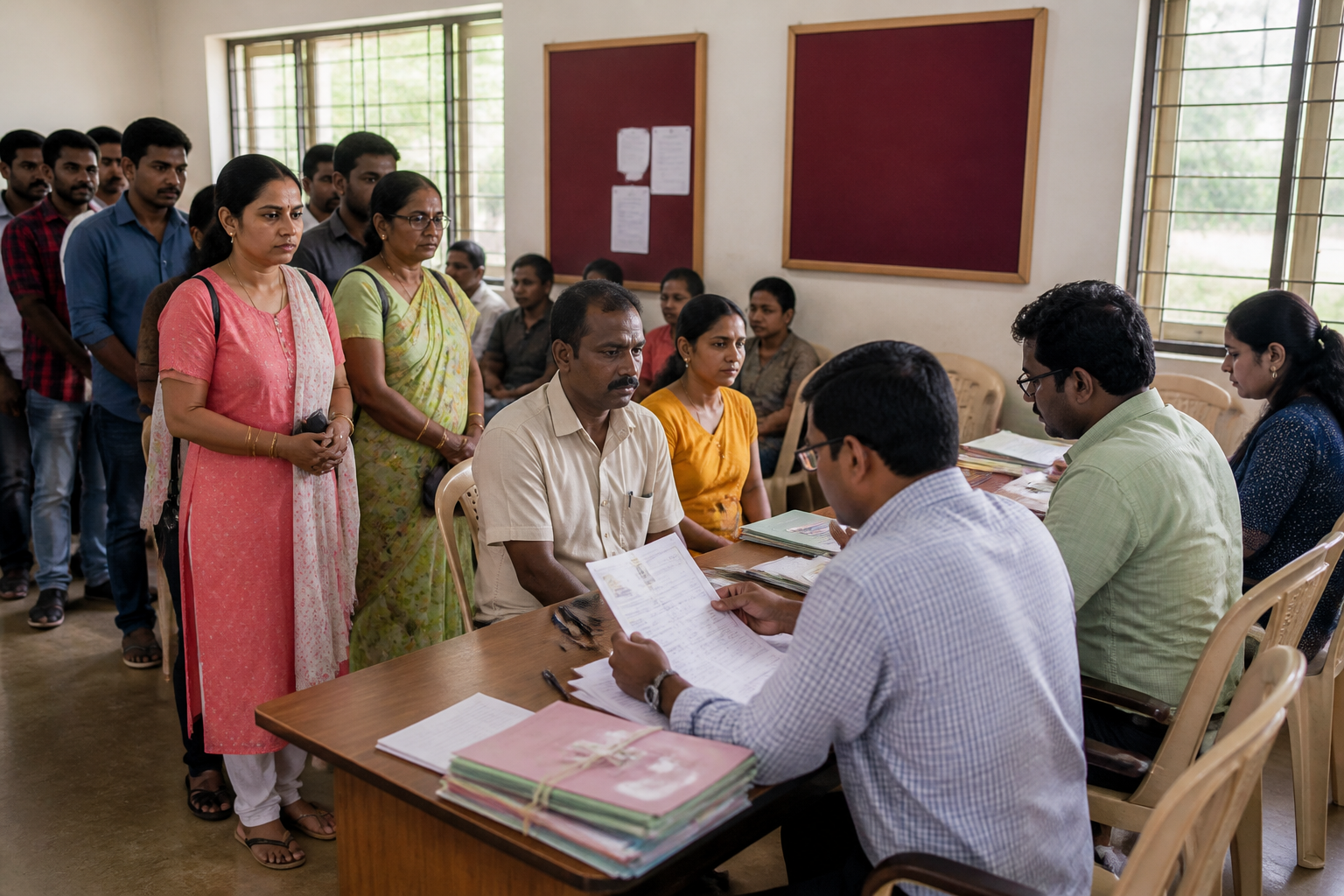
Karnataka’s Special Intensive Revision (SIR) of electoral rolls is revealing a problem that extends beyond the accuracy of voter data: the way administrative systems handle uncertainty can determine how much time, travel and paperwork citizens must bear. With around 43.80 lakh voters served notices, hearings across the state are bringing together cases that range from minor name variations to records that have not been mapped to the earlier roll.
The hearings are intended to resolve discrepancies in electoral records. But the experience reported from hearing centres in coastal Karnataka shows that the process is not only testing the cleanliness of the electoral roll. It is also testing whether the revision system can distinguish between a serious verification concern and a discrepancy that can be explained by a routine change in a person’s identity documents.
One recurring example involves women whose names appear under their maiden name and surname in an older electoral roll but under their married name in the current record. Another involves initials being expanded in a later document. In a database, both situations may appear as mismatches. At a hearing centre, however, an old electoral record, school certificate or another supporting document may establish the link within minutes.
That distinction matters because voters with very different cases are being directed into the same process. Notices have been issued for reasons including “unmapped with last SIR” and self-name mismatch, as well as unusual age differences involving parents, children and grandparents. The supplied report does not establish how many notices belong to each category, but it shows how a broad automated screening exercise can bring minor and complex cases into one queue.
The consequence is a transfer of administrative effort. Tokens are being issued at hearing centres and voters are called one by one. The interaction with an official may last only a few minutes, while the waiting period can extend to one or two hours. For a voter whose identity can be established through an existing official document, the substantive verification may be quick; the burden lies in receiving the notice, travelling to the centre, waiting and producing the document in person.
The case of KPCC spokesperson and activist MG Hegde illustrates this gap between the apparent complexity of a record and the time required to resolve it. Hegde told Deccan Chronicle that his name appeared as “MG Hegde” in the 2002 electoral roll and later as “Mahabaleshwara G Hegde”. He received a notice over the discrepancy, waited for about one-and-a-half hours at the hearing centre and had his SSLC marks card uploaded. According to his account, the verification itself was completed in about two minutes.
Hegde’s criticism is not that electoral records should go unchecked. His argument is that information already visible in the earlier roll could have been incorporated into the enumeration process, allowing voters to explain name changes or age differences while the forms were being completed. He also argued that an explanation field and the option to attach supporting documents could have reduced the number of cases sent to a separate hearing.
An election official involved in the process, quoted by the newspaper, similarly acknowledged that some discrepancies could have been identified earlier if booth-level officers, or BLOs, had been asked to record details such as self-name mismatches in the enumeration form itself. This is a significant institutional point. The issue is not merely whether officials can correct a record after a notice is issued. It is whether the design of the workflow places the right question at the earliest stage.
Electoral roll revision is necessarily document-heavy because the credibility of the roll depends on identifying eligible voters accurately and resolving doubtful entries. A clean roll cannot be produced by accepting every record without scrutiny. At the same time, the reported hearings show the operational cost of treating every computer-generated discrepancy as a problem that must be resolved through a later physical appearance.
This is a familiar challenge in public administration: digital or database-based systems are effective at identifying anomalies, but an anomaly is not automatically an error. A name may change after marriage. An abbreviation may be expanded. Family relationships may appear unusual when converted into age calculations. The system can flag the record, but it may not understand the social or documentary context behind it.
That is where the enumeration stage becomes important. If the person collecting information has the opportunity to record the explanation and supporting evidence at the point of data collection, the later hearing can be reserved for cases that genuinely require closer scrutiny. The report does not provide evidence that such a redesigned workflow was considered across Karnataka, nor does it quantify how many hearing notices could have been avoided. It does, however, document the concern from both a voter and an election official that some routine discrepancies could have been addressed earlier.
The scale of the exercise increases the significance of that design question. Around 43.80 lakh voters have received notices in connection with the SIR process. Even if only a portion of these cases involve minor and easily explainable discrepancies, the cumulative demand on citizens and officials can be substantial. A short verification interaction multiplied across thousands of people still creates queues, travel requirements and additional processing work.
The burden is not distributed equally. A voter who can quickly locate an old electoral record or school certificate may be able to resolve the issue. Another voter may have difficulty finding documents, taking time away from work or reaching a hearing centre. The supplied report does not quantify these differences, but the process described makes clear that the practical meaning of a notice depends on a person’s access to records, time and transport.
The hearings therefore function as more than a final correction mechanism. They are also a live test of how electoral administration translates data rules into citizen-facing services. At the database level, a mismatch is a signal. At the hearing centre, it becomes a queue, a document request and a decision by an official. The quality of the system depends on how efficiently it moves from the first signal to the correct resolution.
The Karnataka experience also raises a question about the division of labour between technology and field administration. Automated checks can identify patterns that deserve attention, but field-level enumeration remains essential for understanding changes that do not fit neatly into fixed fields. If the system is designed only to flag exceptions and not to capture explanations, the later stage must absorb the unresolved complexity.
The report does not suggest that the SIR process has failed or that the notices are invalid. It shows instead that accuracy and convenience are not opposing objectives when the verification process is designed carefully. Early collection of explanations may help officials concentrate on records that require detailed examination, while allowing voters with straightforward documentary explanations to avoid an unnecessary second step.
What the hearings confirm is narrower but important: the same administrative notice can represent very different levels of risk. A minor name variation supported by an old roll and an official certificate is not equivalent, in practical terms, to a record with no mapping to the earlier roll. Yet both can produce a similar citizen experience unless the workflow separates them earlier.
The next stage of the SIR process will show how the notices are resolved and whether the categories of discrepancy are recorded in a way that allows the system to learn from them. For now, the hearings offer a clear institutional lesson: electoral accuracy depends not only on detecting anomalies, but also on giving voters and field officials a timely way to explain them before those anomalies become another queue.
