


The Supreme Court has questioned the Election Commission of India’s handling of the Special Intensive Revision (SIR) of electoral rolls in Delhi, saying notices issued to more than 33 lakh voters appeared to have been generated “mechanically” and asking whether additional safeguards were needed before they were sent.
A three-judge bench headed by Chief Justice of India Surya Kant and comprising Justices Joymalya Bagchi and V Mohana issued notice to the ECI and sought a status report on a petition filed by activists Anjali Bhardwaj and Amrita Johri. The petition alleges that the ECI and the Delhi Chief Electoral Officer have not adequately disclosed the names deleted from the electoral roll or the reasons behind notices issued for what the poll body describes as a “logical discrepancy”.
Justice Bagchi said the notices appeared to be machine-generated and asked the poll panel to examine whether the process could be refined before further notices were issued. “Refinement of the tool is necessary … Almost mechanical notices are going. In all probability, they are machine-generated notices. So, please examine whether some additional filters are necessary before the notices,” he said.
The petitioners’ counsel, senior advocate Prashant Bhushan, told the court that notices had been issued to more than 33 lakh voters for reasons including logical discrepancy. More than 47 lakh names have already been deleted from the draft electoral rolls during the ongoing revision in Delhi, which covers more than 97 lakh voters.
The court also sought greater clarity on what a voter is expected to establish after receiving such a notice. The Chief Justice said that a notice should explain precisely what information the elector needed to provide. He gave the example of a voter who had moved to Delhi after previously voting in Chandigarh, saying that the notice should clearly ask whether the person had voted in Delhi, Chandigarh or another location in 2019.
The exchange highlighted the difficulty of applying a uniform verification process in Delhi, where the voter population includes people who have moved to the Capital from other parts of the country. The Chief Justice said a person who had previously lived in Chandigarh and later moved to Delhi might need to explain that change to ensure there was no double voting.
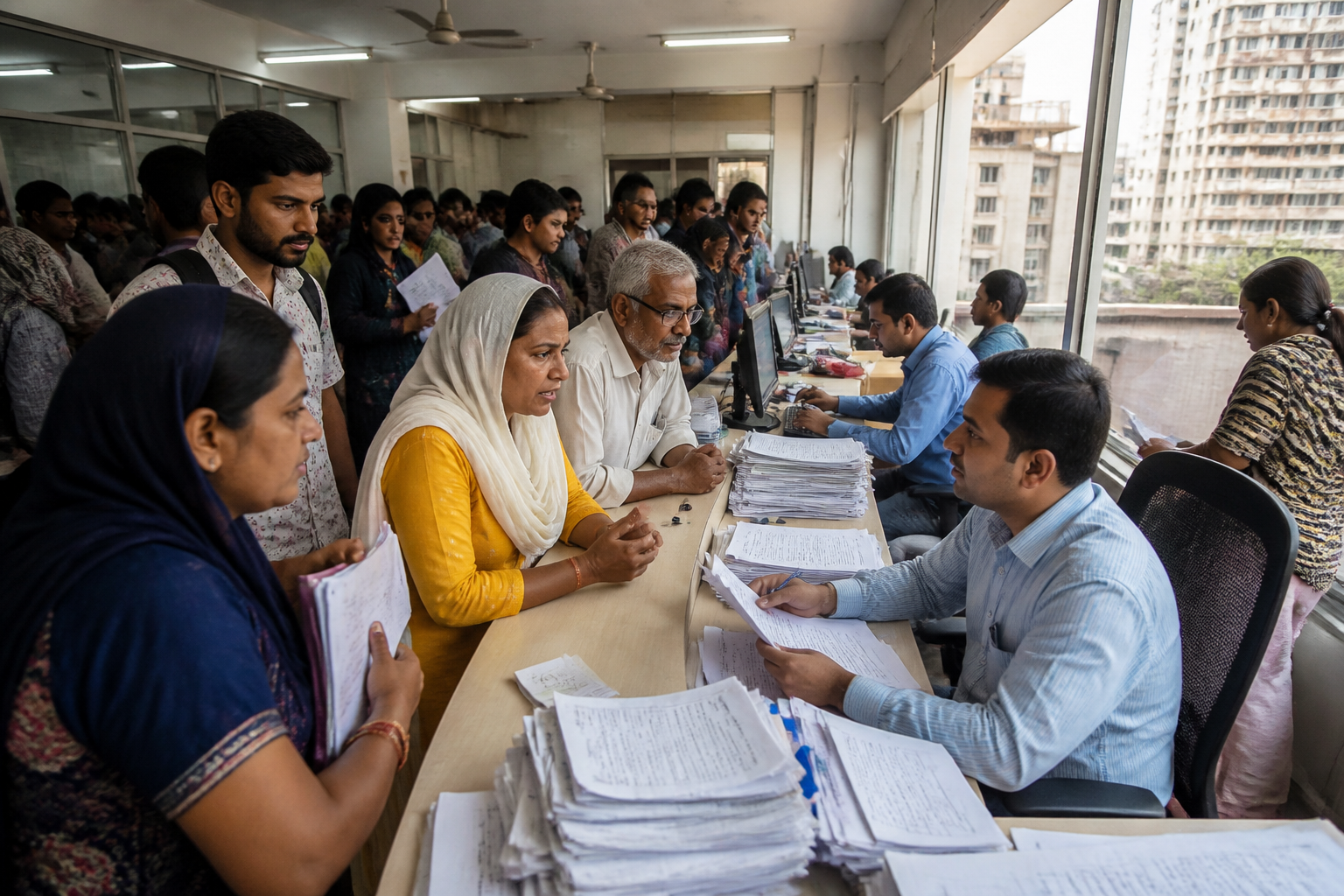
Bhushan argued that voters receiving notices were required to appear with documents and that the documents listed by the ECI might not always be sufficient to refute the discrepancy identified by the poll body. He also questioned why a person who had already submitted an enumeration form and proof of age and residence should be required to provide additional material.
Senior advocate D S Naidu, appearing for the ECI, said every notice mentioned the reason for its issuance and referred to sample notices placed before the court. He added that the 12 documents referred to in the notices were not exhaustive, meaning that voters could rely on other relevant documents as well.
The availability of election officials was another issue before the bench. Justice Mohana said the court had come across a situation where Booth Level Officers, or BLOs, were not available. Senior advocate Kapil Sibal, who appeared in the proceedings and has contested elections in Delhi, said the city had many multi-storey buildings and suggested that it would be difficult to assume that BLOs would visit every household.
When Justice Bagchi asked how many officials had been deployed for the SIR exercise in Delhi, Naidu said there were 14,000 BLOs and 1,200 Electoral Registration Officers. He said BLOs had also been stationed at ward offices so that electors could approach them directly.
The ECI’s counsel said the poll body was willing to extend the October 29 deadline if necessary. The Chief Justice also suggested that the commission could prepare standard responses to the 15 to 20 types of queries and objections likely to arise during the process and circulate them to voters and officials.
Several prominent voters, including former deputy prime minister L K Advani, External Affairs Minister S Jaishankar, former vice-president Jagdeep Dhankhar, Election Commissioner S S Sandhu, Foreign Secretary Vikram Misri, former Delhi deputy chief minister Manish Sisodia and Rajya Sabha MP Kapil Sibal, have received or are likely to receive notices, according to the submissions recorded in court. The Supreme Court will now await the ECI’s response and status report on the revision process.
