


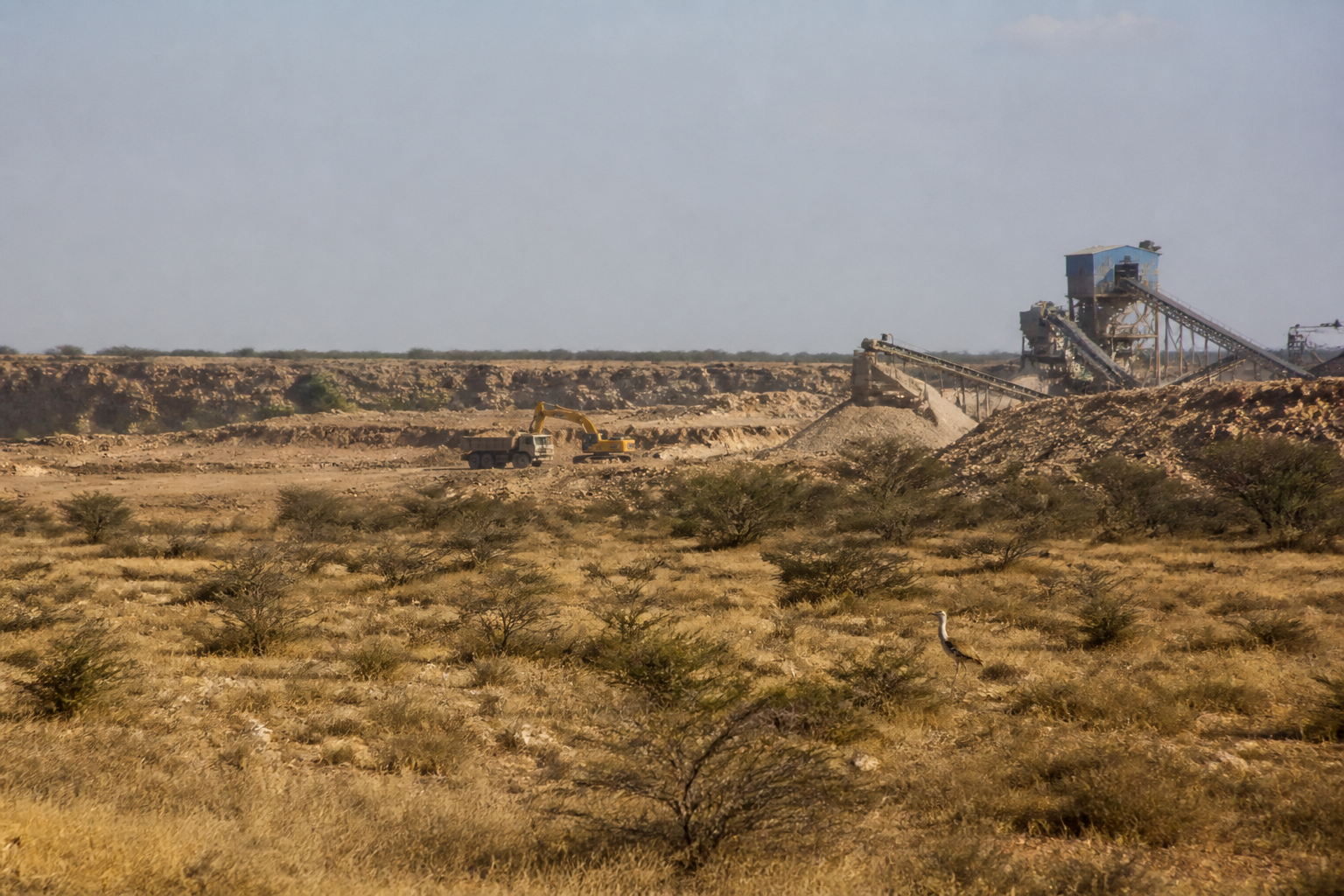
UltraTech Cement’s proposed limestone mine in Jaisalmer has cleared an early approval hurdle, but its location 5.8 km from a Great Indian Bustard priority area places the project inside a difficult environmental compliance test. The Union environment ministry’s expert appraisal committee recommended the grant of terms of reference for the project on September 10, allowing the company to proceed towards preparing a detailed environmental impact assessment.
The proposed mine in Joga village will cover more than 400 hectares and include a stone-crushing unit. Its planned limestone production capacity is one million tonnes per annum, while the crusher is proposed to handle 1,500 tonnes of material per hour, according to the minutes of the EAC meeting cited in the report by Deccan Chronicle and PTI.
Terms of reference do not amount to final environmental clearance. They define the scope, methodology and reporting requirements for the environmental impact assessment that must be prepared before the project can move through subsequent stages. In this case, the EAC has also attached a specific conservation requirement because of the project’s proximity to a Great Indian Bustard priority area.
The committee has asked UltraTech to prepare a conservation plan covering site-specific mitigation measures, grassland habitat management, protection of breeding habitat, monitoring systems, institutional arrangements and budgetary provisions. It has also sought a plan to regulate human activity in and around the conservation zone, including grazing, vehicular movement, human interference and waste disposal.
That list is important because it treats the risk as more than a question of dust from the mine or emissions from the crusher. It recognises that a project can affect a fragile habitat through several routine activities: vehicle movement, disturbance by workers and visitors, waste handling, changes in grassland use and the disruption of breeding areas. The environmental review will therefore have to examine how the mine and its associated operations interact with the wider landscape around the priority area.
The Great Indian Bustard priority area is described as a crucial habitat that functions as a retreat and breeding ground for the critically endangered bird. The proposed project’s distance from that area—5.8 km—makes the conservation plan a central part of the approval process rather than a peripheral condition. The source report does not establish that the mine has caused damage or disturbance to the birds. It does, however, show that the location has triggered additional scrutiny from the appraisal committee.
UltraTech has proposed several mitigation measures for the Jaisalmer project. These include water sprinkling for dust suppression, bag filters at the stone-crushing site and measures to minimise disturbance in adjoining areas. Such measures address the direct environmental impacts identified at an industrial mining and crushing operation. Their effectiveness, however, will depend on how they are specified in the assessment, funded, monitored and enforced after operations begin.
The company’s record at another Rajasthan mining site has become part of the context surrounding the Jaisalmer proposal. At a limestone mine covering more than 500 hectares in Jodhpura-Mohanpura village in the Kotputli-Behror district, UltraTech has faced allegations of violating environmental compliance and other regulations. In November 2025, the Central Zone Bench of the National Green Tribunal held the company responsible for environmental damage and health hazards in the village, according to the report.
The NGT directed the company to stop blasting operations at night, cover the stone-crushing area with tarpaulin, spray water on approach roads, and install or use pollution-control measures including bag filters, vacuum suction hoods and dry fogging systems. These directions provide a concrete reference point for assessing the company’s proposed safeguards at Joga. The relevant question is not only whether mitigation measures are listed in the project documents, but whether they are implemented consistently at operating sites.
A response from UltraTech regarding the allegations at the Kotputli-Behror site was awaited, the report said. The available material does not establish whether the measures ordered by the tribunal have been fully implemented, nor does it provide an independent assessment of their performance. That limits what can be concluded about the company’s compliance record, but the existence of the NGT proceedings makes implementation capacity a material issue for the new project.
The approval pathway also shows how environmental governance separates project design from project operation. At the terms-of-reference stage, the EAC identifies the questions that the environmental impact assessment must answer. The applicant then has to provide information on impacts, safeguards, monitoring arrangements and institutional responsibilities. Later decisions depend on the material submitted and the scrutiny applied by the competent authorities.
For the Jaisalmer mine, the EAC’s requirements place habitat protection inside that formal assessment framework. The conservation plan must address breeding areas and grassland management, while the disturbance plan must cover activities that may appear ordinary in a mining landscape. This creates a broader compliance obligation than installing equipment at the crusher. The project must explain how the entire operational area and its surrounding activity will be controlled.
The project’s scale adds to the importance of those details. A mine spread across more than 400 hectares, linked to a crusher capable of processing 1,500 tonnes per hour, will require movement of material, vehicles and personnel. The supplied report does not provide projected traffic volumes, the proposed transport route, operating hours, water demand or the precise location of the crusher within the project area. Those details will be important in the environmental assessment because they would show how the project’s physical footprint translates into daily activity around the conservation zone.
The available information also does not establish the final design of the mine, the duration of extraction, the number of workers, the source of water for dust suppression or the monitoring frequency proposed for the Great Indian Bustard habitat. These are not minor administrative details. They determine whether mitigation measures can be maintained during dry conditions, high production periods and routine transport operations.
The project therefore sits at the intersection of two regulatory responsibilities. One is to assess whether a limestone resource can be extracted and processed with manageable environmental impacts. The other is to protect a habitat associated with a critically endangered species. The EAC’s recommendations indicate that both responsibilities must be addressed before the proposal can be evaluated further.
The Jaisalmer case also illustrates why an approval process cannot be understood only through the language of clearance or rejection. The first formal step may appear positive for the project proponent, but the terms of reference can impose substantial information and planning obligations. In this instance, the next phase must document conservation arrangements, habitat management, disturbance controls, institutional responsibilities and financial provisions.
The comparison with the Kotputli-Behror site is similarly a question of governance rather than proof of repeated non-compliance. The NGT’s directions at that site identify the kinds of pollution controls that authorities may require when mining and crushing affect nearby communities. The Joga project will need to demonstrate how comparable risks will be prevented or controlled from the outset, while also addressing the distinct ecological risks linked to the Great Indian Bustard priority area.
What is established at this stage is limited but significant: the EAC recommended terms of reference for the Jaisalmer project; the proposed mine is over 400 hectares in area; production is planned at one million tonnes per annum; the crusher’s proposed capacity is 1,500 tonnes per hour; and the site is 5.8 km from a Great Indian Bustard priority area. What remains to be established is how the project will operate in practice and whether the proposed safeguards will be adequate and enforceable.
The next meaningful test will be the environmental impact assessment and the conservation and disturbance plans requested by the EAC. Those documents will determine whether the project’s environmental claims are supported by site-specific evidence, measurable safeguards, monitoring systems and budgeted institutional responsibilities. Until then, the Jaisalmer mine is closer to a full appraisal, not yet to final approval.
