


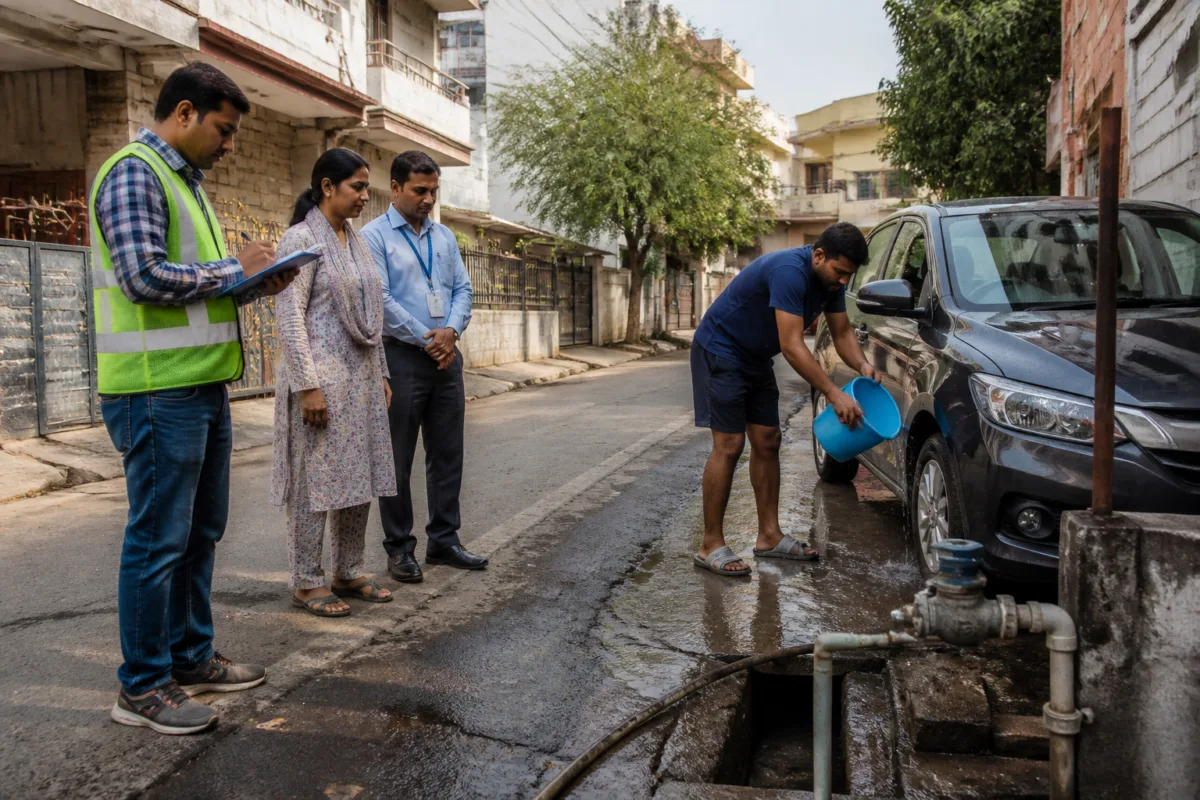
Indore’s new campaign against water wastage is more than a seasonal appeal to residents. It is a response to a widening gap between the city’s present water security and the time required to build additional supply capacity, with the municipal corporation warning households against using drinking water for routine cleaning while a major Narmada project remains years away.
The Indore Municipal Corporation has said it will counsel residents who use pipes to wash floors and cars, issue challans if the behaviour continues and videograph repeat violations before imposing fines under existing rules. The campaign is scheduled to continue until Diwali. Teams of non-governmental organisations have been directed to prepare a monitoring chart and conduct regular checks, according to the Times of India report.
The immediate trigger is a weak monsoon. Indore has received more than 584 mm of rainfall this season, compared with its usual 939 mm, the report said. The shortfall has revived memories of 2008, when the city received about 508 mm of rainfall and subsequently faced a water crisis. The comparison does not establish that Indore will experience the same outcome this year, but it explains why the municipal response has moved from general conservation messaging towards household-level monitoring and penalties.
The campaign also shows how cities often manage water stress: first by attempting to reduce demand, while longer-term infrastructure is still being planned or built. Mayor Pushyamitra Bhargava visited Parshwanath, Vinay Nagar, Jain Colony and Lokmanya Nagar during the launch of the drive and asked residents to use buckets and cups instead of pipes for washing floors and cars. Residents were also advised to reuse wastewater from reverse-osmosis purifiers for plants, vehicles and clothes.
That approach places households at the centre of the conservation effort. It also raises an institutional question: how much of a city’s water risk can be addressed through behaviour change when the system itself continues to face supply, maintenance and planning constraints? The report refers to a recent incident in which thousands of litres of water flowed out of a pipeline, raising concerns about the management and maintenance of the network. Such losses are different from household wastage, but they are part of the same urban water balance.
### Demand management before new supply
The corporation’s proposed enforcement sequence is significant. Residents will reportedly receive two or three counselling opportunities before a challan is issued. Repeat violators may be videographed and fined. This creates a graduated model of enforcement rather than immediate penal action, combining awareness with the threat of sanctions.
The measure is aimed at visible forms of consumption: using hoses or pipes to wash floors and cars. The reported instructions do not provide the proposed fine amount, the precise legal provision being applied, the number of monitoring teams or the method by which violations will be recorded and reviewed. Those details will determine whether the campaign functions as a short-term public-awareness drive or becomes a consistent municipal demand-management programme.
The involvement of NGOs is another important feature. Their teams have been asked to prepare a chart for the campaign and ensure regular monitoring. The report does not specify whether the chart will record household consumption, observed violations, neighbourhood-level patterns or follow-up action. Without that information, the scale and performance of the monitoring system cannot yet be assessed.
The proposed reuse of reverse-osmosis wastewater points to a second layer of demand management. The mayor has asked residents to divert this water towards gardening, vehicle washing and laundry rather than allowing it to be discarded. The measure is presented as a way to reduce the use of drinking water for activities that do not require potable supply. The report does not quantify how much water could be recovered through this practice, nor does it indicate whether the corporation plans to support household-level reuse systems.
### The infrastructure gap
Indore’s longer-term response is the Narmada Phase-IV project, which the municipal corporation has begun implementing. The project is intended to supply around 900 million litres per day to the city. Of this, about 620 MLD is planned for domestic requirements and 280 MLD for commercial needs. However, completion is expected only by 2029.
That timeline explains the urgency of conservation measures in the present. A future project cannot resolve a seasonal shortage before it becomes operational, and additional bulk supply does not by itself settle questions about distribution, leakage, treatment, storage or demand growth. The reported pipeline incident is relevant because it shows that the city’s water challenge is not limited to how much water is available at the source. It also concerns how reliably water moves through the urban network.
The Phase-IV allocation also indicates that the corporation is planning for more than household consumption. Of the proposed 900 MLD, commercial requirements account for 280 MLD, or nearly one-third of the planned supply. The source report does not explain how these estimates were calculated, what population or economic growth assumptions they use, or how the allocation will be adjusted during periods of rainfall failure.
The figures therefore describe the scale of the proposed infrastructure response, but not yet its complete operating model. Questions about source reliability, project financing, construction milestones, distribution capacity and the relationship between domestic and commercial demand remain outside the information supplied in the report.
### A seasonal warning with a governance dimension
The mayor has earlier sought a Rs 50 crore package for water management from Chief Minister Mohan Yadav. The request places Indore’s immediate conservation campaign within a wider question of municipal finance. Water security requires recurring expenditure on supply infrastructure, network maintenance, monitoring and public communication, while large projects require capital funding and long implementation periods.
The report does not state whether the requested package has been approved, what components it would fund or how it would connect with the Narmada Phase-IV project. It does, however, show that the corporation is seeking additional financial support while also asking residents to reduce consumption. The two measures address different parts of the problem: funding can support institutional capacity and infrastructure, while conservation can reduce short-term pressure on available supplies.
The decision to run the campaign until Diwali also gives it a defined administrative window. The report does not say whether monitoring will continue after that period or whether the corporation will publish results. A campaign with a closing date can create focus, but water stress is not limited to a single festival or season. The city’s own comparison with 2008 suggests that rainfall variability can have consequences extending into the following summer.
The focus on green grass adds another operational detail. At locations where green grass is visible, the corporation plans to set a two-day deadline for cutting it. The report does not explain how this instruction relates to water conservation, whether it concerns public land management or whether watering practices are involved. It is therefore not possible to establish from the supplied material whether this is part of the water campaign or a parallel cleanliness and maintenance measure.
### What the available numbers establish
Three numbers define the present situation. Indore’s reported rainfall has crossed 584 mm against a usual 939 mm, leaving a difference of more than 350 mm from the seasonal norm. The 2008 rainfall figure cited for comparison is about 508 mm. The future Narmada Phase-IV project is designed for approximately 900 MLD, divided between 620 MLD for domestic use and 280 MLD for commercial requirements, but is not expected to be complete until 2029.
These figures establish a city facing a rainfall deficit while waiting for a major supply augmentation project. They do not establish current reservoir levels, groundwater conditions, daily municipal demand, distribution losses, household consumption or the quantity of water available for the coming summer. Those omissions matter because rainfall alone cannot measure the full state of an urban water system.
The reported pipeline overflow adds evidence of a different kind. It indicates that leakage or infrastructure failure can undermine water availability even when residents are being asked to conserve. The supplied material does not identify the pipeline, the volume lost, the cause of the incident or the action taken afterwards. The incident should therefore be treated as a reported warning about maintenance, not as a quantified estimate of network losses.
Indore’s immediate policy response combines public messaging, reuse, monitoring and possible fines. Its long-term response depends on the delivery of Phase IV and the city’s ability to operate and maintain its network. The evidence currently supports the conclusion that both sides of the water balance are being addressed, but it does not show how effective either side has been.
### The larger urban question
Indore’s campaign highlights a recurring problem in Indian cities: water shortages are often managed as emergencies even though the underlying pressures are structural. Rainfall variability can expose weaknesses in supply planning, but the consequences are shaped by decisions about infrastructure, maintenance, enforcement and municipal finance.
The city’s proposed response is therefore being tested on two timelines. Until 2029, conservation and maintenance measures must help manage existing supplies through periods of stress. Beyond that, the Narmada Phase-IV project will have to demonstrate that new bulk supply reaches the intended domestic and commercial users through a functioning distribution system.
For now, the report confirms the rainfall shortfall, the municipal campaign, the proposed enforcement process, the request for financial support and the planned 900 MLD project. It does not establish whether fines have already been imposed, how much water the campaign has saved or whether the funding request has been accepted. Those are the developments that will determine whether Indore’s response remains a seasonal warning or becomes a measurable shift in urban water governance.

