


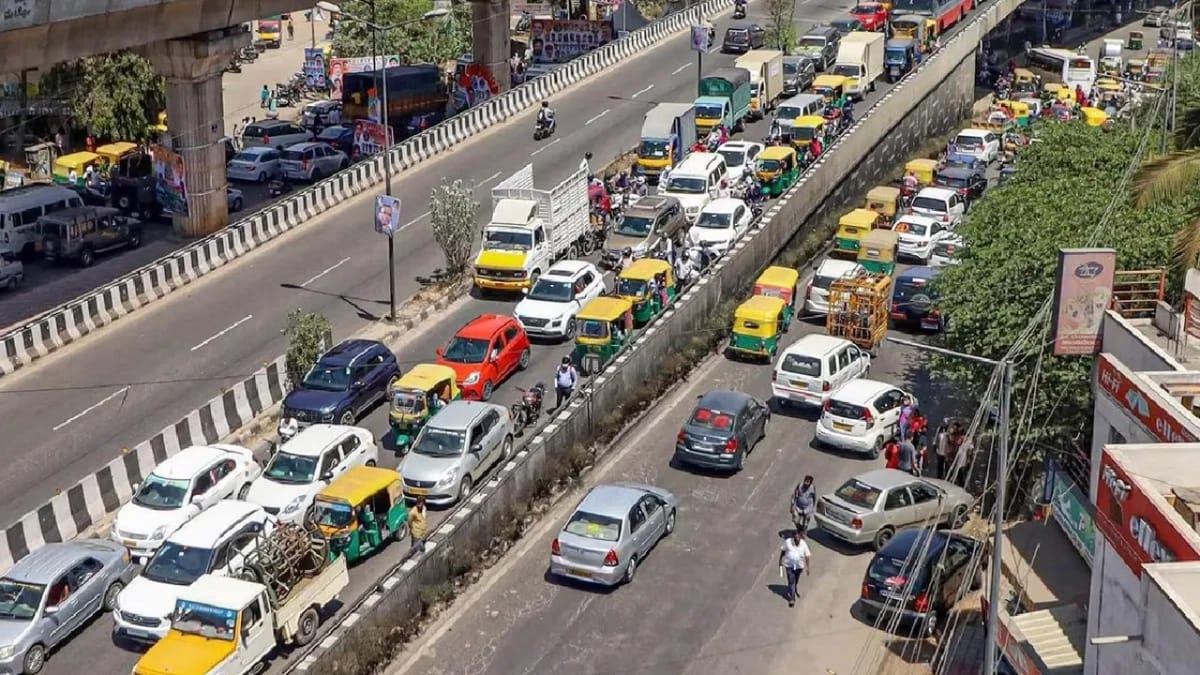
A citywide enforcement drive in Indore has resulted in penalties against more than 1,600 traffic violators in a single day, highlighting persistent gaps in road discipline and urban mobility management. The large-scale action, carried out across multiple zones, reflects both the scale of non-compliance and the growing pressure on city authorities to improve road safety in an expanding urban environment. According to official data, a majority of violations were linked to two-wheeler riders travelling without helmets, followed by cases of improper parking, mobile phone use while driving, and wrong-way movement.
The concentration of such offences points to behavioural challenges rather than isolated infractions, raising concerns about how effectively road safety norms are being communicated and enforced. The enforcement effort, conducted through continuous patrolling and targeted checks in high-traffic areas, aimed to ease congestion and improve traffic flow. However, urban mobility experts note that periodic crackdowns, while necessary, often address symptoms rather than underlying structural issues. Cities like Indore are experiencing rapid growth in vehicle ownership without a proportional shift towards public or non-motorised transport systems. The scale of violations also reflects broader urban design challenges. Congested roads, limited pedestrian infrastructure, and insufficient parking management contribute to everyday rule-breaking. When urban spaces are not designed for safe and efficient movement, enforcement alone struggles to deliver lasting change. A transport policy analyst observed that consistent compliance depends as much on infrastructure quality as on policing. From a sustainability perspective, poor traffic discipline has wider implications. Erratic driving patterns, congestion, and illegal parking contribute to increased fuel consumption and emissions. In rapidly growing cities, these factors can undermine efforts to build low-carbon and climate-resilient urban systems. Encouraging safer and more predictable traffic behaviour is therefore not just a safety issue but also an environmental priority. The enforcement drive also highlights the need for technology-led solutions. Automated surveillance systems, such as camera-based detection of violations, can provide continuous monitoring and reduce reliance on manual checks. Several Indian cities have begun integrating such systems with centralised traffic management platforms, improving both compliance and transparency. Equally important is the role of public awareness. Experts suggest that sustained campaigns targeting young riders, combined with stricter licensing norms and school-level education on road safety, could gradually shift behaviour. Without this, enforcement actions risk becoming cyclical, with violations recurring once monitoring intensity decreases.
The recent crackdown in Indore serves as a reminder that urban mobility is not only about expanding infrastructure but also about ensuring responsible usage. As the city continues to grow, a balanced approach—combining enforcement, infrastructure upgrades, and behavioural change—will be essential to building safer and more efficient streets.
ALSO READ – Indore Traffic Diversions Planned For City Marathon
Indore Traffic Checks Expose Urban Discipline Challenges
