


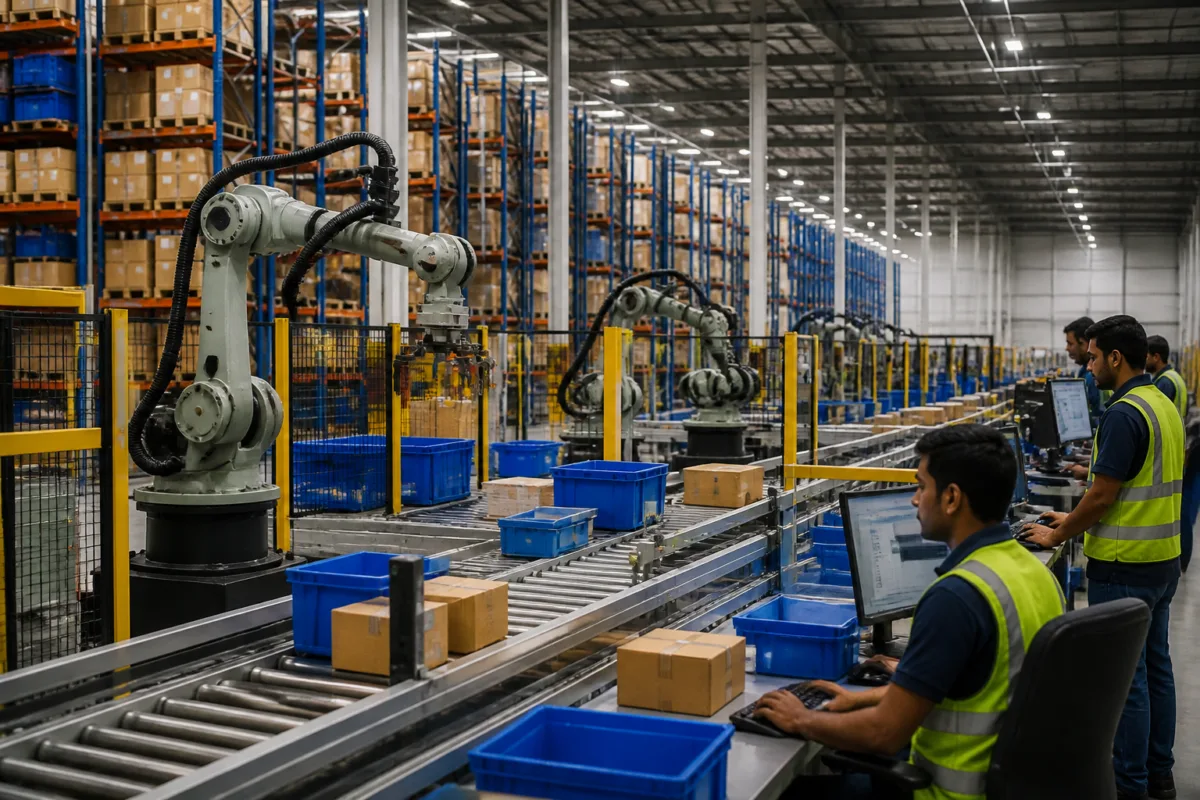
India’s robotics market could more than quadruple from $1.1 billion in 2025 to $4.6 billion by 2030, according to an Avendus Capital report cited by the Times of India. The projected expansion is being led by warehouse and logistics automation, but the same growth story exposes a structural weakness: between 85% and 90% of the value of robotic components used in India is still imported.
That combination—rapid demand growth alongside deep hardware dependence—defines the next phase of India’s robotics market. The country is developing capabilities in system integration, software and deployment, while relying heavily on overseas suppliers for sensors, motors and precision parts. For the built environment, this is not simply a technology story. It is also a question about how warehouses are designed, how goods move through cities and whether Indian firms can capture more value from the infrastructure they help automate.
The immediate commercial opportunity lies in warehouse automation. E-commerce and quick commerce are increasing demand for systems that can move, store and sort goods more efficiently. Avendus identified this segment as India’s strongest robotics opportunity. The report’s assessment places logistics facilities at the centre of the market’s growth, rather than treating robotics as a narrow factory-floor application.
Warehouses are increasingly important urban infrastructure. They connect manufacturers, retailers and consumers, and their performance affects how quickly goods can be delivered across metropolitan areas. The source material does not provide figures for warehouse capacity, delivery volumes or employment, but it identifies a clear demand driver: companies serving e-commerce and quick commerce are seeking greater automation. That demand is helping create a market for machines, software and integrated operating systems.
The distinction between buying robots and building automation systems is important. Indian companies are developing systems that combine machines with software to move, store and sort goods. This means the commercial opportunity is not limited to manufacturing every component domestically. It also includes understanding a customer’s operations, selecting suitable hardware, integrating it with software and deploying the system across multiple locations.
That model gives Indian integrators a route into the market even while a domestic component ecosystem remains incomplete. According to the report, Indian platforms are already being deployed overseas. These deployments indicate that some domestic companies are attempting to move beyond supplying or installing equipment for one facility and are instead developing repeatable solutions that can be used across sites and markets.
The report identifies repeatability as the next commercial test. Winning individual projects can demonstrate technical capability, but repeat contracts across several overseas locations would show that Indian companies can scale their systems and convert early deployments into recurring demand. The distinction matters because project-based revenue and repeatable deployment represent different levels of business maturity.
For warehouse operators, the case for automation is also becoming easier to justify financially. Avendus said payback periods for lower-cost automation have shortened to about 1.5 to two years, compared with several years a decade ago. The report links this improvement partly to rising wages, which can make capital investment in automated systems more commercially attractive.
A shorter payback period does not automatically mean that every warehouse can or should adopt the same technology. The source does not provide a comparison of costs across warehouse sizes, cities or business models. It does, however, establish the direction of the market: the economics of selected forms of automation are becoming more acceptable to users, particularly where systems can address repetitive movement, storage and sorting tasks.
This creates a feedback loop between urban consumption and industrial technology. Growing demand from e-commerce and quick commerce encourages investment in logistics facilities. Those facilities create demand for automation. The resulting market gives integrators more opportunities to refine systems and pursue deployments outside India. The process can strengthen India’s position in the software and integration layers even when the hardware is sourced internationally.
Yet import dependence remains the most significant limitation in the market described by the report. Sensors, motors and precision components account for much of the imported value. These are not interchangeable inputs that can be localised immediately through assembly alone. Precision hardware requires consistent manufacturing, reliability and lengthy customer approvals. Avendus noted that established Japanese and German suppliers have developed these capabilities over decades.
The implication is that localisation will probably be gradual and component-specific, rather than a single transition from imported systems to fully domestic ones. The report expects localisation to proceed component by component. That approach recognises that different parts have different technical requirements, approval cycles and supplier ecosystems.
For Indian robotics companies, this creates two parallel tasks. The first is to build commercially viable systems using the hardware that is currently available. The second is to help create enough demand and technical confidence for domestic component manufacturers to enter more difficult parts of the supply chain. The source does not identify specific government incentives, manufacturing schemes or companies pursuing this effort, so the precise policy framework supporting localisation is not established in the available material.
The market’s projected increase to $4.6 billion by 2030 should therefore not be read only as a measure of domestic hardware production. It includes an ecosystem in which imported components, Indian software, systems integration and operational deployment interact. That distinction is essential when assessing what growth means for industrial capability. A larger market can create opportunities for Indian firms without immediately eliminating dependence on foreign suppliers.
The warehouse focus also raises a question about how automation will be distributed across India’s logistics geography. The report refers to deployments across multiple sites and to demand from e-commerce and quick commerce, but it does not specify locations, facility types or the balance between large distribution centres and smaller urban fulfilment facilities. Those details would be necessary to determine how broadly the gains from automation are spreading through the logistics network.
What is clearer is that the value of integration may become a defining competitive advantage. Indian companies can potentially compete by adapting robotics to customer operations, deploying systems repeatedly and combining hardware with software. This is different from competing solely on the ability to manufacture every machine domestically. It places operational knowledge and implementation capability at the centre of the business model.
The same model also brings a limit. Integrators remain exposed to the availability, price and performance of imported components. If sensors, motors or precision parts are difficult to source, the ability to deliver a complete system can be affected even when the software and integration work are developed in India. The supplied report does not quantify that exposure or identify specific supply disruptions, but the 85% to 90% import share indicates that the dependence is substantial.
India’s robotics market is consequently expanding on an uneven foundation. Demand is strengthening, payback periods for lower-cost automation have shortened, and Indian platforms are reaching overseas sites. At the same time, the component base remains dominated by foreign suppliers, and the capabilities needed for precision manufacturing take time to establish.
The central urban question is whether India can turn automation demand in warehouses into a deeper industrial ecosystem. The answer will depend not only on the number of robots installed, but also on whether Indian companies can win repeat contracts, retain value in software and integration, and gradually localise components without compromising reliability. The next evidence to watch is the emergence of multi-site overseas orders and the progress of component-by-component localisation—both identified by Avendus as important tests for the sector’s next stage.

