


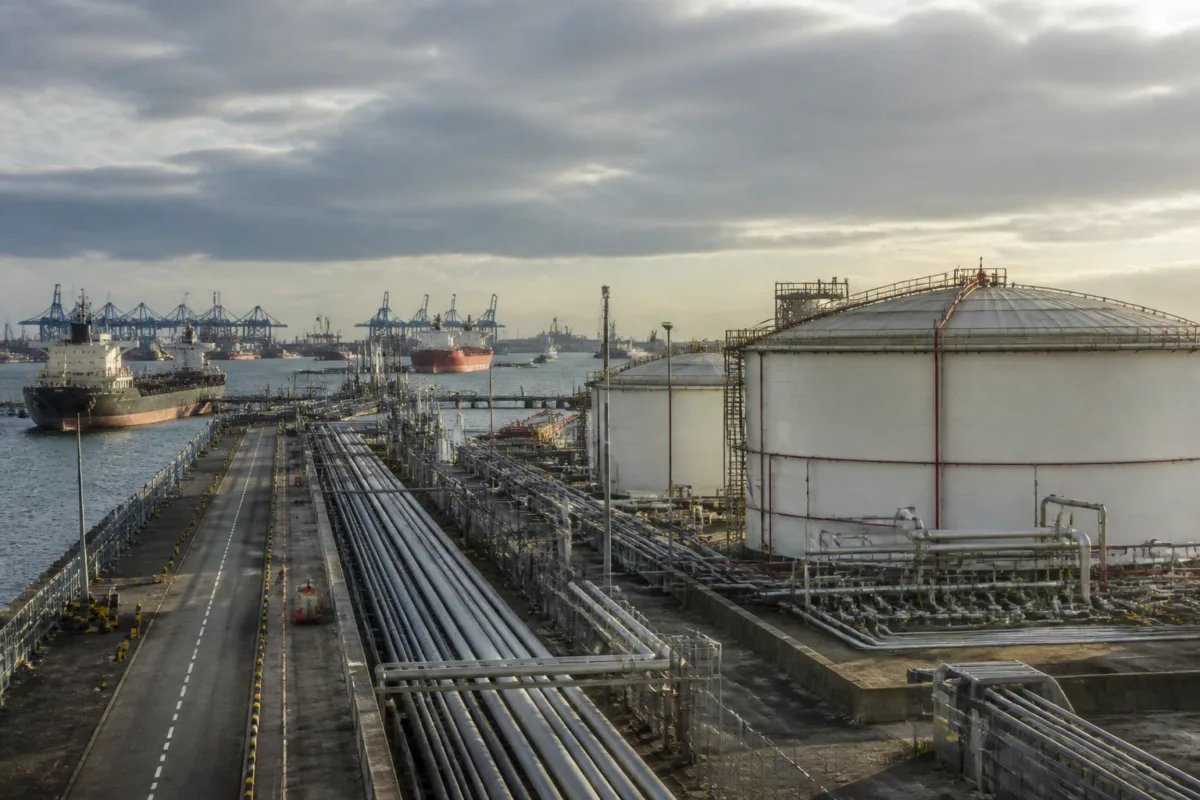
Adani Group’s reported interest in acquiring Dutch energy-storage company VTTI points to a broader shift in the infrastructure business: storage terminals are no longer merely passive facilities for holding fuels and chemicals, but strategic assets positioned between volatile global supply chains and energy markets. The potential transaction, which could value VTTI at about €3 billion, would extend an Indian conglomerate’s infrastructure ambitions into a global network of terminals handling fossil fuels, biofuels and solvents.
The report by Economic Times, citing people familiar with the matter, says Adani Group is among the parties evaluating Rotterdam-based VTTI. The deliberations are ongoing and may not lead to a transaction. IFM Investors and Vitol each own about 45% of VTTI, while Abu Dhabi National Oil Co. holds the remaining 10%. Adnoc is considering selling its entire stake, and the other co-owners may also reduce their positions, according to the report.
That uncertainty is important. This is not an announced acquisition, a signed agreement or a completed change in ownership. Representatives for Adani Group did not immediately respond to queries, while spokespeople for IFM, Adnoc and VTTI declined to comment. A Vitol representative also did not immediately comment. The central fact established by the supplied report is therefore that Adani is evaluating a possible deal, not that it has secured VTTI.
The urban and infrastructure significance lies in what VTTI operates. Its terminals store fuels, biofuels, solvents and other chemicals across a global network. Such facilities connect ships, pipelines, industrial users, traders and energy markets. They are part of the physical infrastructure that allows commodities to move through ports, remain available during supply interruptions and be redirected when prices or demand change.
For cities and industrial regions, this infrastructure is often less visible than roads, airports or power plants. Yet storage terminals influence how ports function, how industrial clusters receive inputs and how energy supplies are buffered between arrival and consumption. Their importance becomes more apparent when supply routes are disrupted. The report says supply disruptions have made VTTI’s facilities increasingly valuable for energy trading, attracting multiple suitors.
That description places VTTI within a changing energy-logistics system. Energy security is not determined only by production capacity or the number of power-generation assets. It also depends on the ability to receive, store and move fuels and related products at the right locations. Ports and terminals are therefore becoming more central to the operation of energy markets, particularly when international supply chains are under pressure.
The potential acquisition would also fit into Adani Group’s existing infrastructure profile. The conglomerate’s portfolio includes airports, roads and data centres, alongside mining and defence assets. Its listed flagship, Adani Enterprises Ltd., raised 150 billion rupees, or about $1.6 billion, from institutional investors in July to fund capital expenditure and possible debt repayment, according to the report.
The report does not specify how Adani would finance a VTTI transaction, whether it would acquire a controlling stake or whether any deal would be made through a particular group company. It also does not establish the operational structure that would follow a purchase. Those details matter because terminal ownership involves not just financial capacity, but also port access, environmental compliance, safety systems, commodity expertise and relationships with industrial customers and regulators.
VTTI’s ownership structure makes the possible transaction a negotiated infrastructure deal rather than a straightforward purchase of a single facility. IFM Investors and Vitol are each reported to hold approximately 45%, with Adnoc holding the balance. If Adnoc exits and the other shareholders reduce their positions, a buyer could potentially obtain a significant stake. But the supplied report does not say whether the owners are jointly pursuing a sale, whether there is a formal auction or whether Adani is seeking a minority or controlling interest.
The presence of multiple suitors indicates that the assets are being assessed as more than conventional storage capacity. Terminals can provide access to established trade routes and industrial markets, while their locations may be difficult to replicate because of land constraints, port infrastructure, permitting requirements and connections to transport networks. The report, however, does not provide VTTI’s terminal-by-terminal capacity, revenue, geographic breakdown or operating performance. Those omissions limit what can be concluded about the company’s precise strategic value.
The possible VTTI bid also extends a pattern of Adani Group examining overseas infrastructure opportunities. According to the report, the group recently explored acquiring a stake in Associated British Ports, the United Kingdom’s largest port operator. IFM ultimately won that transaction, which valued AB Ports at about £10 billion, or $13.4 billion. The comparison is relevant because ports and storage terminals occupy adjacent positions in the movement of commodities: one provides the gateway and the other provides the capacity to hold and transfer materials after arrival.
However, the two assets are not interchangeable. A port operator manages marine access, berths, cargo handling and associated land-side logistics. A storage-terminal company manages tanks, handling systems, safety infrastructure and commercial relationships around particular commodities. The report establishes Adani’s interest in both types of infrastructure, but it does not show that the group is pursuing a single integrated acquisition strategy or that the VTTI and AB Ports evaluations were connected.
The broader policy landscape is also not established in the supplied material. Any acquisition involving terminals for fuels, biofuels, chemicals and solvents would operate within the regulatory frameworks of the countries where those assets are located. Those frameworks may cover hazardous materials, land use, port operations, environmental protection and competition. The report does not identify the approvals that a transaction would require, so it would be premature to describe the potential deal as cleared or close to completion.
There is also a transition question. VTTI stores both conventional and alternative products, including fossil fuels and biofuels. That mix reflects the complexity of the current energy system, in which established fuels remain part of global logistics while lower-carbon alternatives expand. The supplied report does not provide the share of VTTI’s business represented by each product category, nor does it describe any timetable for shifting the company’s asset base. The potential acquisition therefore cannot, on the available evidence, be described as either a fossil-fuel expansion or a clean-energy transaction alone.
What the available numbers do show is the scale of the parties involved. VTTI could be valued at approximately €3 billion. Its ownership is divided between two shareholders with roughly 45% each and a third with 10%. Adani Enterprises raised 150 billion rupees from institutional investors in July, while the group is described as having a broad portfolio across infrastructure and other sectors. These figures establish the size of the proposed asset and the financial context of Adani’s expansion, but they do not establish the final purchase price, funding mix or effect on group leverage.
That distinction is especially important because the report also refers to debt and capital expenditure as part of the group’s recent financial activity. It says the July fund-raising was intended to support capital expenditure and possible debt repayment. It does not provide consolidated debt figures, transaction-level financing terms or an assessment of how a €3 billion acquisition would affect the group’s balance sheet. Any such conclusion would require information beyond the supplied report.
For India’s infrastructure sector, the reported interest illustrates how the geography of infrastructure ownership is changing. Large Indian conglomerates are evaluating assets outside the domestic market, while global investors and commodity companies continue to hold or sell stakes in strategic logistics businesses. The result is a more international ownership structure for the systems that move energy and industrial materials.
The key question is not simply whether Adani acquires VTTI. It is whether ownership of storage and terminal infrastructure is becoming a more important competitive advantage as supply chains become less predictable. The report provides evidence that investors see value in these assets during supply disruptions. It does not yet show how that value is distributed among terminal owners, traders, ports, industrial users or cities located near the facilities.
For now, the evidence supports a measured conclusion. Adani Group is reported to be evaluating a potential acquisition of VTTI at a possible valuation of about €3 billion, alongside other interested parties. The talks remain uncertain, and no transaction has been announced. The developments to monitor are whether the owners formally pursue a sale, whether Adani confirms its interest, what stake may be offered, how the acquisition would be financed and whether regulators approve any eventual agreement.

