


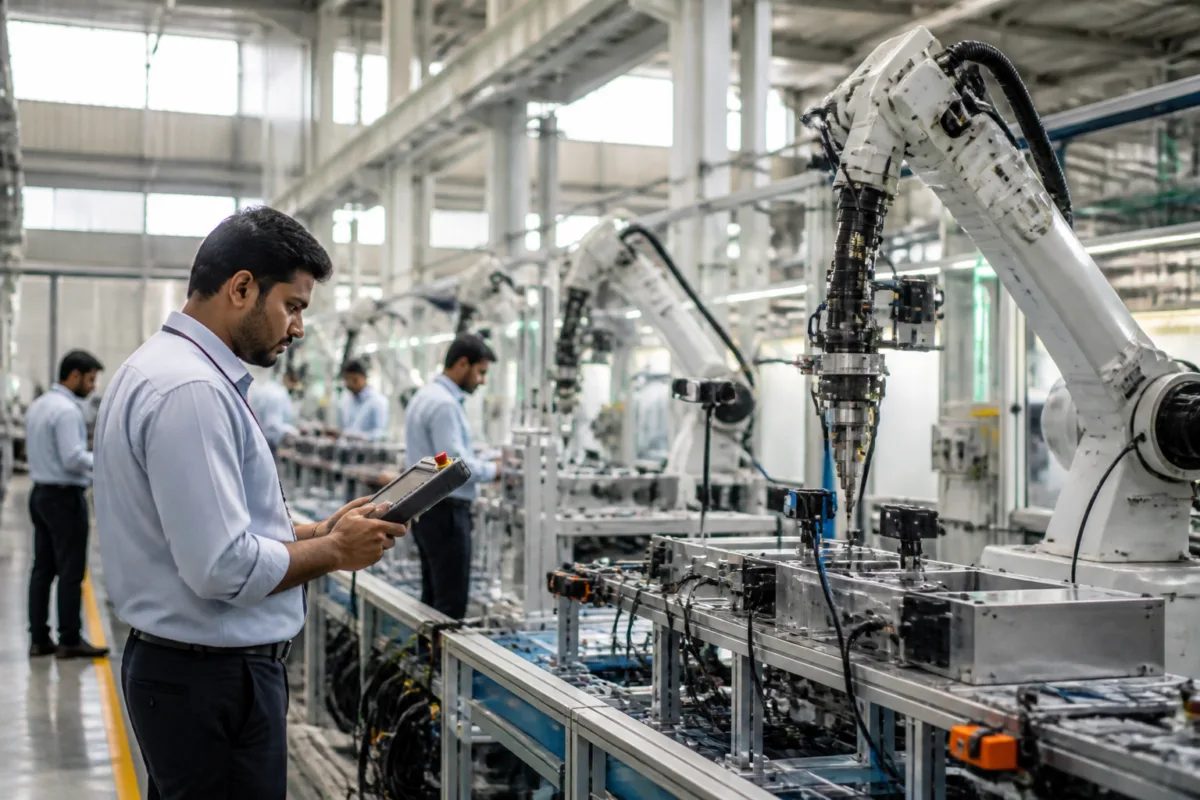
India’s manufacturing sector is no longer treating artificial intelligence as a specialised technology function kept separate from factory operations. The search for executives who can connect machine learning, data architecture and automation with plant output, quality and cost signals a broader change: AI is being positioned as part of the operating model of industrial companies.
That shift matters beyond individual corporate hiring decisions. Manufacturing plants sit inside larger urban and regional systems that include workers, suppliers, logistics networks, engineering services and training institutions. When companies begin seeking leaders who understand both algorithms and plant operations, they are also revealing a gap in the way industrial capabilities have traditionally been organised. The question is no longer only whether a factory can buy new software or install connected equipment. It is whether the organisation has the people and governance needed to make those systems work consistently across plants and businesses.
According to the report by The Economic Times, companies including Honeywell Technologies, RPG Group and ITC are building capabilities around AI and digital operations. Executive search firms said manufacturers are looking for leaders who can connect technological development to output, quality and costs. The roles span AI and analytics leadership, heads of AI centres of excellence and operational specialists working on predictive maintenance, computer vision, robotics, quality, supply chains and energy optimisation.
This is an important distinction from the earlier automation story. Conventional automation generally focused on carrying out a defined task with machines or software. The current demand described by companies is wider. It includes using data to detect equipment problems before failure, applying computer vision to production quality, improving supply-chain decisions and managing energy use. The report also refers to generative AI, agentic AI, machine-learning operations, large-language-model operations and model governance as part of the skill set being sought.
The breadth of these requirements explains why the talent market is becoming difficult. A conventional technology executive may understand data science but not the realities of a plant floor, quality systems or industrial automation. A manufacturing leader may understand production processes without having experience in machine-learning models, data engineering or model governance. The emerging role is expected to bridge these two worlds.
Agamjeet Dang, chief executive officer of Executive Access India, said manufacturing has a strong operational layer around smart factories, predictive maintenance, quality, computer vision, robotics, supply chain and energy optimisation. He identified increased activity in automotive, auto components and textiles, while also pointing to demand across diversified industrial groups, chemicals, agri-inputs, pharmaceuticals, tyres and consumer manufacturing.
The list is significant because it shows that AI adoption is not confined to one high-technology manufacturing niche. The requirements extend across sectors with different production processes, compliance obligations and supply-chain structures. Yet the available report does not establish how many factories are deploying these systems, what proportion of projects have reached production or how much productivity improvement has been achieved. What it does establish is that companies are investing in leadership capacity intended to make these systems operational.
RPG Group’s hiring approach illustrates the institutional question. The group is looking for people who combine AI, data science and digital technology expertise with knowledge of manufacturing processes, plant operations, quality systems, supply chains and industrial automation. Amol Deshpande, head of digital and innovation at RPG Group, said the group’s digital talent base had grown by 20% over the previous two years. He added that companies including CEAT, Zensar, KEC and RPG Life Sciences had been integrating digital capabilities, including AI, across manufacturing, engineering, supply-chain and industrial operations.
A group-level approach can matter in a diversified industrial organisation because the same digital capability may need to serve businesses with very different operating conditions. A tyre plant, an engineering operation and a life-sciences company cannot necessarily use identical models or processes. However, they may share requirements for reliable data, cybersecurity, governance, analytics talent and senior leadership capable of converting technology investments into operating decisions.
Companies must also decide where responsibility for AI should sit. The report says employers are weighing dedicated group-level AI chiefs against assigning the brief to a chief information officer, chief digital officer or transformation head. This is not merely an organisational chart question. It determines whether AI is treated as a central strategic function, a technology deployment programme or a business transformation responsibility distributed across operating units.
The choice also affects accountability. Predictive maintenance, quality control and energy optimisation operate close to the factory floor, where inaccurate data or poorly designed systems can affect production decisions. Generative and agentic AI introduce additional requirements around oversight and model governance. Honeywell Technologies India is hiring across AI and machine-learning architecture, generative and agentic AI, data engineering and data science, with Python, Spark, machine-learning operations, large-language-model operations and model governance among the required skills.
Arppna Mehra, vice-president of human resources at Honeywell Technologies India, said AI was central to the company’s shift from automation to autonomy, both in its products and internal operations. The statement captures the direction of travel described in the report, but it should not be read as evidence that industrial autonomy has already been achieved across the sector. The supplied material provides no deployment timeline, plant-level case study or operational performance data for Honeywell or the other companies mentioned.
The geography of recruitment is another part of the transition. Companies are looking overseas for talent, with stronger interest in Indian-origin executives than in traditional foreign expatriates. Dang said the United States was the leading search market, followed by the United Kingdom and Europe. This reflects the specialised nature of the roles being created, but it also exposes a capability question for India’s industrial centres: whether domestic institutions can produce enough leaders who understand both advanced digital systems and the practical constraints of manufacturing.
For cities and industrial regions, that question is connected to more than executive compensation. Manufacturing ecosystems depend on a layered labour market. They require engineers, technicians, data specialists, maintenance teams, production managers and vendors that can support new systems. The report does not provide evidence on how AI hiring is affecting frontline employment or whether automation is displacing particular roles. It does, however, show that companies are prioritising senior talent capable of integrating digital tools with existing industrial work.
Compensation offers another indication of the intensity of the competition. Dang said pay for leaders who combine technical depth with business judgement can reach ₹7-8 crore annually at larger groups, before retention or long-term incentives. That figure applies to the senior end of the market and should not be treated as a benchmark for manufacturing workers generally. Its relevance lies in showing how companies value a scarce combination of capabilities at a time when AI is being linked directly to operations and business performance.
The policy and institutional landscape behind this shift is not fully detailed in the supplied report. There is no information here on government funding, industrial policy incentives, public training programmes or the role of specific state agencies. That absence is important. Corporate hiring can create internal capability, but the wider availability of AI-enabled manufacturing depends on data infrastructure, technical education, industrial connectivity and the ability of smaller suppliers to participate in digital supply chains. These issues cannot be established from the reported hiring announcements alone.
What the evidence does show is a movement from isolated digital projects toward enterprise-wide capability building. RPG Group’s reported 20% growth in its digital talent base over two years, Honeywell’s search across multiple technical disciplines and the recruitment activity described across manufacturing sectors all point in the same direction. Companies are trying to make AI a repeatable operating capability rather than a one-off experiment.
The larger urban question is whether industrial cities and regions can adapt to this new division of work. Manufacturing transformation may require fewer narrowly separated technology and production functions and more people who can move between them. It may also increase the importance of institutions that connect engineering education, plant experience and data skills. The report does not show whether that institutional alignment exists at the required scale, but the hiring patterns suggest that companies are currently looking for it in a limited and competitive talent market.
India’s AI-in-manufacturing story, therefore, is not only about software entering factories. It is about who controls the connection between software, machines, workers, supply chains and business decisions. The evidence supplied confirms rising corporate demand for leaders who can make that connection. It does not yet establish the productivity, employment or regional development results of the transition. Those outcomes will depend on how these new roles are embedded in plants, how models are governed and whether the capabilities spread beyond the largest industrial groups.

